Skip to Qlik microsite content

QLIK OPEN LAKEHOUSE SERVICES

Build an Open, Governed Apache Iceberg Lakehouse

Create a scalable data foundation that combines real-time ingestion, open table formats, continuous optimization and governed access for analytics and AI.

Artha helps enterprises turn Qlik Open Lakehouse into an operating data architecture, not an isolated storage project.

See the Reference Architecture
  • Qlik Talend Cloud capability
  • Apache Iceberg tables
  • Customer AWS environment
  • Amazon S3 and AWS Glue

AI OVERVIEW

Build an Open, Governed Apache Iceberg Lakehouse

Artha Solutions designs and implements Qlik Open Lakehouse, a fully managed Apache Iceberg-based capability within Qlik Talend Cloud. Current implementations run in the customer’s AWS environment using Amazon S3 and AWS Glue, with governed access for compatible analytics and AI engines.

Artha SolutionsQlikQlik Talend CloudTalendTalend Data FabricTalend Data CatalogApache IcebergQlik Open LakehouseQlik AnswersQlik PredictQlik AutomateDatabricksSnowflakeB’etl

What Is Qlik Open Lakehouse?

Qlik Open Lakehouse is a fully managed Apache Iceberg-based capability within Qlik Talend Cloud. It supports ingestion, transformation, optimization and governance of Iceberg data in a customer’s AWS environment.

Artha designs the surrounding domain model, security, quality, observability, query access and operating ownership needed to make the capability production-ready.

Why Enterprises Consider an Open Lakehouse

Warehouse cost and rigidity

Warehouse pricing assumes the data earns its keep. Seven years of immutable transaction history, raw clickstream and IoT telemetry rarely do: they are queried occasionally, but they must be retained and they dominate volume. Holding them as Iceberg tables on Amazon S3 separates that storage cost from query compute, so retention stops competing with performance for the same budget.

Repeated data copies

The usual pattern is one copy per consumer, because each engine wanted its own format. Every copy is a job to schedule, a reconciliation to explain and another version of the truth. Iceberg is read natively by Athena, Spark, Trino and Snowflake, so a governed table can serve several engines without being duplicated for each of them.

Pipeline fragmentation

Ingestion in one tool, transformation in a second, quality checks in a third and cataloguing done by hand is where lineage breaks. Nobody can answer what changed upstream of a wrong number, so incidents are diagnosed by reading code. Consolidating movement, transformation and governance behind one control plane makes that traceable rather than archaeological.

AI and analytics demand

Model training needs full history and point-in-time correctness, not the aggregated current-state view that BI runs on. Iceberg snapshots make a training set reproducible: the same query against the same snapshot id returns the same rows months later, which is what turns a model result into something you can audit.

Iceberg operations

Iceberg is not maintenance-free. Frequent small writes leave thousands of tiny data files that slow scans, expired snapshots hold storage that is no longer referenced, and failed writes leave orphan files behind. Compaction, snapshot expiry and orphan cleanup have to run on a schedule tuned to each table's write pattern, or query time and S3 spend both drift upward.

What Artha Implements

Architecture and foundations

Workload inventory scored on volume, freshness need and query pattern, then the AWS foundation underneath it: VPC and subnet layout, S3 bucket and prefix structure, KMS encryption, and the IAM roles that separate the platform's write access from each consuming engine's read access. Naming and layout decisions are cheap now and expensive to revisit once tables carry history.

Data movement

Per-source ingestion design rather than one default. Transaction-log CDC where the source database supports it and the target needs low latency, scheduled batch where a daily window is genuinely sufficient, and streaming from Kafka or Kinesis where events arrive continuously. Each path is specified with its landing pattern, expected file sizes and the compaction cadence that follows from them.

Iceberg table design

Domain boundaries drawn so a table has one owner, partitioning chosen from the queries that will actually run rather than from the ingestion date by habit, and Glue catalog registration with defined responsibility for schema change. Partition evolution means an early choice is recoverable, but a wrong one still costs a rewrite, so this is settled with the consuming teams up front.

Trust controls

Quality rules with thresholds and a named owner per data product, lineage captured from source through to consuming engine, classification and masking for regulated fields, and access policy expressed once and enforced consistently across engines. Controls run in the pipeline where they can stop bad data, not in a report that describes it afterwards.

Consumption and operations

Engine integration tested against the real query mix, monitoring on freshness, table health, file counts and failed writes, S3 and compute cost attributed back to the workload that generates it, and runbooks that name who responds to each alert. Handover is to a team that has already worked an incident, not to documentation.

Qlik Open Lakehouse Reference Architecture

01

Sources

Databases · SAP · Mainframes · SaaS · Kafka · Kinesis · S3

02

Ingestion paths

Batch · CDC · Streaming

03

AWS foundation

Customer VPC · Amazon S3 · Managed lakehouse compute

04

Open tables

Apache Iceberg · AWS Glue catalog · Optimization and maintenance

05

Consumers

Amazon Athena · Apache Spark · Trino · Snowflake · SageMaker · Qlik Cloud Analytics

Horizontal controlsQualityGovernanceLineageSecurityObservabilityFinOps

What Is Apache Iceberg?

Apache Iceberg is an open table format for large analytical datasets. Rather than treating a table as whatever files happen to sit in a storage folder, Iceberg keeps a metadata layer that records exactly which files belong to the table at each point in time. That one change is what makes the rest possible.

  • Transactional consistency, so a reader never sees a half-finished write and two writers cannot silently overwrite each other
  • Schema evolution that adds, renames or drops a column without rewriting existing data files
  • Partition evolution, so a partitioning choice made a year ago can be changed for new data without invalidating history
  • Time travel and rollback against a snapshot id, which makes a query reproducible and a bad load reversible
  • Engine interoperability, because the format is specified openly rather than owned by one vendor

Together these bring warehouse-like reliability to data held in open object storage. What they do not bring is table maintenance, ownership or governance, which is the work that decides whether a lakehouse stays usable in its second year.

Architecture Decisions Artha Helps Resolve

Workload placement

Which workloads move and which stay. High-concurrency dashboards with second-level response expectations usually belong where they are; large historical scans, raw event data and ML feature preparation are the strong candidates. Splitting on that basis is deliberate architecture, not indecision.

Freshness and ingestion

What each consumer actually needs, stated as a number. Streaming ingestion costs more to run and produces more small files to compact, so it is worth it where minutes matter and wasteful where a business process runs once a day. This decision sets both the pipeline design and the operating cost.

Table and catalog design

Domain boundaries, partition keys, and who owns a schema change. Iceberg allows columns to be added and partitioning to evolve without rewriting history, which removes the fear from schema change, but it does not decide who is allowed to make one or who is told when it happens.

Governance and access

One classification and one set of quality rules, enforced the same way whichever engine reads the table. When Athena, Spark and Snowflake each carry their own permission model, the effective access is whatever the most permissive one allows, and nobody can state what that is.

Cost and operations

Where spend accumulates and who watches it. S3 storage is the visible line, but request volume from wide scans, compaction compute and unexpired snapshots are usually the ones that grow quietly. Cost is attributed per workload so the team generating it can see it.

Open Lakehouse Readiness Assessment

The readiness assessment produces a workload inventory, architecture scorecard, prioritized use cases and target-state diagram.

  • Cost and risk assumptions
  • AWS foundation dependencies
  • Catalog and governance decisions
  • Query and consumption patterns
  • A practical 90-day foundation roadmap

CUSTOMER EVIDENCE

Implementation Experience Grounded in Enterprise Outcomes

Selected from Artha’s existing published case-study system. Customer anonymization is preserved.

Manufacturing

Real-Time Logistics Analytics and ETL Modernization

Challenge: Inventory and logistics events took more than 24 hours to reach executive reporting, limiting hot-order visibility and increasing operational intervention.

Artha solution: Artha implemented Qlik Replicate change data capture, Qlik Compose modeling and a governed cloud analytics pipeline.

Qlik Cloud, Qlik Replicate, Qlik Compose, Snowflake, Microsoft Azure, Azure, Qlik

<2 minPublished logistics-data latency after modernization
Read the case study

Healthcare & Life Sciences

Scalable Talend and DIF for 100+ TB Healthcare Datasets

Challenge: A healthcare analytics provider needed to ingest and govern more than 100 TB of diverse data while improving access and processing performance.

Artha solution: Artha deployed Talend with its Dynamic Ingestion Framework across AWS and Snowflake, adding automated validation and scalable processing.

Talend, AWS, Snowflake, Tableau

50%Published reduction in data processing time
Read the case study
RELATED RESOURCES

Continue the Architecture Conversation

Whitepaper

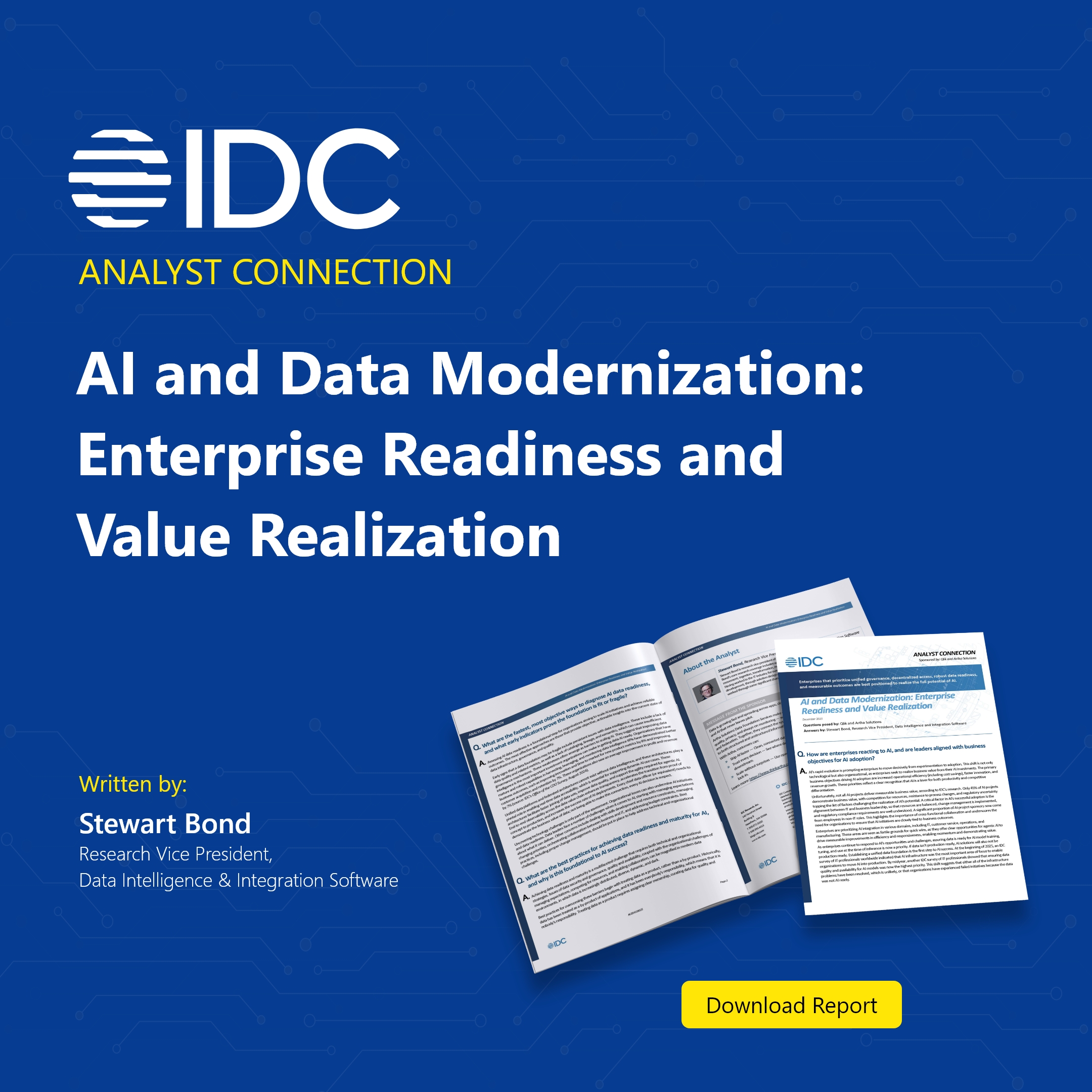
AI and Data Modernization: Enterprise Readiness and Value Realization

ANALYST CONNECTION Sponsored by: Qlik and Artha Solutions AI and Data Modernization: Enterprise Readiness and Value Realization December 2025 Questions posed by: Qlik and Artha Solutions Answers by: Stewart Bond.

Explore whitepaper
Whitepaper

Future-Ready Data Foundation: From AI Pilot to Production Value

Success with AI starts with data. Improving data quality and accessibility for AI is today’s top organizational priority; nine months ago, it was improving AI infrastructure. However, laying a solid data foundation for.

Explore whitepaper
Article

It’s Much Easier to Migrate from Informatica to Qlik Than You Think

In today’s data-driven world, staying future proof often means leaving behind legacy ETL platforms like Informatica PowerCenter, especially as they approach end-of-support. While such migrations are often perceived as...

Explore article

FREQUENTLY ASKED QUESTIONS

Questions Buyers and Architects Ask

Concise answers based on current Qlik product information and Artha’s consulting approach.

What is Qlik Open Lakehouse?

Qlik Open Lakehouse is a fully managed Apache Iceberg-based capability within Qlik Talend Cloud. It helps ingest, transform, optimize and govern Iceberg tables in the customer’s AWS environment for access by compatible analytics and AI engines.

Is Qlik Open Lakehouse based on Apache Iceberg?

Yes. Qlik Open Lakehouse uses Apache Iceberg as its open table format. Current Qlik documentation describes deployment in the customer’s AWS environment with Amazon S3 storage and AWS Glue as the catalog.

Why use Apache Iceberg instead of proprietary tables?

Iceberg provides an open specification, transactional consistency, schema and partition evolution, time travel and access from compatible engines. It can reduce architectural lock-in, but teams still need deliberate catalog, governance, security and operational decisions.

Does an open lakehouse replace a data warehouse?

Not necessarily. A lakehouse may complement or replace selected warehouse workloads depending on latency, performance, governance, skills and economics. Artha evaluates workloads individually instead of assuming one destination for every dataset.

How does data enter Qlik Open Lakehouse?

Supported sources can be onboarded using Qlik data movement with batch, change data capture and supported streaming paths. Data is processed into query-ready Iceberg tables in the configured AWS environment.

What analytics engines can access Iceberg tables?

Compatible engines documented by Qlik include Amazon Athena, Apache Spark, Trino, Snowflake and Amazon SageMaker-related workflows. Exact integration and availability should be confirmed for the customer’s Qlik subscription and region during architecture.

How does Artha implement governance?

Artha defines data ownership, classifications, quality rules, lineage, catalog responsibilities, access policy, retention and exception processes. Governance is implemented as a horizontal operating control rather than a final reporting step.

What workloads should move first?

Strong first candidates have clear business value, understood source behavior, measurable freshness or cost constraints, accountable owners and manageable governance needs. A readiness assessment ranks them against complexity, risk and architectural fit.

NEXT STEP

Assess Your Open Lakehouse Opportunity

Prioritize the right workloads and establish AWS, catalog, governance and operating assumptions before implementation.

ARCHITECTURE CONVERSATION

Talk to a Qlik Architect

Tell us about the platform, workload and business priority you are evaluating.