Skip to Qlik microsite content

QLIK/TALEND SUPPORT SOLUTIONS

Qlik/Talend Support Solutions Built Around Your Production Estate

Implement Talend Data Fabric properly, then keep it running: production support with real response targets, managed operations, platform administration and the engineering that stops the same incident recurring.

Artha supports Qlik and Talend estates that businesses actually depend on, with escalation paths into Qlik and more than a decade of Talend delivery behind the runbooks.

Review Our Support Portfolio

AI OVERVIEW

Qlik/Talend Support Solutions Built Around Your Production Estate

Artha Solutions provides Qlik/Talend support solutions: Talend Data Fabric implementation, production support with defined service levels, managed operations, platform administration, performance engineering and release currency for enterprise Qlik and Talend environments.

Artha SolutionsQlikQlik Talend CloudTalendTalend Data FabricTalend Data CatalogApache IcebergQlik Open LakehouseQlik AnswersQlik PredictQlik AutomateDatabricksSnowflakeB’etl

Common Talend Challenges

These are the six findings that come up most often when we open an established Talend estate. If two or three sound familiar, an assessment will usually pay for itself in avoided rework.

Aging platform posture

An estate several minor versions behind accumulates risk quietly: Studio and server drift apart, the JDK baseline no longer matches what the version supports, and custom components built against older APIs stop compiling. Each deferred upgrade makes the next one larger, because you end up crossing several version boundaries at once.

Hard-coded jobs

Connection strings, file paths and credentials embedded directly in components instead of held in contexts mean the same job cannot move between dev, test and production without being edited. The same lookup or cleansing logic then gets copy-pasted across dozens of jobs, so one business-rule change becomes an estate-wide search.

Inconsistent delivery

Where releases are still published from a developer's Studio rather than built from source, there is no reliable way to say which version of a job is running. Without CommandLine builds, an artifact repository and promotion gates, a rollback means finding whoever last touched it.

Performance constraints

Long-running jobs are usually design problems rather than capacity problems: row-by-row lookups that should be joins, tMap components holding large reference sets in memory, unbounded commit sizes, or a schedule that starts everything at once and starves the runtime.

Limited lineage

When nothing records which jobs read which tables, impact analysis becomes archaeology. A schema change ships without anyone knowing the six downstream jobs it breaks, and audit questions about where a reported figure came from cannot be answered from the platform itself.

Key-person dependency

Undocumented naming, error handling and restart conventions live in the heads of one or two engineers. Onboarding takes months, holiday cover is thin, and the team avoids touching the jobs nobody understands, which is usually where the risk is concentrated.

Qlik/Talend Support Portfolio

Six service lines, engaged individually or as one support contract. Implementation and support are deliberately in the same portfolio: the people who build the estate are accountable for how it runs.

Talend Data Fabric implementation

Design and implementation across what Data Fabric actually spans: data movement, transformation, quality and governance, streaming, and application and API integration on Talend Runtime. Environments, project structure, Remote Engine placement and promotion gates are set up as part of the build, because support inherits whatever implementation leaves behind.

Production support

Defined response and resolution targets by severity, a named escalation path, and engineers who can read the job as well as the log. Incident work is closed with root cause, not with a rerun: a feed that fails every month-end is a design defect with a calendar, and it gets fixed as one.

Managed operations

Day-to-day operation with defined response times: monitoring and incident response, job operations and reruns, patching and platform maintenance, release execution, periodic performance review, and a continuous-improvement backlog so the estate gets better rather than merely staying up.

Platform administration

The control plane kept healthy: Talend Administration Center or Management Console, execution servers and Remote Engines, user and project administration, certificate and credential rotation, environment separation and capacity watch. Unglamorous, and the reason upgrades and audits stop being frightening.

Performance engineering

We rework the jobs that cost the most to run and maintain. That means replacing duplicated logic with joblets and shared routines, moving embedded configuration into contexts, tuning tMap lookups and commit behaviour, and putting builds behind CommandLine, Maven and an artifact repository so releases become repeatable.

Release currency

Talend 8 ships fixes and CVE patches through monthly service releases, and an estate that never takes them accumulates the same risk as one that never upgrades. We plan, test and apply service releases on a cadence, so staying current is routine maintenance rather than an annual event. Full version moves are a different discipline and live on the Modernization page.

What Does a Talend Health Assessment Cover?

A bounded review that produces evidence rather than opinion: what you are running, what it costs you, and what has to be true before an upgrade or cloud move is safe.

  • Version, patch level and support posture across Studio, the control plane and every execution runtime
  • A full job inventory classified by complexity, run frequency, business criticality and duplication
  • Dependency and lineage mapping so schema-change impact can be answered from evidence
  • Runtime performance evidence: job durations, failure and rerun rates, memory and concurrency behaviour
  • Custom components, routines and third-party libraries that will need remediation to cross a version boundary
  • Security and delivery controls: credential handling, environment separation, promotion gates and rollback
  • Cloud-readiness classification per workload, target pattern and a sequenced roadmap with effort ranges

The deliverable is a prioritized findings register and a roadmap with effort ranges, not a maturity score. You should be able to take it to a budget conversation.

Optimization Framework

Sequenced so that each stage makes the next one cheaper. We do not standardize before stabilizing, or automate before there is a pattern worth automating.

  1. 01

    Assess

    Establish the baseline: inventory, support posture, job durations and failure rates. Without a before-figure, later improvement claims cannot be defended.

  2. 02

    Stabilize

    Fix what is actively hurting operations first, typically the recurring failures and the handful of jobs whose runtime blocks everything downstream. Fast, visible, buys room for the rest.

  3. 03

    Standardize

    Introduce the conventions that stop the estate re-fragmenting: contexts instead of hard-coded values, joblets and routines instead of copy-paste, agreed naming, error handling and restart behaviour.

  4. 04

    Automate

    Move builds and promotion into CommandLine, Maven and an artifact repository, add regression suites for the critical paths, and instrument the jobs so monitoring reports failures rather than users doing it.

  5. 05

    Operate

    Run the estate as a named service with runbooks, response targets and a standing improvement backlog, so the gains hold and the next incident is smaller than the last. When a version move becomes due, it starts from a stable, documented baseline instead of a rescue.

In one Talend optimization programme this sequence produced 25-30% faster job execution and testing, 10-15% less code redundancy, and 15-20% projected operational cost reduction, with the estate assessed at 90% cloud-migration readiness.

Flexible Engagement Models

How the work is contracted, from a two-to-four week review through to ongoing operation.

Focused advisory assessment

A time-boxed review, typically two to four weeks depending on estate size and access. You get the findings register and roadmap with no obligation to use us for the delivery.

Fixed-scope implementation

A defined platform, pipeline or governance outcome with written acceptance criteria. Appropriate where the scope is genuinely known, which after an assessment it usually is.

Support takeover

A structured transition from an incumbent or from unsupported in-house operation: shadow period, runbook capture, access and monitoring handover, then a cutover date after which incidents are ours. Nothing is accepted into support that has not been inventoried first.

Development augmentation

Specialist Talend engineering capacity working inside your standards, branches and review process. For teams that have the roadmap but not the bench.

Managed service

Ongoing operation with runbooks, agreed response times and named ownership, including the improvement backlog so the platform keeps moving forward.

STILL ON TALEND 7.3?

Extended Support Ends in December 2026

Talend 7.3 reached end of life in November 2024, and the purchasable extended-support window closes in December 2026. Support can keep a 7.3 estate stable, but it cannot extend that date. If any part of your estate is still on 7.3, the modernization conversation has a deadline attached.

Plan the move on the Modernization page

CUSTOMER EVIDENCE

Implementation Experience Grounded in Enterprise Outcomes

Selected from Artha’s existing published case-study system. Customer anonymization is preserved.

Healthcare & Life Sciences

Managed Services Framework for Operating Systems Optimization

Challenge: A healthcare organization needed repeatable operations, monitoring and production support for a complex data estate.

Artha solution: Artha established managed-service controls, operational ownership and continuous platform optimization.

Talend, Data Integration

Read the case study

Healthcare & Life Sciences

Talend Data Integration Platform Optimization for Large Enterprises

Challenge: Under-resourced Talend environments, hard-coded settings and limited monitoring constrained development, testing and cloud readiness.

Artha solution: Artha improved runtime configuration, reusable engineering patterns, environment controls and operational monitoring.

Talend

25–30%Published improvement in job execution and testing speed
Read the case study

Utilities & Energy

Talend Data Integration Hub for Real-Time Validation

Challenge: More than 300 utility partners supplied data in varied formats, creating validation, onboarding and audit complexity.

Artha solution: Artha built a metadata-driven Talend Data Integration Hub with validation, stewardship and automated partner processing.

Talend

50%Published reduction in manual processing time
Read the case study
RELATED RESOURCES

Continue the Architecture Conversation

Whitepaper

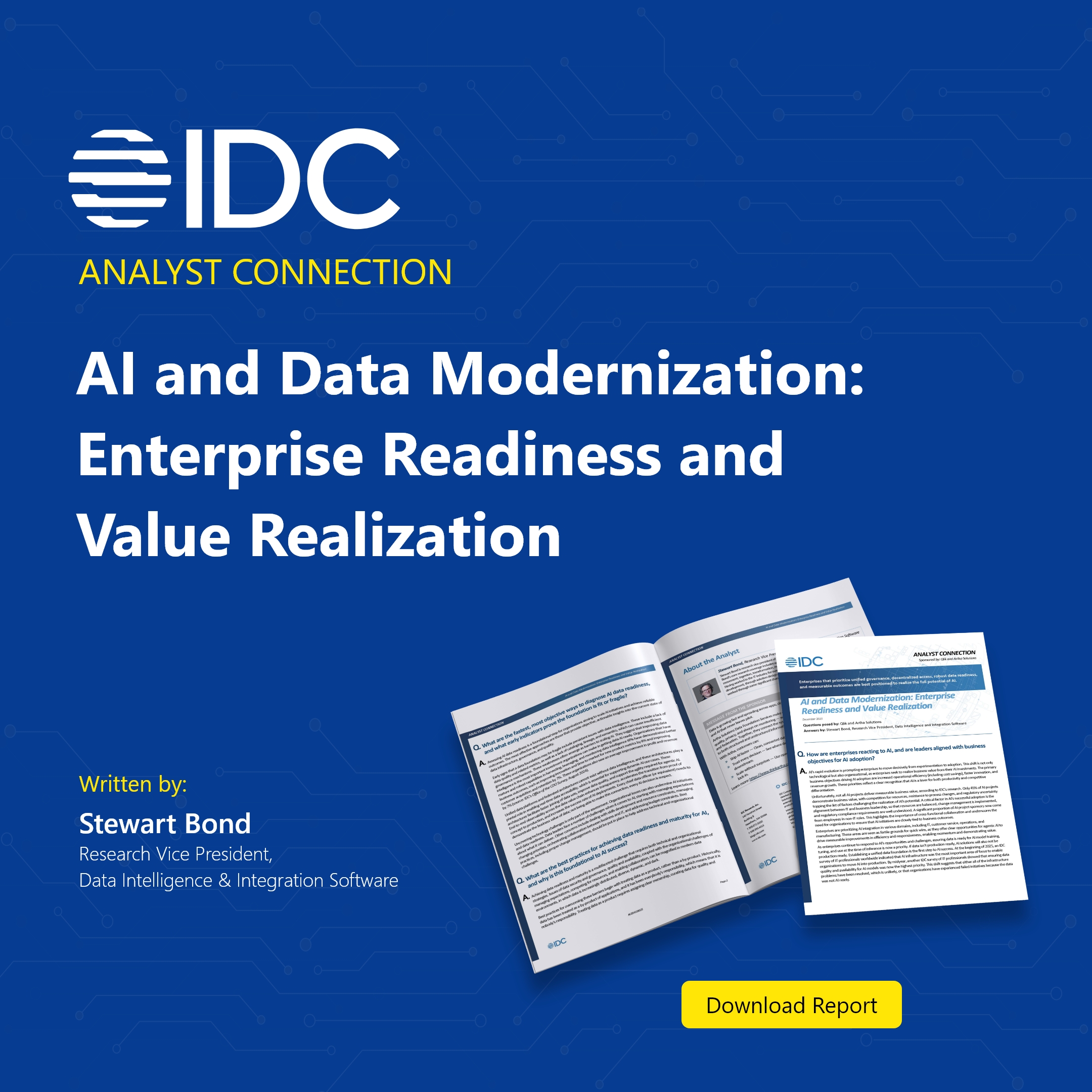
AI and Data Modernization: Enterprise Readiness and Value Realization

ANALYST CONNECTION Sponsored by: Qlik and Artha Solutions AI and Data Modernization: Enterprise Readiness and Value Realization December 2025 Questions posed by: Qlik and Artha Solutions Answers by: Stewart Bond.

Explore whitepaper
Whitepaper

Future-Ready Data Foundation: From AI Pilot to Production Value

Success with AI starts with data. Improving data quality and accessibility for AI is today’s top organizational priority; nine months ago, it was improving AI infrastructure. However, laying a solid data foundation for.

Explore whitepaper
Article

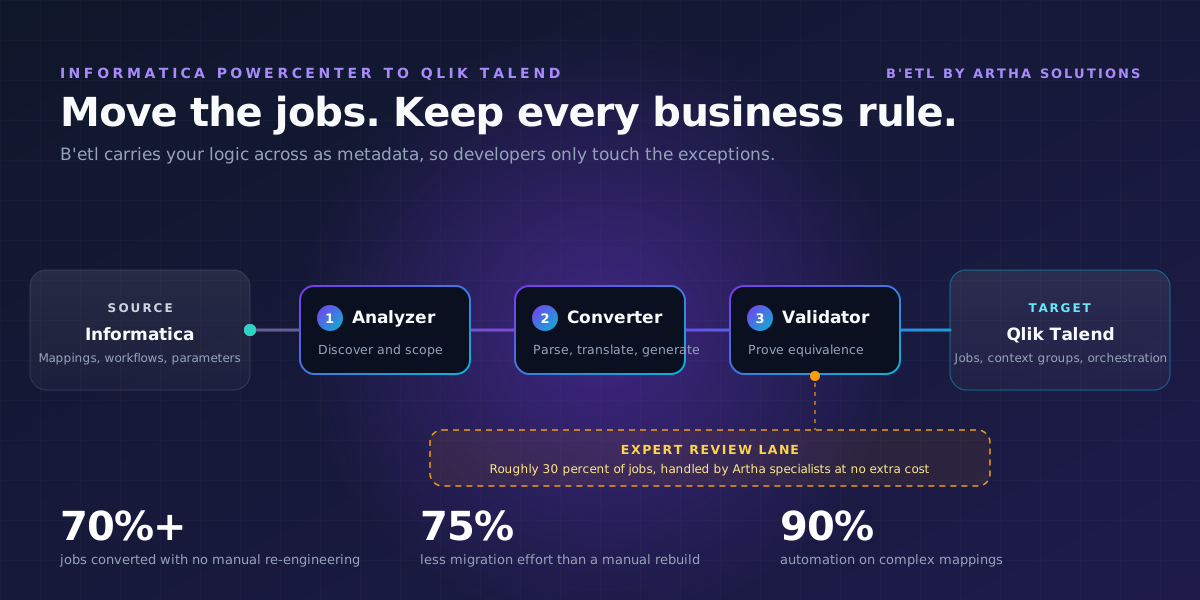
It’s Much Easier to Migrate from Informatica to Qlik Than You Think

In today’s data-driven world, staying future proof often means leaving behind legacy ETL platforms like Informatica PowerCenter, especially as they approach end-of-support. While such migrations are often perceived as...

Explore article

FREQUENTLY ASKED QUESTIONS

Questions Buyers and Architects Ask

Concise answers based on current Qlik product information and Artha’s consulting approach.

What do Qlik/Talend Support Solutions cover?

Talend Data Fabric implementation, production support with defined service levels, managed operations, platform administration, performance engineering and service-release currency. API and ESB services on Talend Runtime are included where Talend carries application integration as well as analytics loads. Scope is shaped around platform risk, business priorities and the operating model you already have.

What does a support agreement actually commit to?

Response and resolution targets by severity, a named escalation path, coverage windows matched to your run schedule rather than a generic business day, and a monthly service report that shows incidents, causes and the improvement backlog. The commitments are written against your estate inventory, so there is no ambiguity later about what was in scope.

How does escalation into Qlik work?

Artha holds Qlik Elite Channel Partner status and works with Qlik support on the customer's behalf: we open, evidence and drive vendor tickets where the fault sits in the product, and we say plainly when it does not. You keep one accountable party either way, rather than a triangle where each side points at the other.

Can Artha take over support from another provider or an internal team?

Yes, through a structured takeover: an inventory of jobs, versions and customizations first, a shadow period alongside the incumbent, runbook and access handover, then a cutover date after which incidents are ours. The inventory step is non-negotiable, because committing to service levels on an estate nobody has measured is how support contracts fail.

Can Artha support Talend MDM now that it is end of life?

Talend MDM Server reached end of life on December 31, 2024, so there are no further product fixes. Artha can still stabilize and operate existing MDM estates, and in parallel plan the exit: where the matching, survivorship and stewardship logic moves, and how golden records are preserved. What we will not do is pretend an EOL product is a long-term plan.

How is Talend performance assessed?

Performance assessment combines job-duration and failure data, runtime and memory configuration, database and network behavior, component design, concurrency, logging, scheduling and data-volume patterns. Recommendations distinguish code issues from infrastructure and operating-model constraints.

How long does a Talend health assessment take?

Typically two to four weeks, depending on estate size, how quickly access is granted, how much documentation exists and whether deep performance analysis is required. Artha scopes it after a short discovery and agrees the evidence, stakeholders and deliverables before work begins.

Does support include version upgrades?

Service-release currency is part of support: Talend 8 ships fixes and CVE patches monthly, and we plan and apply them on a cadence. A full version move, such as 7.3 to Talend 8 or a transition to Qlik Talend Cloud, is a modernization programme with its own assessment, regression testing and cutover discipline. Support keeps the estate stable while that programme runs, and the two are priced and governed separately so neither subsidises the other.

NEXT STEP

Put Your Qlik/Talend Estate Under Real Support

Start with a health assessment that establishes the inventory, support posture and baseline, then agree service levels that mean something.

ARCHITECTURE CONVERSATION

Talk to a Qlik Architect

Tell us about the platform, workload and business priority you are evaluating.