Skip to Qlik microsite content

QLIK TALEND CLOUD SERVICES

Deliver Trusted, Governed Data Products with Qlik Talend Cloud

Connect enterprise data, improve quality and governance, and deliver reusable data products for analytics and AI across hybrid and cloud environments.

Artha helps organizations design, implement and operate Qlik Talend Cloud as an enterprise data delivery platform, not simply another set of integration jobs.

Explore the Reference Architecture

AI OVERVIEW

Deliver Trusted, Governed Data Products with Qlik Talend Cloud

Artha Solutions provides Qlik Talend Cloud consulting, implementation and managed services across real-time data movement, transformation, data quality, governance, lineage and business-owned data products for hybrid and cloud environments.

Artha SolutionsQlikQlik Talend CloudTalendTalend Data FabricTalend Data CatalogApache IcebergQlik Open LakehouseQlik AnswersQlik PredictQlik AutomateDatabricksSnowflakeB’etl

Why Qlik Talend Cloud?

Qlik Talend Cloud brings data movement, transformation, quality and governance into one managed platform, rather than the more common arrangement where each of those lives in a different tool with its own credentials, schedule and definition of what counts as correct.

  • Change data capture, batch and streaming from the same platform, so freshness becomes a per-pipeline decision rather than a product choice
  • Quality rules that run inside the pipeline, so a failing record is caught on the way through instead of reported in next month's dashboard
  • Lineage captured as a by-product of delivery rather than maintained by hand in a spreadsheet nobody trusts
  • Hybrid connectivity through Remote Engines, so on-premises sources are reached without opening inbound access to the estate
  • Reusable data products, so the second team asking for customer data consumes what the first team built

The platform does not remove the design work. Which sources need change data capture rather than a nightly batch, where transformation belongs, who owns each product and what its quality thresholds are: those decisions determine whether this becomes a governed foundation or a faster way to move ungoverned data. That design work is what Artha does.

Artha’s Qlik Talend Cloud Service Portfolio

Six service lines covering the full path from a licensing conversation to a platform someone else operates.

Strategy and platform assessment

We start with the workloads rather than the tooling: which data flows actually matter to the business, what freshness each consumer needs, where the source systems will tolerate load, and which of those constraints will drive licensing. The output is a sequenced roadmap with the dependencies made explicit, so the first phase does not quietly depend on the third.

Architecture and foundation setup

The decisions that are expensive to revisit later: Remote Engine placement and sizing, network and identity architecture for hybrid reach, environment separation between development, test and production, project and branch structure, and the naming and deployment conventions the estate will inherit for years.

Data ingestion and CDC

Change data capture reads the source's transaction log instead of querying tables, which is why it can keep targets current without adding load to a system that cannot take it. We select per source: log-based capture where the impact budget is tight and freshness matters, batch where a nightly window is genuinely sufficient, streaming where events arrive continuously.

Transformation and data products

Transformation logic built once as a reusable, domain-aligned product with a named owner, a documented schema and agreed quality thresholds, rather than re-implemented per consuming team. This is the difference between a platform that gets cheaper per use case and one that gets more expensive.

Quality, metadata and governance

Profiling first to establish where quality actually stands rather than where people believe it stands, then validation rules enforced in the pipeline, stewardship workflows for exceptions needing a human decision, and classification and lineage recorded so access rules and audit questions can be answered from the platform.

Managed services and optimization

Ongoing operation with defined response times: pipeline monitoring, exception resolution, workload tuning as volumes grow, and periodic review of whether the platform standards still fit what the estate has become. Includes an improvement backlog so the answer to a recurring failure is a fix rather than a rerun.

A Reference Architecture for Trusted Data Delivery

01

Sources

SAP · Oracle · SQL Server · Mainframes · SaaS · Files · APIs · Streams

02

Integration

Batch · CDC · Streaming · APIs · Transformation

03

Trust

Profiling · Validation · Lineage · Ownership · Policy

04

Products

Reusable domain data products · Contracts · Service levels

05

Destinations

Snowflake · Databricks · Microsoft Fabric · AWS · Azure · Analytics · AI

A Business-Owned Data Product Operating Model

A data product is only reusable if four things are written down. Where any one is missing, the next team quietly rebuilds the pipeline instead of consuming it.

Ownership

A named business owner who can decide what the data means, and a named technical owner who can change how it is produced. Where ownership sits with a committee, schema questions wait for the next meeting and consumers route around the product.

Contracts and quality

The schema, the business meaning of each field, the quality thresholds the product commits to, and how much notice consumers get before a breaking change. Written down, this is what lets a downstream team build against it without reading the pipeline code.

Policy and metadata

Classification driving who may see which columns, lineage showing what the data was derived from, and enough usage context that someone finding the product in a catalog can tell whether it fits their question. Discoverability is what stops the fifth duplicate being built.

Service expectations

Freshness, availability and support commitments, tracked rather than asserted. Recording actual consumption also tells you which products earn their keep and which can be retired, which matters once the estate has a few dozen.

Implementation Approach

Six stages. The gate that matters most is Validate, because reconciliation is where a migration either earns trust or loses it permanently.

  1. 01

    Discover

    Source inventory, consumer requirements and the constraints that will actually shape the design: source-system load budgets, latency needs, network and identity boundaries, and compliance obligations on residency or retention.

  2. 02

    Design

    Target architecture and the standards the estate inherits: Remote Engine topology, environment separation, naming and branch conventions, quality-rule placement, and how data products will be structured and owned.

  3. 03

    Build

    Pipelines, transformation logic and quality rules built to those standards, in reviewed increments rather than one large delivery, so the conventions get tested against real work early.

  4. 04

    Validate

    Row counts and control totals reconciled against source, security and access behaviour verified per role, and performance measured under production-like volume rather than a sample. Business acceptance against criteria agreed before build, not negotiated afterwards.

  5. 05

    Transition

    Release with a tested rollback, runbooks covering the failures that actually occur, and knowledge transfer to whoever operates it. A cutover without a rehearsed rollback is a decision to succeed on the first attempt.

  6. 06

    Optimize

    Post-go-live tuning against observed behaviour: pipeline durations, exception patterns, cost per workload, and whether consumers are adopting the data products or still building their own extracts.

Priority Use Cases

Where this platform earns its cost fastest, based on the engagements we see most often.

Real-time replication

Log-based change data capture keeps an analytics target current without the source system carrying query load. The usual driver is an operational database that cannot take a daytime extract but whose changes are needed before tomorrow morning.

Cloud warehouse modernization

Moving loads to Snowflake, Databricks or Microsoft Fabric with push-down transformation so the compute happens where the data lands. The reusable delivery patterns matter more than the first pipeline, because they set the cost of the next fifty.

SAP integration

SAP data is rarely the problem on its own; joining it to non-SAP data while keeping both the governance and the historical context is. This covers extraction that respects SAP's own semantics rather than treating it as an ordinary relational source.

Customer 360

One governed customer product assembled from the CRM, billing, service and web systems, with survivorship rules deciding which source wins per field. The rules are a business decision, not a technical one, which is why ownership is defined before build.

Regulatory reporting

Lineage from report back to source, quality controls that fail loudly rather than silently, and enough repeatability that the same period can be regenerated and produce the same figure. Auditability is the deliverable, not a side effect.

Trusted data for AI

Model and retrieval inputs that are documented, monitored and fit for the specific purpose, with the freshness and quality characteristics recorded. An AI system inherits every weakness of the data behind it, and inherits it silently.

CUSTOMER EVIDENCE

Implementation Experience Grounded in Enterprise Outcomes

Selected from Artha’s existing published case-study system. Customer anonymization is preserved.

Manufacturing

Real-Time Logistics Analytics and ETL Modernization

Challenge: Inventory and logistics events took more than 24 hours to reach executive reporting, limiting hot-order visibility and increasing operational intervention.

Artha solution: Artha implemented Qlik Replicate change data capture, Qlik Compose modeling and a governed cloud analytics pipeline.

Qlik Cloud, Qlik Replicate, Qlik Compose, Snowflake, Microsoft Azure, Azure, Qlik

<2 minPublished logistics-data latency after modernization
Read the case study

Utilities & Energy

Talend Data Integration Hub for Real-Time Validation

Challenge: More than 300 utility partners supplied data in varied formats, creating validation, onboarding and audit complexity.

Artha solution: Artha built a metadata-driven Talend Data Integration Hub with validation, stewardship and automated partner processing.

Talend

50%Published reduction in manual processing time
Read the case study

BFSI

Enterprise Data Governance and Master Data Management (MDM)

Challenge: Customer records across 12 legacy platforms created inconsistent profiles, compliance effort and manual reconciliation.

Artha solution: Artha implemented Talend Data Fabric, stewardship and governed master data in a Snowflake and AWS data foundation.

Talend Data Fabric, Snowflake, AWS S3, Apache Spark, Talend, AWS, S3

40%Published reduction in compliance reporting time
Read the case study
RELATED RESOURCES

Continue the Architecture Conversation

Whitepaper

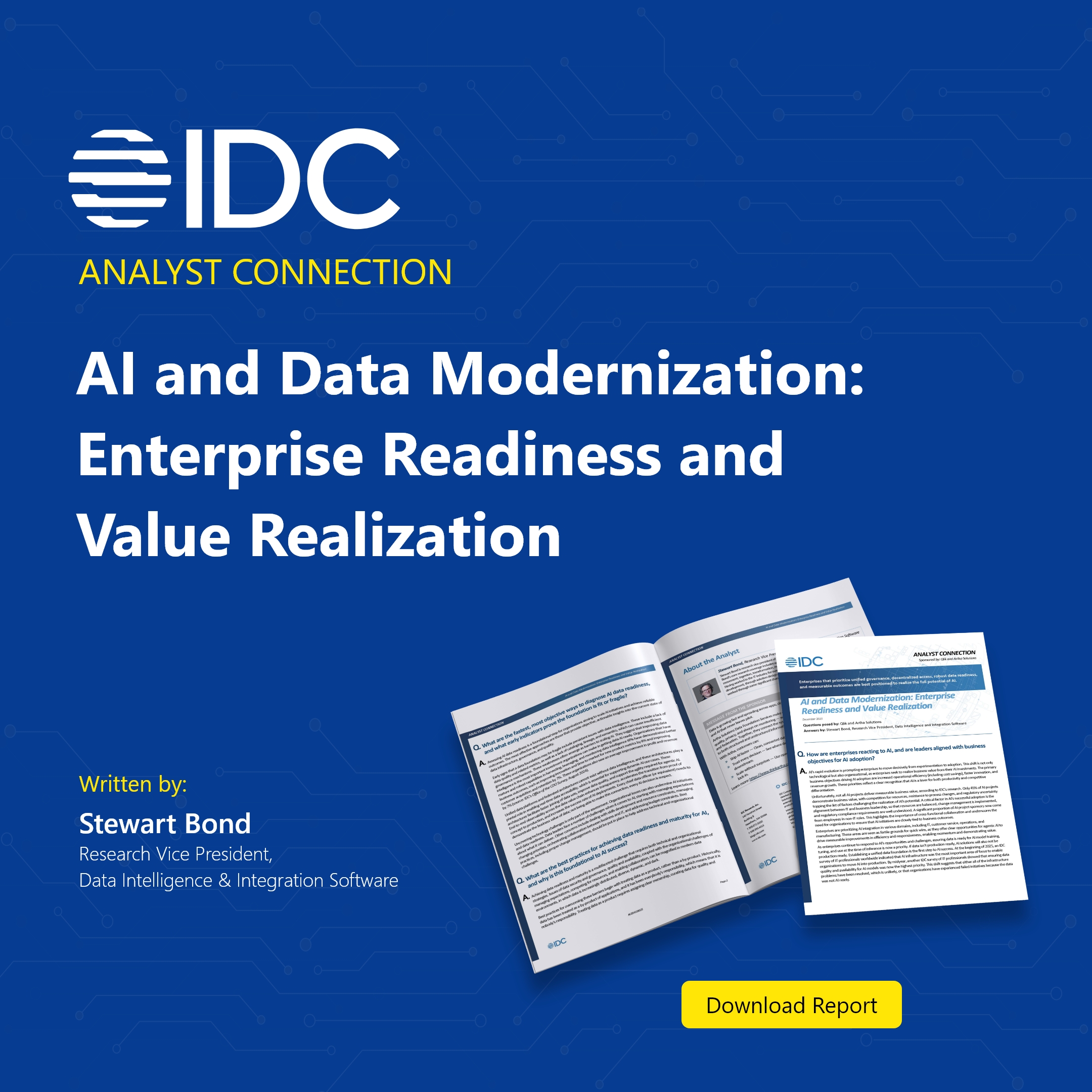
AI and Data Modernization: Enterprise Readiness and Value Realization

ANALYST CONNECTION Sponsored by: Qlik and Artha Solutions AI and Data Modernization: Enterprise Readiness and Value Realization December 2025 Questions posed by: Qlik and Artha Solutions Answers by: Stewart Bond.

Explore whitepaper
Whitepaper

Future-Ready Data Foundation: From AI Pilot to Production Value

Success with AI starts with data. Improving data quality and accessibility for AI is today’s top organizational priority; nine months ago, it was improving AI infrastructure. However, laying a solid data foundation for.

Explore whitepaper
Article

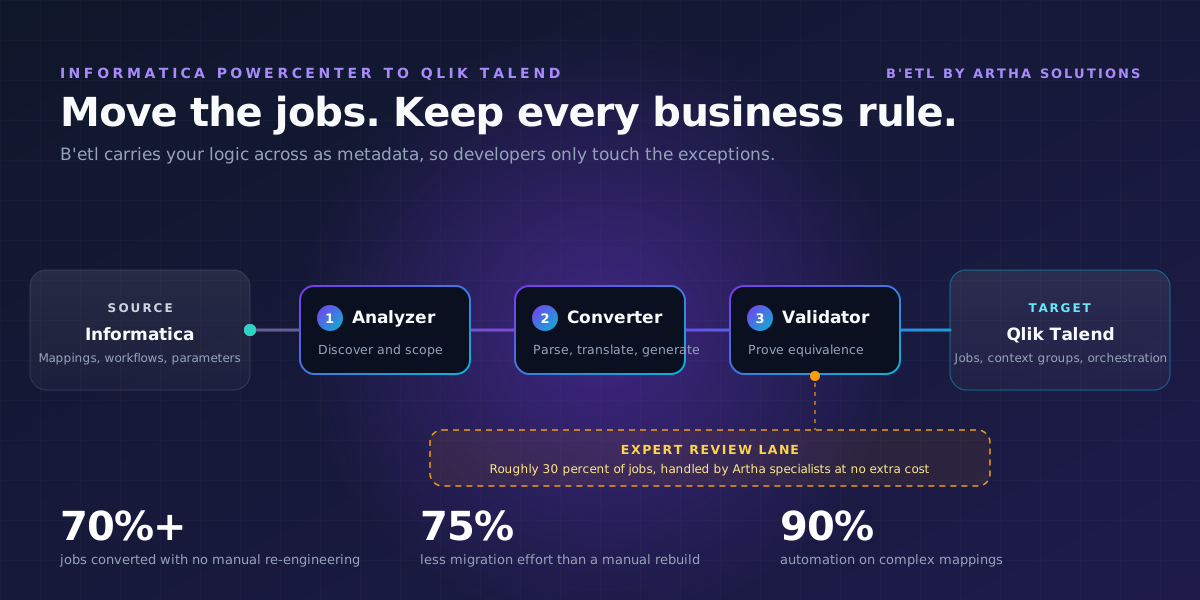
It’s Much Easier to Migrate from Informatica to Qlik Than You Think

In today’s data-driven world, staying future proof often means leaving behind legacy ETL platforms like Informatica PowerCenter, especially as they approach end-of-support. While such migrations are often perceived as...

Explore article

FREQUENTLY ASKED QUESTIONS

Questions Buyers and Architects Ask

Concise answers based on current Qlik product information and Artha’s consulting approach.

What is Qlik Talend Cloud used for?

Qlik Talend Cloud is used to move, transform, improve and govern data across hybrid and cloud environments. It supports real-time data movement, ETL and ELT patterns, data quality, lineage, stewardship and reusable data products for analytics, operations and AI.

Does Qlik Talend Cloud support real-time data?

Yes. Qlik Talend Cloud supports change data capture and real-time data movement from supported sources, alongside batch and streaming patterns. Artha selects an approach according to source-system impact, freshness requirements, recovery objectives and target-platform behavior.

Can Qlik Talend Cloud connect on-premises and cloud systems?

Yes. Qlik Talend Cloud supports hybrid connectivity across on-premises databases, enterprise applications, SaaS platforms and cloud data services. Secure gateway, network and identity architecture must be designed for the customer’s environment and compliance needs.

What is a data product in Qlik Talend Cloud?

A data product packages data, transformations, quality rules, contracts, ownership and access expectations into a reusable unit aligned to a business domain. It gives producers and consumers a shared definition of what the data means and how it should perform.

Can Artha migrate existing Talend workloads?

Yes. Artha inventories Talend jobs, dependencies, runtime behavior and reusable logic, then determines which workloads should be upgraded, standardized, retained or moved. Migration includes reconciliation and controlled transition rather than assuming direct one-to-one conversion.

How does Qlik Talend Cloud support AI readiness?

It helps create AI-ready foundations through current data movement, repeatable transformation, quality measurement, lineage, governance and discoverable data products. AI readiness also requires business ownership, access policy, evaluation and monitoring beyond platform configuration.

What does a typical implementation include?

A typical engagement includes discovery, architecture, connectivity, security, environment standards, pipeline development, quality and governance controls, data products, testing, production transition, runbooks and operational enablement. Scope depends on sources, latency, compliance and target platforms.

How do we avoid rebuilding the same problems we have today?

Most estates degrade for structural reasons rather than technical ones: configuration embedded in pipelines instead of held as parameters, transformation logic duplicated per consumer because nothing was reusable, and no owner accountable for what a field means. A new platform accelerates whatever practice you bring to it, so Artha fixes the conventions in the design phase, before volume is built. In practice that means environment-specific values held as parameters rather than hard-coded, shared logic published once as an owned data product, quality thresholds agreed with a named business owner, and promotion through gates rather than direct edits. The platform is a genuine improvement on an ageing on-premises estate, but it will reproduce a copy-paste culture faithfully if that culture travels with it.

NEXT STEP

Design a Trusted Data Delivery Platform

Start with an architecture session focused on priority workloads, operating constraints and measurable acceptance criteria.

ARCHITECTURE CONVERSATION

Talk to a Qlik Architect

Tell us about the platform, workload and business priority you are evaluating.