Skip to Qlik microsite content

INDUSTRY DATA MODERNIZATION

Qlik Solutions Designed Around Industry Decisions

Artha maps Qlik capabilities to the decisions, controls and operating realities of regulated and data-intensive industries.

Each program connects data movement, quality, governance, analytics and AI to a defined business context.

Explore Customer Evidence

AI OVERVIEW

Qlik Solutions Designed Around Industry Decisions

Artha Solutions delivers Qlik and Talend programs across healthcare and life sciences, financial services and insurance, manufacturing, retail and consumer, and utilities and energy. Work is shaped around industry data, governance, latency and decision requirements.

Artha SolutionsQlikQlik Talend CloudTalendTalend Data FabricTalend Data CatalogApache IcebergQlik Open LakehouseQlik AnswersQlik PredictQlik AutomateDatabricksSnowflakeB’etl

The Platform Is the Same. The Constraints Are Not.

Qlik Talend Cloud looks identical on day one whichever industry installs it. What differs is what a field is allowed to mean, how fresh it has to be, who may see it, and what you must be able to prove about it two years later. Those four answers shape an architecture more than the product choice does.

  • A claim and a retail order are both transactions, but one carries a retention obligation and a patient identifier, and that changes storage, masking and access before any pipeline is written
  • Freshness is only generous relative to the decision: overnight is fine for a monthly regulatory return and useless for fraud screening on the same customer record
  • Quality thresholds follow consequence, so a two per cent match failure is acceptable in a marketing segment and unacceptable in a payment file
  • Access in regulated sectors has to be demonstrable to an auditor after the fact, not merely configured correctly today
  • What AI may be used for is bounded before design starts, which is why the scope line in healthcare is drawn at operational content rather than clinical judgement

So Artha scopes an industry program from the decision being made and the controls around it, then works back to sources, latency and ownership. Done in the other order you get a technically sound platform that cannot be used for the thing it was bought for, which is a more common outcome than the market admits.

Industry Priorities and Qlik Use Cases

Healthcare and Life Sciences

Member, provider, claims, eligibility and clinical data must be integrated while protecting sensitive information and supporting auditability.

Explore Healthcare and Life Sciences services
Relevant Qlik capabilities
  • Qlik Talend Cloud
  • Data quality and governance
  • Qlik Answers
High-value use cases
  • Member and provider data
  • Eligibility and MOOP
  • Risk adjustment
  • Regulatory reporting
  • Operational knowledge assistants
Governance considerations

HIPAA-aligned access, data quality ownership, lineage, retention and approved clinical or operational content.

Financial Services and Insurance

Customer, policy, transaction and risk data is fragmented across core, digital and acquired platforms.

Explore Financial Services and Insurance services
Relevant Qlik capabilities
  • CDC and integration
  • Data products
  • Quality and governance
  • Qlik Answers
High-value use cases
  • Customer and policyholder 360
  • Fraud signals
  • Compliance
  • Regulatory reporting
  • Policy assistants
Governance considerations

KYC/AML controls, classification, explainability, lineage, segregation of duties and retention.

Manufacturing

SAP, plant, supply-chain, inventory and telemetry data operate at different speeds and standards.

Explore Manufacturing services
Relevant Qlik capabilities
  • SAP integration
  • Qlik Replicate
  • Open Lakehouse
  • Analytics
High-value use cases
  • SAP modernization
  • Supply-chain visibility
  • Real-time inventory
  • IoT and telemetry
  • Maintenance knowledge
Governance considerations

Plant and domain ownership, master data, operational safety, lineage and lifecycle controls.

Retail and Consumer

Customer, product, order, loyalty and inventory data must stay consistent across digital and physical channels.

Explore Retail and Consumer services
Relevant Qlik capabilities
  • Customer data products
  • MDM and quality
  • Real-time integration
High-value use cases
  • Customer 360
  • Product MDM
  • Omnichannel integration
  • Personalization
  • Real-time inventory
Governance considerations

Consent, identity matching, product ownership, data freshness and explainable activation.

Utilities and Energy

Partner, meter, asset and customer data arrives in varied formats and requires strong validation.

Explore Utilities and Energy services
Relevant Qlik capabilities
  • Talend integration
  • Metadata-driven ingestion
  • Quality and stewardship
High-value use cases
  • Partner exchange
  • Meter and operational data
  • Asset monitoring
  • Regulatory reporting
  • Customer integration
Governance considerations

Partner contracts, validation rules, audit history, operational ownership and critical-infrastructure access.

The Six Questions That Differ by Industry

What a field means

An active customer is a different set of rows in insurance, retail and utilities, and the difference is contractual rather than technical. Until the definition is written down and owned, every consuming team encodes its own version, which is how two correct reports disagree.

How fresh it has to be

This is stated as a number tied to a decision, not as an aspiration. Real-time replication and a nightly batch differ by an order of magnitude in running cost and in the maintenance they generate, so choosing the stricter one everywhere is an expensive way to avoid a conversation.

What quality threshold applies

Rules need a pass mark and a defined action when the mark is missed. Whether a batch is held, flagged or released with a warning is a business decision about consequence, and it belongs to a named owner rather than to whoever is on call.

Who may see it

Role, region and legal entity all restrict access, and in insurance and banking so does segregation of duties. Modelling these at the platform layer keeps the answer consistent whichever tool asks the question, instead of leaving each engine to enforce its own approximation.

What you must prove later

In regulated sectors the requirement is evidence: which source produced this figure, what transformed it, who approved the change and when. Lineage and audit history designed in from the start cost far less than reconstructing them in response to a request.

What AI is allowed to do

The boundary is set before design, in writing. Healthcare assistants stay on operational and administrative content rather than clinical judgement, financial ones cite the policy version that authorised an answer, and both are scoped to approved sources with an escalation path to a person.

How an Industry Program Is Scoped

  1. 01

    Frame the decision

    Start from one decision a named business owner makes on a known cycle, and what they currently do instead because the data is not there. That statement is what makes success measurable later.

  2. 02

    Map the real sources

    Trace the systems that hold the truth, including the spreadsheet that reconciles two of them, because that spreadsheet usually contains the business rule nobody documented.

  3. 03

    Agree the controls

    Set classification, access, quality thresholds, retention and audit evidence with risk and compliance before build, so the review at the end confirms a design rather than reopening it.

  4. 04

    Prove it on one use case

    Deliver one governed data product end to end against agreed acceptance criteria. A narrow first delivery that is genuinely in production beats a broad one that is nearly ready.

  5. 05

    Scale by pattern

    Reuse the ingestion, quality and access patterns the first use case established, so the second is faster than the first. If it is not, the pattern was never actually reusable and that is worth knowing early.

CUSTOMER EVIDENCE

Implementation Experience Grounded in Enterprise Outcomes

Selected from Artha’s existing published case-study system. Customer anonymization is preserved.

Healthcare & Life Sciences

Scalable Talend and DIF for 100+ TB Healthcare Datasets

Challenge: A healthcare analytics provider needed to ingest and govern more than 100 TB of diverse data while improving access and processing performance.

Artha solution: Artha deployed Talend with its Dynamic Ingestion Framework across AWS and Snowflake, adding automated validation and scalable processing.

Talend, AWS, Snowflake, Tableau

50%Published reduction in data processing time
Read the case study

BFSI

Enterprise Data Governance and Master Data Management (MDM)

Challenge: Customer records across 12 legacy platforms created inconsistent profiles, compliance effort and manual reconciliation.

Artha solution: Artha implemented Talend Data Fabric, stewardship and governed master data in a Snowflake and AWS data foundation.

Talend Data Fabric, Snowflake, AWS S3, Apache Spark, Talend, AWS, S3

40%Published reduction in compliance reporting time
Read the case study

Manufacturing

Real-Time Logistics Analytics and ETL Modernization

Challenge: Inventory and logistics events took more than 24 hours to reach executive reporting, limiting hot-order visibility and increasing operational intervention.

Artha solution: Artha implemented Qlik Replicate change data capture, Qlik Compose modeling and a governed cloud analytics pipeline.

Qlik Cloud, Qlik Replicate, Qlik Compose, Snowflake, Microsoft Azure, Azure, Qlik

<2 minPublished logistics-data latency after modernization
Read the case study

Utilities & Energy

Talend Data Integration Hub for Real-Time Validation

Challenge: More than 300 utility partners supplied data in varied formats, creating validation, onboarding and audit complexity.

Artha solution: Artha built a metadata-driven Talend Data Integration Hub with validation, stewardship and automated partner processing.

Talend

50%Published reduction in manual processing time
Read the case study
RELATED RESOURCES

Continue the Architecture Conversation

Whitepaper

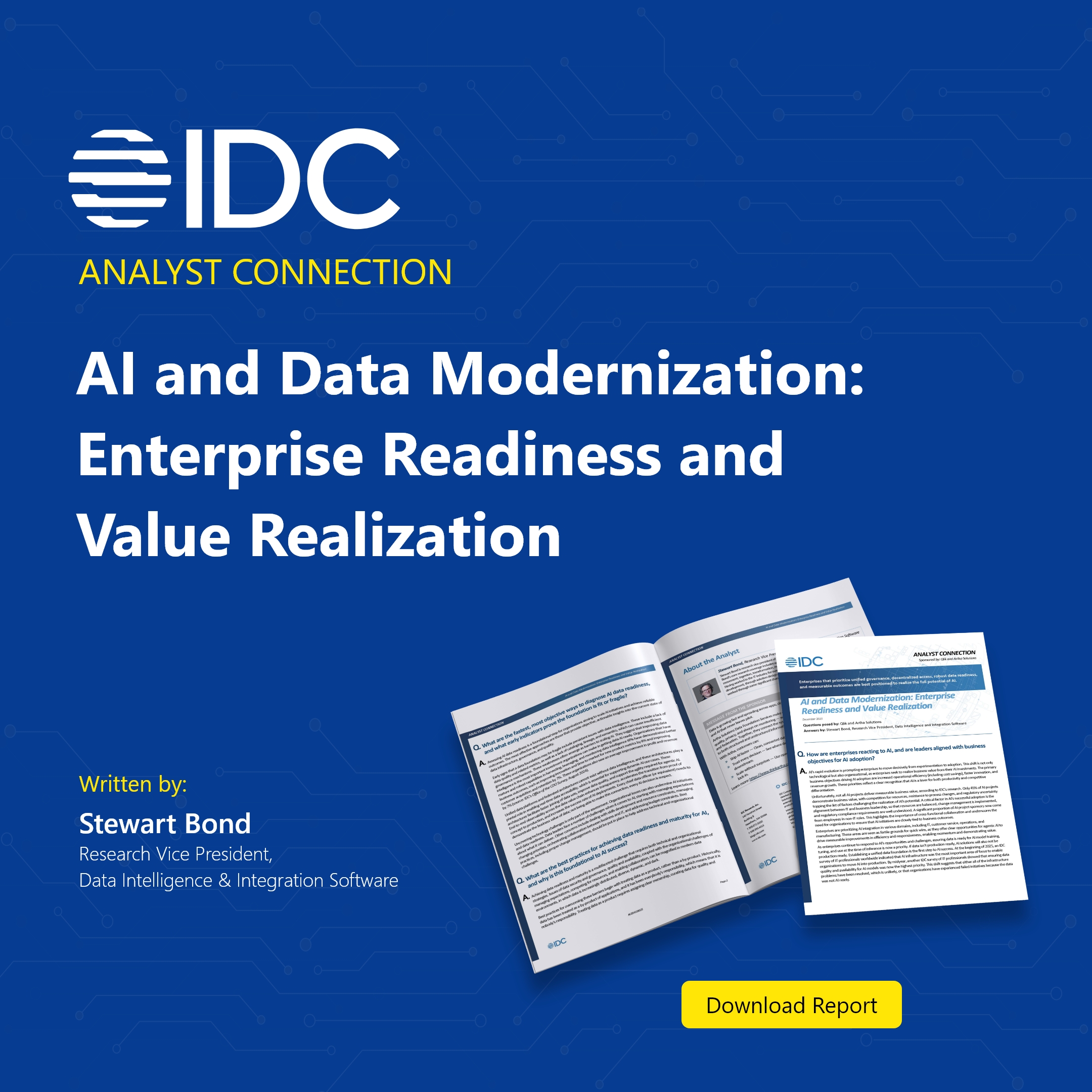
AI and Data Modernization: Enterprise Readiness and Value Realization

ANALYST CONNECTION Sponsored by: Qlik and Artha Solutions AI and Data Modernization: Enterprise Readiness and Value Realization December 2025 Questions posed by: Qlik and Artha Solutions Answers by: Stewart Bond.

Explore whitepaper
Whitepaper

Future-Ready Data Foundation: From AI Pilot to Production Value

Success with AI starts with data. Improving data quality and accessibility for AI is today’s top organizational priority; nine months ago, it was improving AI infrastructure. However, laying a solid data foundation for.

Explore whitepaper
Article

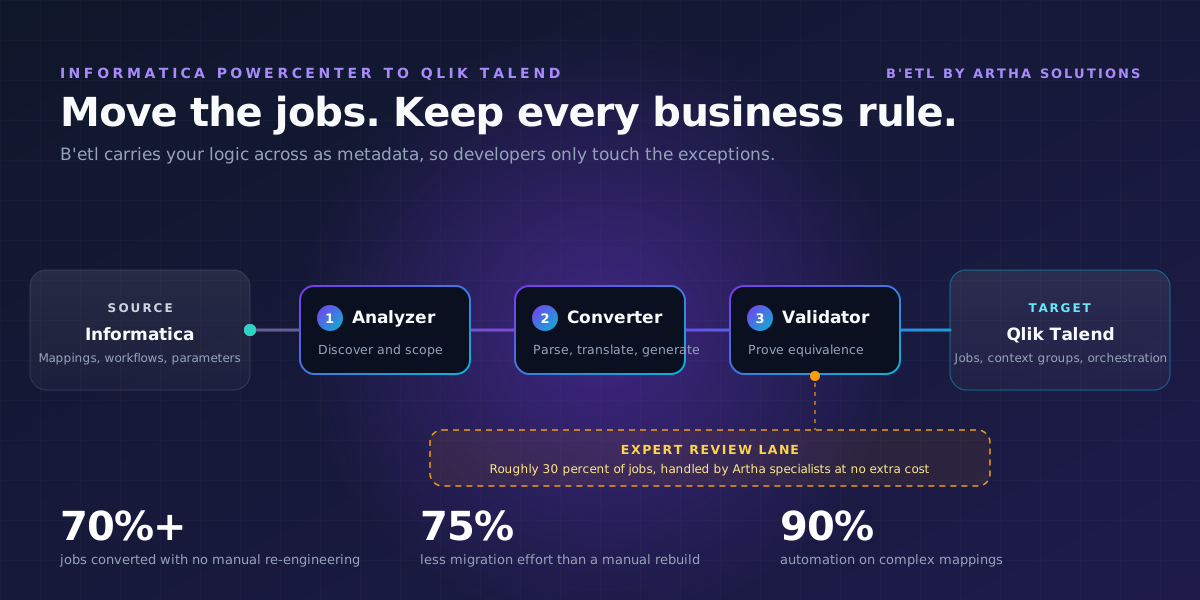
It’s Much Easier to Migrate from Informatica to Qlik Than You Think

In today’s data-driven world, staying future proof often means leaving behind legacy ETL platforms like Informatica PowerCenter, especially as they approach end-of-support. While such migrations are often perceived as...

Explore article

FREQUENTLY ASKED QUESTIONS

Questions Buyers and Architects Ask

Concise answers based on current Qlik product information and Artha’s consulting approach.

Which industries does Artha support with Qlik?

Artha supports Qlik and Talend programs across healthcare and life sciences, financial services and insurance, manufacturing, retail and consumer, utilities and energy, and other data-intensive sectors. The implementation pattern is adapted to each industry’s decisions, controls and data landscape.

How does industry context change a Qlik implementation?

Industry context changes source priorities, data definitions, freshness, quality thresholds, access controls, retention, audit evidence and acceptable AI use. Artha incorporates these decisions into architecture and operating governance.

Can Qlik support regulated data environments?

Qlik capabilities can support governed data delivery, lineage, quality, role-based access and controlled analytics. Compliance depends on the customer’s architecture, configuration, processes and responsibilities; platform features alone do not establish compliance.

How are industry case studies selected?

The microsite surfaces existing published Artha case studies by relevant technology and industry. Customer names remain anonymized according to the current case-study approach, and only clean, verifiable excerpts are shown.

Can one program support multiple regions?

Yes, but data residency, privacy, connectivity, operating hours and regulatory obligations must be evaluated by region. Artha’s global delivery model supports cross-region programs with responsibilities defined during architecture.

Where should an industry program start?

With one decision that a named business owner makes on a known cycle, where the data is currently missing, late or disputed. That gives you a measurable acceptance test and a person who cares whether it is met. Programs that start from a platform rollout instead tend to deliver capability that nobody has a reason to adopt, because no specific decision was waiting on it.

Do we need a different platform for each industry?

No. The Qlik and Talend components are the same; what changes is configuration, data definitions, freshness targets, quality thresholds, access modelling, retention and the boundary set on AI use. Artha reuses the same delivery method across industries and adapts those decisions, which is why a second use case in the same organisation should cost less than the first.

How is sensitive data handled during implementation?

Classification comes first, then masking or tokenisation for regulated fields, restricted non-production data, and access scoped to the people doing the work. Development against unmasked production extracts is a common shortcut and a poor one, since it moves regulated data into environments that were never designed to hold it.

NEXT STEP

Connect Qlik Capabilities to an Industry Decision

Define the data, controls, users and measurable outcome for your priority use case.

ARCHITECTURE CONVERSATION

Talk to a Qlik Architect

Tell us about the platform, workload and business priority you are evaluating.