Skip to Qlik microsite content

QLIK/TALEND MODERNIZATION

The Talend 7.3 Clock Runs Out in December 2026

Talend 7.3 reached end of life in November 2024, and the purchasable extended-support window closes in December 2026. After that, an estate the business depends on runs without fixes, CVE patches or vendor help.

Artha upgrades Talend estates with factory discipline: inventory first, a path chosen per workload between Talend 8 and Qlik Talend Cloud, and regression evidence before anything cuts over.

Compare the Modernization Paths

AI OVERVIEW

The Talend 7.3 Clock Runs Out in December 2026

Artha Solutions modernizes Talend estates: upgrades from Talend 7.3 and earlier to Talend 8, transitions to Qlik Talend Cloud, hybrid patterns, Talend MDM end-of-life exits and Talend Data Catalog upgrades to 8.1, delivered with inventory, regression testing and controlled cutover.

Artha SolutionsQlikQlik Talend CloudTalendTalend Data FabricTalend Data CatalogApache IcebergQlik Open LakehouseQlik AnswersQlik PredictQlik AutomateDatabricksSnowflakeB’etl

Where the Lifecycle Actually Stands

Modernization conversations go better with the published dates on the table. These are Qlik's, not ours.

  • Talend 7.3, released February 2020, was retired in May 2023 and reached end of life on November 30, 2024
  • A purchasable extended-support offering covers 7.3 only through December 2026; after that there are no fixes at any price
  • Talend 8 is the supported on-premises platform, receiving features, bug fixes and CVE patches through monthly service releases
  • Talend MDM Server reached end of life on December 31, 2024, with no successor version
  • Talend Data Catalog 8.0 reached end of support on December 31, 2024; 8.1 is the current, supported release
  • Every active Talend subscription is entitled to a current Talend 8 licence, so the move is a delivery decision, not a procurement one

An estate still on 7.3 in mid-2026 is not doomed, but it is on a deadline, and the queue of organizations discovering the same date is not getting shorter.

Six Modernization Paths, Chosen Per Workload

Estates do not modernize; workloads do. The assessment classifies every job, and each one takes the path that fits it.

Upgrade to Talend 8

The in-place path for estates staying client-managed: remediation of custom components and deprecated component usage, the Java runtime move, build pipeline updates, then wave-by-wave regression against 7.3 baselines. Most jobs cross cleanly; the assessment exists to find the ones that will not before they find you.

Move to Qlik Talend Cloud

The replatform path where managed infrastructure fits: management moves to the cloud control plane while Remote Engines keep execution wherever data gravity and compliance demand. Jobs are classified for conversion, redesign or retirement rather than lifted blind, because a cloud copy of your technical debt still accrues interest.

Hybrid transition

The honest interim for most large estates: some workloads to Qlik Talend Cloud now, some on Talend 8 for another cycle, one set of standards across both. Designed deliberately, with a rule for which workload goes where, it is a strategy rather than a stall.

Rationalize and retire

The cheapest migration is the job you delete. Runtime evidence routinely shows a quarter of an aging estate has not executed in a year, and near-duplicates that consolidation removes before anyone pays to upgrade them. Rationalization is the first wave, not an afterthought.

Talend MDM exit

MDM Server is end of life with no successor, so staying is not a path. Matching, survivorship and stewardship logic moves to Qlik Talend Cloud quality and data products, or to a dedicated MDM platform where multi-domain requirements demand one. Golden records are migrated with reconciliation evidence, not re-mastered from scratch.

Data Catalog to 8.1

Estates on Data Catalog 8.0 or earlier move to 8.1, the release that still receives monthly updates. Harvest configurations, lineage history and glossary content carry across with validation, so the metadata investment survives the upgrade instead of restarting.

What Actually Breaks in a Talend Upgrade

Version moves fail on specifics, not on concepts. These are the four we check first, because they are where the remediation effort concentrates.

Custom components

Components built against older APIs may not compile on the new version, and the developer who wrote them has often moved on. The assessment inventories every custom component and third-party library, and each gets a verdict: carries over, needs rework, or is replaced by a native component that did not exist when it was written.

Deprecated components

Components that still ran in 7.3 can be removed or replaced in newer releases, and a job that references one fails at build time, not runtime, which is the good case. The bad case is behaviour that changed subtly. Baseline outputs from the old estate are the only defence, which is why the factory captures them before touching anything.

Java and runtime moves

Talend 8 moved the Java baseline forward, and custom routines, JDBC drivers and OS-level dependencies feel it. The upgrade plan pins the certified Java version per component of the stack and tests the drivers your jobs actually use, rather than assuming compatibility from release notes.

Build and deployment pipelines

CommandLine, Maven versions and CI integrations shift between major versions, and moving to Qlik Talend Cloud replaces Talend Administration Center scheduling with Management Console operation. The delivery pipeline is migrated and rehearsed as its own workstream, because an estate you cannot release to is down in a way monitoring will not show.

The Upgrade Factory

  1. 01

    Inventory

    Every job, joblet, route, custom component, context and schedule, taken from repositories and runtime evidence rather than memory. The jobs that have not run in a year surface here, and they are removed from scope before anyone estimates them.

  2. 02

    Assess

    Classify each workload for complexity, criticality and upgrade risk: deprecated component usage, custom code, driver dependencies. The output is a wave plan where the first wave is genuinely low-risk and the awkward jobs are known by name.

  3. 03

    Choose per workload

    Talend 8, Qlik Talend Cloud, redesign or retirement, decided against stated criteria: latency, connectivity, compliance, cost and the life expectancy of the business process the job serves.

  4. 04

    Upgrade factory

    Waves of remediation, conversion and unit verification run to a repeatable pattern, so the cost per wave stays flat instead of growing. Exceptions route to named engineers rather than stalling the line.

  5. 05

    Validate

    Row-count and value reconciliation against the 7.3 baselines for the same inputs, plus schedule, restart and performance behaviour. Matching outputs on the happy path is not validation; month-end is where upgrades are proven.

  6. 06

    Cut over

    Wave-by-wave release with rehearsed cutover and rollback that has been tested rather than described. The old estate is retired deliberately at the end, so the licence and infrastructure saving actually lands.

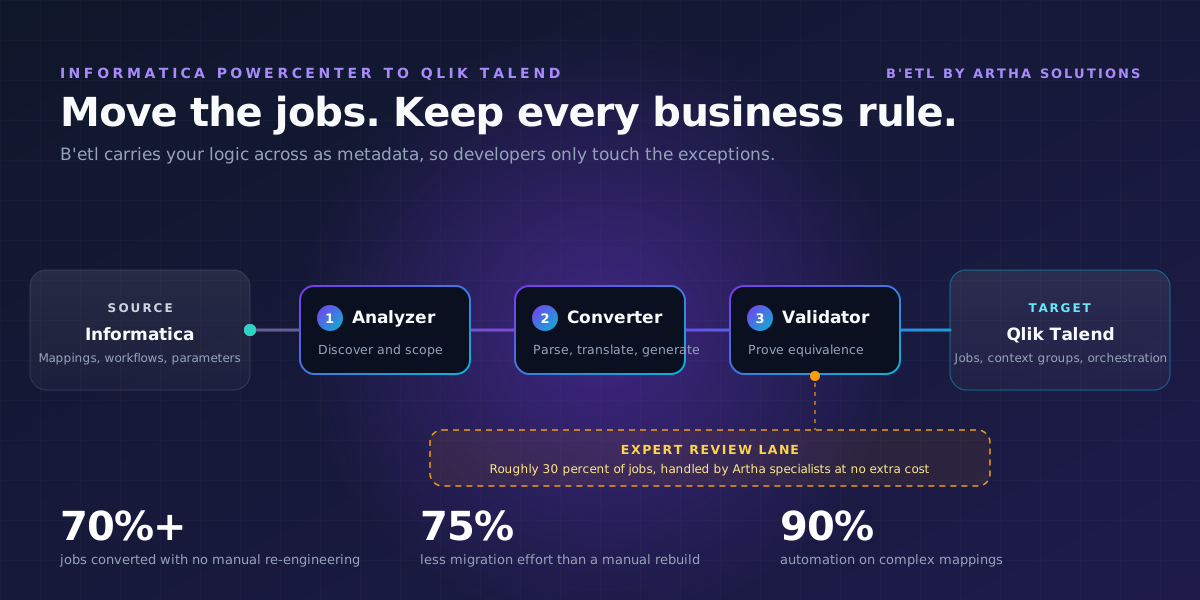
The same factory pattern, with B'etl automation, handles moves from Informatica, DataStage and other platforms; that work lives in the Migration Center. This page is for estates staying in the Qlik and Talend family.

CUSTOMER EVIDENCE

Implementation Experience Grounded in Enterprise Outcomes

Selected from Artha’s existing published case-study system. Customer anonymization is preserved.

Utilities & Energy

Seamless On-Premises to Cloud IT Infrastructure Transition

Challenge: Talend workloads and operational data had to move from on-premises infrastructure to AWS without interrupting day-to-day business operations.

Artha solution: Artha ran a controlled transition covering Talend Cloud, AWS and the remaining on-premises applications, tuning resource allocation as workloads moved.

Talend, AWS, S3

30%Published reduction in operational and IT cost after migration
Read the case study

Hospitality & Travel

Modernizing Data Infrastructure with Talend and Snowflake

Challenge: Growing volumes, slow reporting and strict compliance requirements had outgrown a hospitality group's aging data infrastructure.

Artha solution: Artha modernized the estate on Talend and Snowflake, carrying quality and governance controls into the new architecture rather than bolting them on later.

Talend, Snowflake

6xPublished improvement in report generation speed
Read the case study

BFSI

Banking System Digital Transformation and Legacy Core Integration

Challenge: Fragmented data marts, costly legacy interfaces and static digital channels limited real-time customer engagement at a retail bank.

Artha solution: Artha built a governed integration foundation over the legacy core using Talend and its Dynamic Ingestion Framework.

Talend

4xPublished ingestion performance gain from the Dynamic Ingestion Framework
Read the case study
RELATED RESOURCES

Continue the Architecture Conversation

Whitepaper

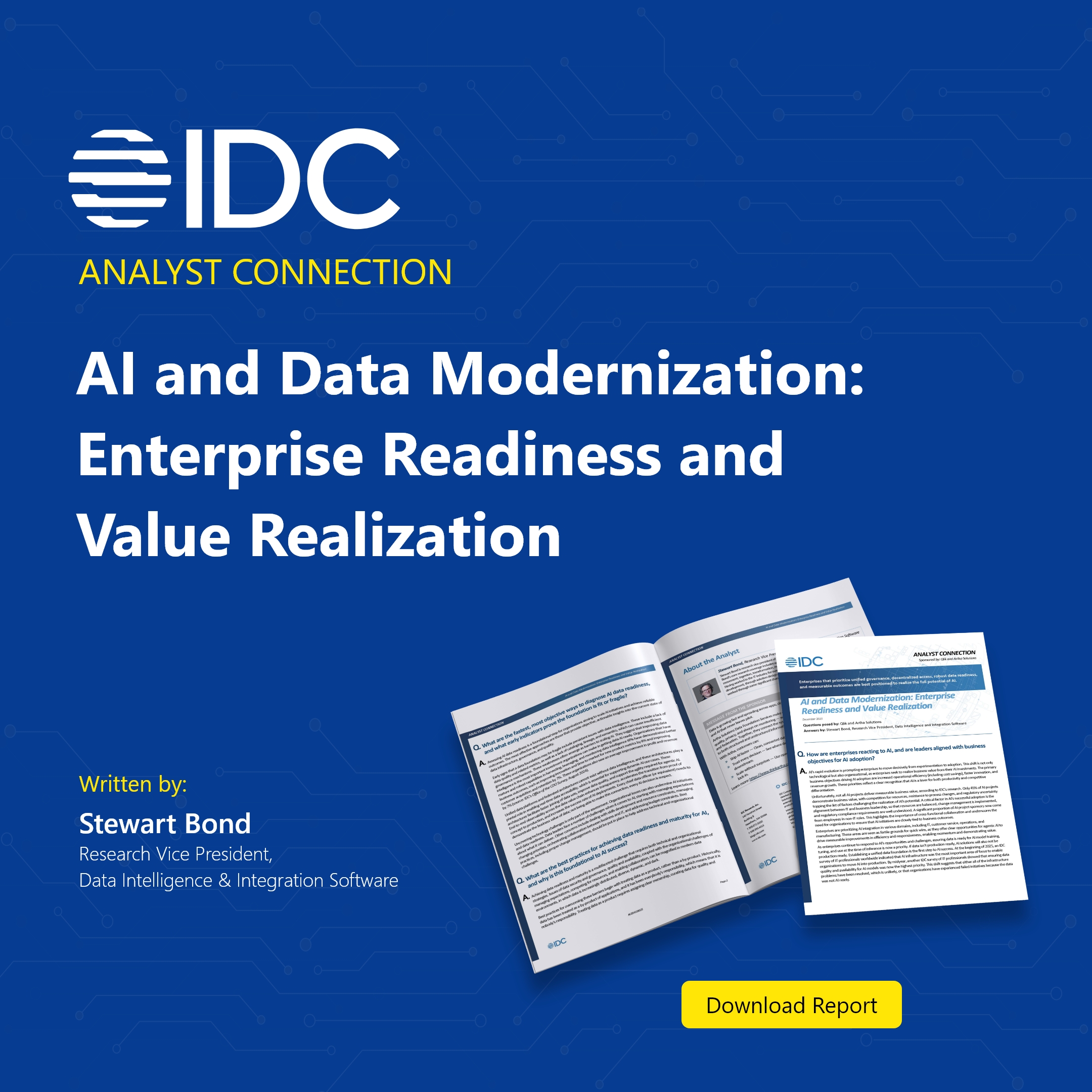
AI and Data Modernization: Enterprise Readiness and Value Realization

ANALYST CONNECTION Sponsored by: Qlik and Artha Solutions AI and Data Modernization: Enterprise Readiness and Value Realization December 2025 Questions posed by: Qlik and Artha Solutions Answers by: Stewart Bond.

Explore whitepaper
Whitepaper

Future-Ready Data Foundation: From AI Pilot to Production Value

Success with AI starts with data. Improving data quality and accessibility for AI is today’s top organizational priority; nine months ago, it was improving AI infrastructure. However, laying a solid data foundation for.

Explore whitepaper
Article

It’s Much Easier to Migrate from Informatica to Qlik Than You Think

In today’s data-driven world, staying future proof often means leaving behind legacy ETL platforms like Informatica PowerCenter, especially as they approach end-of-support. While such migrations are often perceived as...

Explore article

FREQUENTLY ASKED QUESTIONS

Questions Buyers and Architects Ask

Concise answers based on current Qlik product information and Artha’s consulting approach.

Is Talend 7.3 still supported?

Standard support ended November 30, 2024. A purchasable extended-support offering runs only through December 2026, and versions before 7.3 are already fully end of life. Qlik's published lifecycle lists Talend 8 as the version receiving monthly service releases. If your estate is on 7.3, the remaining runway is measured in months, and remediation plus regression testing consumes most of it.

What happens if we just stay on 7.3 after December 2026?

The jobs keep running, and that is precisely the trap: nothing fails on day one. What changes is that the next CVE, driver incompatibility or OS patch has no vendor fix at any price, so the first serious incident becomes an unplanned migration executed under pressure. Regulated organizations also inherit an audit finding, since unsupported software in a data path is a standard control failure.

Should we upgrade to Talend 8 or move to Qlik Talend Cloud?

Per workload, not per estate. Talend 8 suits workloads staying client-managed for residency, network or operating-model reasons; Qlik Talend Cloud suits teams shedding infrastructure operation, with Remote Engines keeping execution local where data gravity demands. Most large estates land on a deliberate hybrid. The assessment prices both paths per workload, which turns an opinion argument into a costed decision.

Do our jobs need rewriting to move to Talend 8?

Most do not: the majority of standard jobs cross with remediation rather than rewrites. The effort concentrates in custom components, deprecated component usage, Java-dependent routines and driver updates, which is exactly what the inventory quantifies before anyone commits to a date. Budgeting from the inventory rather than the job count is the difference between an estimate and a guess.

We still run Talend MDM. What are our options?

MDM Server reached end of life on December 31, 2024, with no successor product, so the options are: operate the existing estate under engineering support while planning the exit, move matching and survivorship into Qlik Talend Cloud quality and data products, or adopt a dedicated MDM platform where multi-domain scope justifies one. Artha runs the old estate and builds the new home in parallel, so golden records never stop being served.

Does an upgrade interrupt production?

It should not, and the method is designed so it cannot: the new environment is built and validated alongside the old, waves cut over with rehearsed procedures and tested rollback, and parallel running covers the workloads where criticality justifies the cost. The old estate stays available until its waves are proven, then is retired deliberately.

Is the Talend 8 licence an extra purchase?

No. Qlik's published position is that every active Talend subscription is entitled to a current Talend 8 licence, so the move is a delivery project rather than a procurement negotiation. Extended support for 7.3, by contrast, is a paid offering with a hard end date, which is why spending that budget on the actual upgrade usually wins.

How is this different from the Migration Center?

Same factory discipline, different starting point. The Migration Center handles moves from other vendors' platforms, such as Informatica, DataStage and SSIS, where B'etl automates analysis and conversion. This page covers estates staying in the Qlik and Talend family: version upgrades, cloud transitions and product-line exits like MDM. If you are consolidating from both situations at once, the two programmes share one inventory and one governance.

NEXT STEP

Get Off 7.3 Before the Window Closes

Start with the inventory and a per-workload path decision. The assessment is bounded; the December 2026 deadline is not moving.

ARCHITECTURE CONVERSATION

Talk to a Qlik Architect

Tell us about the platform, workload and business priority you are evaluating.