Skip to Qlik microsite content

DATA FOUNDATIONS FOR AI

AI Projects Fail on Data. Data Products Are the Fix.

Qlik data products package a dataset with the things AI actually needs: a contract, a named owner, enforced quality thresholds, a freshness commitment and lineage back to source.

Artha designs and builds them on Qlik Talend Cloud, one business decision at a time, so the model teams stop spending eighty percent of their week re-verifying inputs.

See What a Data Product Includes

AI OVERVIEW

AI Projects Fail on Data. Data Products Are the Fix.

Artha Solutions builds AI-ready data foundations using Qlik data products in Qlik Talend Cloud: governed, discoverable datasets with contracts, named owners, enforced quality thresholds, freshness commitments and lineage, designed to serve AI models, assistants and analytics reliably.

Artha SolutionsQlikQlik Talend CloudTalendTalend Data FabricTalend Data CatalogApache IcebergQlik Open LakehouseQlik AnswersQlik PredictQlik AutomateDatabricksSnowflakeB’etl

Why AI Initiatives Stall on Data

The model was never the problem. AI initiatives stall because every project starts by rediscovering the same questions: where is the customer data, which copy is right, who owns it, how fresh is it, and may we legally use it. Answer those once, per dataset, and publish the answer. That is all a data product is.

  • A model trained on data nobody certified produces predictions nobody can defend, which is why so many pilots never reach production
  • Reproducibility requires knowing exactly what data trained the model; an ungoverned extract cannot answer that a month later
  • Generative assistants amplify quiet data errors into confident wrong answers, so the quality gate has to sit before the model, not after the complaint
  • Each AI team building its own pipeline from raw sources multiplies cost and produces subtly different versions of the same truth
  • Qlik positions data products around exactly this: solving domain-specific business outcomes with trusted, packaged data rather than one-off extracts

None of this needs a new platform if you already run Qlik Talend Cloud. It needs the discipline of treating data as something you publish deliberately, with a name on it.

What a Data Product Actually Includes

Six properties separate a data product from a dataset with a nice name. Remove any one of them and the AI team is back to re-verifying inputs by hand.

A contract, not a dump

The schema, semantics and permitted uses are stated and versioned. A consuming model knows what each field means and what changes will be announced rather than discovered. When the contract changes, consumers hear about it before their pipelines break, not from them breaking.

A named owner

One accountable person answers for the product: its meaning, its quality thresholds and its roadmap. Disputes about what counts as an active customer end at a desk rather than circulating between teams. Ownerless data products decay into exactly the swamp they were built to replace.

Quality thresholds with teeth

The rules from your governance layer run inside the product's pipeline, and a batch that fails its thresholds does not get published. Consumers see the quality status with the data. This is what makes the difference between a certified input and a hopeful one.

A freshness commitment

Stated as a number tied to the decision the product serves: minutes for a fraud signal, hours for operational reporting, daily for finance. The commitment is monitored, and a missed window is an incident with an owner rather than a silent staleness nobody notices until quarter end.

Lineage back to source

Every field traces to the systems and transformations that produced it, recorded by the platform rather than by a diagram from 2023. When a model's output is challenged, the provenance of its inputs is an answer, not an investigation.

Access policy built in

Who may consume the product, for what purpose, with which fields masked, is enforced at the product boundary. AI teams get self-service access to what they are entitled to, and the compliance conversation happens once at design time instead of per request.

Where Data Products Sit

01

Sources

Operational systems · SAP and ERP · SaaS applications · Events and history

02

Ingestion paths

Change data capture · Batch · Streaming

03

Data products

Contracts and owners · Quality gates · Freshness commitments · Qlik Talend Cloud

04

AI and analytics consumers

ML models and Qlik Predict · Qlik Answers · Analytics and reporting · Open Lakehouse workloads

Horizontal controlsLineageAccess policyQuality indicatorsVersion controlMonitoring

One Product at a Time, Deliberately

  1. 01

    Identify the decision

    Start from one decision or model that matters and is currently starved: churn scoring, demand forecasting, an assistant that needs governed context. The decision defines the product's scope, not the other way round.

  2. 02

    Define the contract

    Agree schema, semantics, quality thresholds, freshness and permitted uses with the owner and the consuming team in the same room. Most of the value of a data product is created in this conversation, before any pipeline exists.

  3. 03

    Build the product

    Implement the pipelines, quality gates and transformations in Qlik Talend Cloud, drawing on ingestion patterns that already exist in your estate rather than inventing parallel ones.

  4. 04

    Certify

    Run the product against its own contract: thresholds met on production data, lineage complete, access policy tested with real roles, freshness observed over a full cycle including month-end. Certification is evidence, not a meeting.

  5. 05

    Publish and adopt

    Make the product discoverable, onboard the first consumer, and measure usage. A data product with one committed consumer beats a marketplace of forty that nobody trusts, and the second consumer is where the reuse economics start paying.

CUSTOMER EVIDENCE

Implementation Experience Grounded in Enterprise Outcomes

Selected from Artha’s existing published case-study system. Customer anonymization is preserved.

Healthcare & Life Sciences

Scalable Talend and DIF for 100+ TB Healthcare Datasets

Challenge: A healthcare analytics provider needed to ingest and govern more than 100 TB of diverse data while improving access and processing performance.

Artha solution: Artha deployed Talend with its Dynamic Ingestion Framework across AWS and Snowflake, adding automated validation and scalable processing.

Talend, AWS, Snowflake, Tableau

50%Published reduction in data processing time
Read the case study

Healthcare & Life Sciences

AI/ML Predictive Forecasting for Healthcare Resource Optimization

Challenge: Clinic staffing decisions ran on inconsistent history and patient volumes that swing daily, weekly and seasonally, so sites were routinely over- or under-staffed.

Artha solution: Artha implemented AI/ML demand forecasting tuned to each site, including cold-start handling for locations with no history.

Talend, Data Integration

35%Published staffing cost saving at maintained service levels
Read the case study

Healthcare & Life Sciences

Quick-Start AI/ML Lab Establishment for Enterprise Modeling

Challenge: A healthcare organization wanted to adopt AI/ML but had no validated prototype, governance model or clear starting point.

Artha solution: Artha stood up a Quick-Start AI/ML Lab: a working forecasting prototype on the organization's own data, plus adoption, retraining and governance guidelines.

Azure

6-8 wksPublished engagement length from start to working prototype
Read the case study
RELATED RESOURCES

Continue the Architecture Conversation

Whitepaper

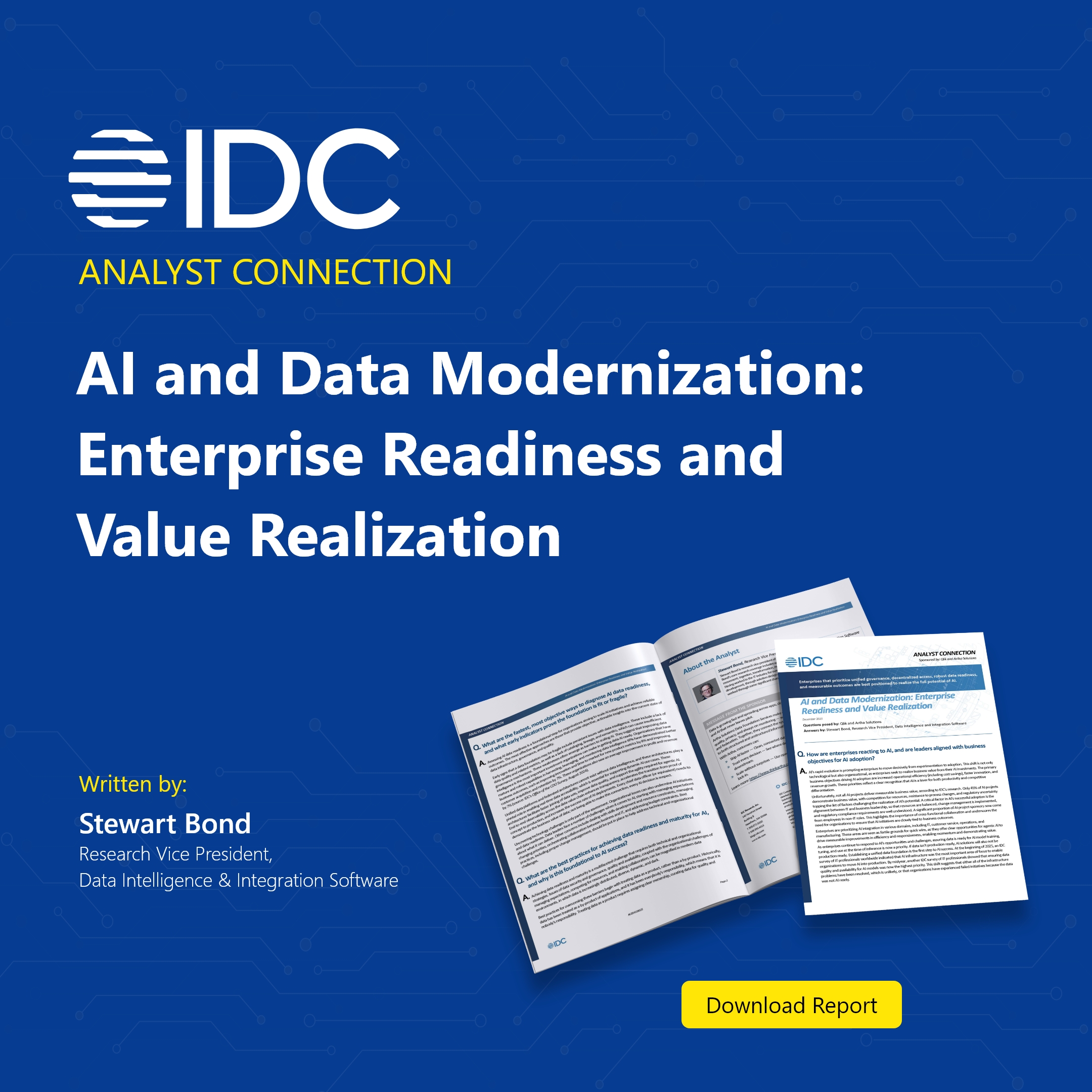
AI and Data Modernization: Enterprise Readiness and Value Realization

ANALYST CONNECTION Sponsored by: Qlik and Artha Solutions AI and Data Modernization: Enterprise Readiness and Value Realization December 2025 Questions posed by: Qlik and Artha Solutions Answers by: Stewart Bond.

Explore whitepaper
Whitepaper

Future-Ready Data Foundation: From AI Pilot to Production Value

Success with AI starts with data. Improving data quality and accessibility for AI is today’s top organizational priority; nine months ago, it was improving AI infrastructure. However, laying a solid data foundation for.

Explore whitepaper
Article

It’s Much Easier to Migrate from Informatica to Qlik Than You Think

In today’s data-driven world, staying future proof often means leaving behind legacy ETL platforms like Informatica PowerCenter, especially as they approach end-of-support. While such migrations are often perceived as...

Explore article

FREQUENTLY ASKED QUESTIONS

Questions Buyers and Architects Ask

Concise answers based on current Qlik product information and Artha’s consulting approach.

What is a data product in Qlik Talend Cloud?

A governed, packaged dataset built to serve a specific business outcome: it carries a contract describing schema and semantics, a named owner, enforced quality thresholds, a freshness commitment, lineage and access policy. Qlik Talend Cloud provides the pipelines, quality functions and metadata that make the package enforceable rather than aspirational.

How is a data product different from a dataset or a table?

A table is a location; a data product is a commitment. The difference is operational: versioned schema changes announced to consumers, quality gates that stop a bad batch from publishing, a freshness target that is monitored, and one person accountable when any of that slips. Consumers build on it the way they build on an API, because it behaves like one.

Why do AI projects specifically need data products?

Because models are consumers that cannot ask clarifying questions. A human analyst who spots a suspicious figure investigates; a model trains on it. Reproducibility, auditability and quality gating have to be properties of the input data, and a data product is the unit that carries those properties. It is also what lets a second and third AI use case start in days rather than re-fighting the same data battles.

Do we need Qlik Open Lakehouse or can products live in the warehouse?

Data products are an operating pattern, not a storage decision. They can be published into a warehouse, an Apache Iceberg lakehouse or both, and the right home follows the workload: high-volume history and multi-engine ML access favour the lakehouse, while governed BI serving often stays in the warehouse. The contract, owner and quality gate travel with the product either way.

How do data products feed Qlik Answers and Qlik Predict?

Qlik Answers needs governed, current content it can cite; Qlik Predict needs training data whose lineage and quality are known. Data products supply both: the assistant draws on certified structured data, and the model trains on inputs that can be reproduced exactly. Without that layer, both tools work, but their outputs inherit whatever the ungoverned inputs happened to contain.

How many data products should we start with?

One, chosen because a decision that matters is starved without it. The first product proves the operating pattern: contract, owner, gates, publication. The second and third reuse the ingestion and quality patterns and land much faster. Programmes that announce forty products up front spend their budget on cataloguing intent rather than serving consumers.

Who owns a data product: IT or the business?

The business owns meaning, thresholds and the roadmap, because the product exists to serve a business outcome. The platform team owns the pipelines and enforcement mechanics. Artha sets this split up explicitly with names attached, because a product owned by everybody is owned by nobody, and it shows within a quarter.

What does Artha actually deliver in an engagement?

The operating model and the first products: contract workshops with owners and consumers, pipeline and quality-gate implementation in Qlik Talend Cloud, certification evidence, publication and consumer onboarding, and the runbook for operating products in production. Where the foundation needs work first, we say so; the Data Quality & Governance page describes that layer.

NEXT STEP

Give Your AI Teams Data They Can Build On

Pick the one decision that is currently starved of trustworthy data, and ship the product that feeds it.

ARCHITECTURE CONVERSATION

Talk to a Qlik Architect

Tell us about the platform, workload and business priority you are evaluating.