Skip to Qlik microsite content

DATA QUALITY & GOVERNANCE

Data Quality That Stops Bad Data, Not Just Reports It

Profiling that establishes where quality actually stands, rules with thresholds enforced in the pipeline, Talend Data Catalog for lineage and meaning, and stewardship with named owners.

Artha holds the Talend Data Governance Expert designation and has been doing this work since before it was fashionable, including some of the fastest Talend MDM deliveries on record.

See the Trust Architecture

AI OVERVIEW

Data Quality That Stops Bad Data, Not Just Reports It

Artha Solutions delivers data quality and governance on the Qlik and Talend stack: data profiling, enforced quality rules, Talend Data Catalog implementation, lineage, business glossary, stewardship operating models, and support and transition services for Talend MDM estates following the product's end of life.

Artha SolutionsQlikQlik Talend CloudTalendTalend Data FabricTalend Data CatalogApache IcebergQlik Open LakehouseQlik AnswersQlik PredictQlik AutomateDatabricksSnowflakeB’etl

Quality Is a Production Control, Not a Report

Most organizations measure data quality the way a smoke alarm with no batteries measures fire: a dashboard says 94% complete, nobody can say 94% of what, and the bad batch shipped anyway. The mechanics that actually change outcomes are unglamorous and specific.

  • Profiling against real production data, because rules written from the schema alone miss what the data actually does
  • Every rule carries a threshold and a decision: hold the batch, flag it, or release with a warning, agreed with a named business owner
  • Rules run inside the pipeline where they can stop a load, not in a report that describes the damage afterwards
  • Lineage recorded from source to consumer, so an audit question is answered from the platform rather than from memory
  • Exceptions route to a steward with the authority to fix the source, because remediation that only patches the copy repeats forever

This is the difference between governance as paperwork and governance as an operating control. The second kind is the only kind that survives contact with month-end.

What Artha Delivers

Six service lines that add up to a governance capability rather than a tool install.

Data profiling and rules

Column and cross-field profiling on production-shaped data, then rules that encode what the business actually tolerates: validity, completeness, referential integrity, duplication and timeliness, each with a threshold and a named owner. The output is enforced in Talend pipelines and Qlik Talend Cloud, not filed in a spreadsheet.

Talend Data Catalog

Implementation of Talend Data Catalog 8.1, the current, supported release: automated metadata harvesting from databases, files and Talend jobs, end-to-end lineage, a business glossary owned by the business, and semantic tagging so regulated fields are findable before an auditor asks. A catalog nobody curates is a phone book from 2009, so curation duties are assigned as part of the build.

Stewardship operating model

Named data owners per domain, stewards with defined queues and authority, escalation for disputes about what a field means, and remediation that fixes root causes in source systems. Talend Data Stewardship campaigns are configured where human review is genuinely needed, and eliminated where a rule can decide.

Talend MDM support and transition

Talend MDM Server reached end of life on December 31, 2024. Artha stabilizes and operates existing MDM estates, and plans the exit: which matching and survivorship logic moves to Qlik Talend Cloud quality and data products, what belongs in a dedicated MDM platform, and how golden records survive the move. Pretending the EOL date does not exist is not one of the options we offer.

Golden records on the modern stack

Match, merge and survivorship as a capability rather than a product: identity resolution built on Qlik Talend Cloud quality functions, with steward review on low-confidence matches. This is the pattern behind our published work eliminating 50,000 duplicate customer records in six hours, and it does not require licensing a discontinued server to get.

Governance that survives audits

Classification, retention, access policy and change evidence designed with compliance stakeholders before build. When the question is which source produced this figure, who approved the transformation, and when it changed, the answer comes from lineage and logs rather than a reconstruction project.

The Trust Layer, End to End

01

Sources

Core systems · SaaS applications · Files and feeds · Legacy databases

02

Rules and thresholds

Profiling · Validity and completeness · Duplication · Hold, flag or release

03

Catalog and lineage

Talend Data Catalog 8.1 · Metadata harvesting · Business glossary · End-to-end lineage

04

Stewardship

Named owners · Exception queues · Source remediation · Golden records

05

Consumers

Analytics · AI and data products · Regulatory reporting · Operational systems

Horizontal controlsClassificationAccess policyRetentionChange evidenceAudit trail

From First Profile to Standing Control

  1. 01

    Profile

    Run profiling on production-shaped data across the domains that matter, and publish the honest baseline. This step routinely surprises the owners of the data more than anyone else.

  2. 02

    Define

    Write the rules with the business, not for them: each one gets a threshold, an action on breach and a named owner. A rule nobody owns is a rule nobody believes.

  3. 03

    Enforce

    Wire the rules into the pipelines where they can hold a bad batch before it lands. Reports still exist, but they describe what was prevented rather than what leaked.

  4. 04

    Steward

    Stand up the exception queues, review campaigns and source-remediation loop, sized from the real breach rates the first weeks produce rather than from optimism.

  5. 05

    Prove

    Assemble the evidence trail: lineage, rule history, steward decisions and access records. The test is whether an audit question can be answered in an afternoon without convening a task force.

CUSTOMER EVIDENCE

Implementation Experience Grounded in Enterprise Outcomes

Selected from Artha’s existing published case-study system. Customer anonymization is preserved.

BFSI

Automating Data Quality Audits and Financial Governance with Talend

Challenge: Inconsistent definitions, duplicate records and incomplete customer profiles across core banking systems eroded reporting accuracy and regulatory confidence.

Artha solution: Artha implemented automated Talend data-quality controls, cleansing rules and governance so accuracy was enforced in the pipeline rather than repaired afterwards.

Talend

95%Published share of duplicate records eliminated across banking systems
Read the case study

Retail & E-Commerce

Rapid On-Premises Talend Master Data Management Deployment

Challenge: A global workwear brand carried duplicate and inconsistent customer records across SAP, Salesforce and e-commerce, distorting planning and order handling.

Artha solution: Artha deployed on-premises Talend Master Data Management in three months, with matching and quality enforcement tied into the operational systems.

Talend, Salesforce, SAP

50KPublished duplicate customer records removed in the first six hours
Read the case study

Manufacturing

Enterprise Data Governance Framework with Talend Integrations

Challenge: Data quality, governance and integration gaps limited reliable risk assessment, fraud detection and operational reporting for a manufacturing-sector lender.

Artha solution: Artha implemented a Talend-based governance framework with real-time integration, validation and monitoring feeding risk and compliance reporting.

Talend

99.5%Published data accuracy across validated reporting
Read the case study
RELATED RESOURCES

Continue the Architecture Conversation

Whitepaper

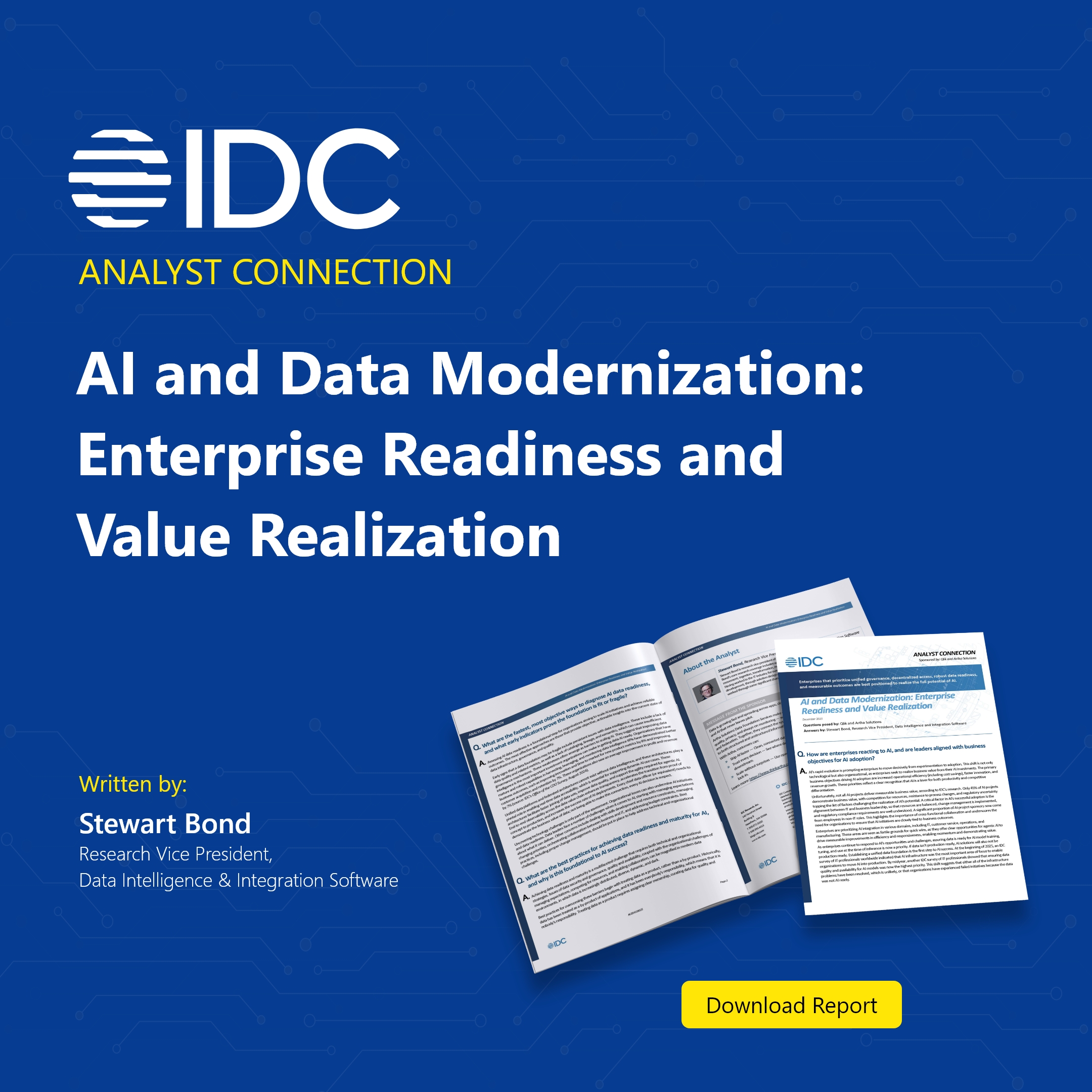
AI and Data Modernization: Enterprise Readiness and Value Realization

ANALYST CONNECTION Sponsored by: Qlik and Artha Solutions AI and Data Modernization: Enterprise Readiness and Value Realization December 2025 Questions posed by: Qlik and Artha Solutions Answers by: Stewart Bond.

Explore whitepaper
Whitepaper

Future-Ready Data Foundation: From AI Pilot to Production Value

Success with AI starts with data. Improving data quality and accessibility for AI is today’s top organizational priority; nine months ago, it was improving AI infrastructure. However, laying a solid data foundation for.

Explore whitepaper
Article

It’s Much Easier to Migrate from Informatica to Qlik Than You Think

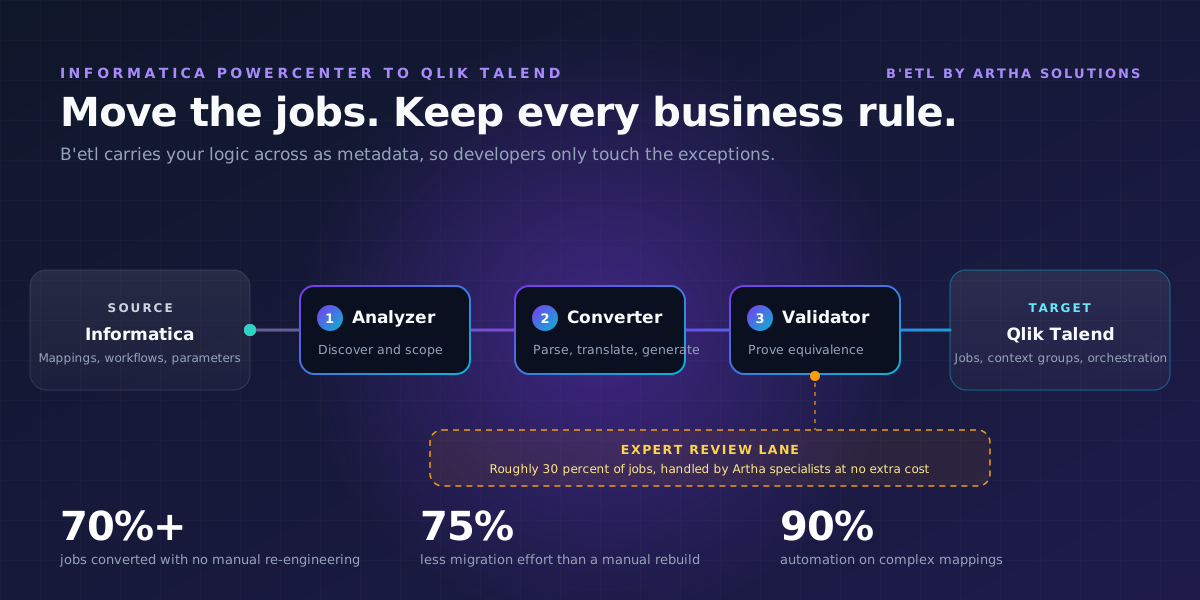
In today’s data-driven world, staying future proof often means leaving behind legacy ETL platforms like Informatica PowerCenter, especially as they approach end-of-support. While such migrations are often perceived as...

Explore article

FREQUENTLY ASKED QUESTIONS

Questions Buyers and Architects Ask

Concise answers based on current Qlik product information and Artha’s consulting approach.

What is Talend Data Catalog and is it still supported?

Talend Data Catalog is Qlik's metadata management product: automated harvesting, end-to-end lineage, a business glossary and semantic discovery across databases, files and Talend jobs. Version 8.1, released in April 2024, is the current supported release and receives monthly updates; 8.0 reached end of support on December 31, 2024. Artha implements 8.1 and upgrades estates still on 8.0.

Is Talend MDM end of life, and what should we do about it?

Yes. Talend MDM Server reached end of life on December 31, 2024, and receives no further fixes. Existing estates keep running, so the sensible sequence is stabilize, then plan the exit: move matching, survivorship and stewardship into Qlik Talend Cloud quality and data products where that fits, or into a dedicated MDM platform where requirements demand one. Artha operates the old estate while building the new home, so the golden records never stop being served.

Can we still get master data management without Talend MDM?

Yes. MDM is a discipline, not a licence: identity resolution, match and merge rules, survivorship and steward review can be built on Qlik Talend Cloud quality capabilities and governed data products. For most customer- and product-mastering use cases that pattern is sufficient, and it avoids introducing another platform. Where a full multi-domain MDM product is genuinely warranted, we say so and design the integration instead.

What does a data quality rule actually look like in practice?

A rule has five parts: the check itself, the threshold that defines pass, the action on breach (hold the batch, flag it, or release with warning), the named owner who agreed the threshold, and the evidence trail of every decision. A check without a threshold is an observation. A threshold without an owner is a suggestion. We implement all five parts or we do not call it a rule.

How is data quality enforced in Qlik Talend Cloud?

Quality functions run inside the pipelines: profiling, validation and standardization execute as data moves, so a failing batch can be held before it reaches consumers. Quality indicators travel with the dataset, which is what lets a downstream user see trust information instead of assuming it. Artha configures the rules, thresholds and hold behaviour to match what your business owners actually signed up to.

Who should own data quality: IT or the business?

Thresholds and meaning belong to the business, because only the business can say whether 2% duplicate customers is tolerable. Enforcement mechanics belong to the platform team. The failure mode is letting IT own both, which produces technically perfect rules calibrated to nobody's actual risk. Artha's stewardship model splits the two on paper, with names, so the question never becomes rhetorical.

How long does it take to stand up a governance capability?

A profiling baseline and the first enforced rules on one domain typically land within weeks, not quarters. The catalog, glossary and stewardship operating model build out over a few months alongside real usage. What takes longest is organizational: agreeing owners and thresholds. Starting with one domain that has an motivated owner beats a twelve-domain programme that spends its first year in workshops.

How does this connect to AI readiness?

Every AI initiative inherits the quality of the data underneath it, and generative systems are spectacular amplifiers of quietly wrong data. The same rules, lineage and stewardship this page describes are what make a dataset certifiable as a data product for AI consumption. That path is covered on the Data Foundations for AI page.

NEXT STEP

Find Out Where Your Data Quality Actually Stands

Start with a profiling baseline on one domain: real numbers, enforced rules and an owner who signed the thresholds.

ARCHITECTURE CONVERSATION

Talk to a Qlik Architect

Tell us about the platform, workload and business priority you are evaluating.