Skip to Qlik microsite content

QLIK ANSWERS IMPLEMENTATION SERVICES

Turn Trusted Enterprise Knowledge into Answers People Can Use

Help employees find contextual, source-linked answers across approved policies, manuals, contracts, knowledge bases and enterprise data.

Artha combines knowledge architecture, governance, data engineering, AI evaluation and workflow design to implement Qlik Answers as a trusted business capability.

Review the Trust Architecture

AI OVERVIEW

Turn Trusted Enterprise Knowledge into Answers People Can Use

Artha Solutions implements Qlik Answers for natural-language access to trusted analytics and curated unstructured content. Services cover use-case selection, sources, metadata, access controls, knowledge bases, evaluation, adoption and operating governance.

Artha SolutionsQlikQlik Talend CloudTalendTalend Data FabricTalend Data CatalogApache IcebergQlik Open LakehouseQlik AnswersQlik PredictQlik AutomateDatabricksSnowflakeB’etl

The Enterprise Knowledge Problem

Scattered information

The answer to a routine question is split across a policy document in SharePoint, an exception noted in a team wiki and a threshold that only exists in a dashboard. Nobody holds all three, so the question gets asked of a colleague instead, and the colleague answers from memory.

Search returns documents

Keyword search ranks files, so a 90-page manual is a hit because the term appears once on page 74. The employee still has to open it, find the passage and judge whether it applies to their situation. That final step is the actual work, and search has never done it.

Unclear authority

A superseded policy and its replacement usually sit in the same repository, and no metadata distinguishes them. Retrieval treats both as equally relevant, so the assistant can quote a rule that was withdrawn last year with exactly the same confidence as the current one. This is a content-ownership problem before it is an AI problem.

Access complexity

Each repository has its own permission model, and the one that matters most is the identity used to index content. Index as a privileged service account and everything becomes reachable by anyone who can phrase the question; index per user and coverage collapses. Which way that is resolved determines whether the assistant is safe to deploy.

Weak traceability

A pilot that demos well is usually judged on whether the answers sounded right, because there was no question set with expected sources to score against. Without that baseline nobody can tell whether a content change improved the assistant or quietly broke it, and no owner is accountable when it is wrong.

What Does Qlik Answers Enable?

Qlik Answers is Qlik’s natural-language AI assistant for questions across trusted analytics and curated unstructured content. It provides contextual responses, explainability and citations for unstructured sources. Understanding roughly how it gets there is what makes the design decisions obvious:

  • Approved sources are connected and indexed into a knowledge base, which is why source selection is a governance decision and not a configuration step
  • A question retrieves the passages most relevant to it, so a narrow, current source set outperforms a large one almost every time
  • The response is generated from those retrieved passages and cited back to them, which is what lets a user check the answer rather than trust it
  • Coverage is bounded by what was indexed and by the permissions in force, so gaps show up as weak answers rather than as errors

Artha helps reduce unsupported responses through governed content, source transparency, evaluation and operating controls. No generative AI system should be presented as eliminating hallucinations, and any vendor who tells you otherwise is selling. The realistic goal is an assistant that is right on the questions it was scoped for, cites its sources, and declines the rest.

Artha Implementation Services

Discover and govern

We start from the questions people actually ask, gathered from support tickets, helpdesk queues and the inbox of whoever currently gets asked. That set defines the source scope, and it usually exposes content nobody owns. Each included source gets a named owner and a retirement rule, because unowned content is what produces confidently wrong answers later.

Design access

The indexing identity and the query-time permission model are designed together, since the first decides what exists in the knowledge base and the second decides who can reach it. Where structured Qlik apps are in scope, Section Access behaviour is verified against real user roles rather than assumed, because row-level restrictions have to survive being asked in natural language.

Configure the experience

Knowledge bases scoped per domain rather than one corpus for the whole enterprise, because a narrow source set is the single biggest lever on retrieval quality. Assistant behaviour is configured to cite and to decline: an assistant that says it cannot find an answer is more useful than one that assembles a plausible paragraph from adjacent material.

Evaluate and secure

A representative question set with the expected supporting source for each one, scored on whether the answer is grounded in that source and not merely fluent. The set deliberately includes questions that should be refused and questions a restricted user must not get answered. It is re-run after content changes, so regression is visible instead of anecdotal.

Adopt and improve

Feedback captured in the assistant and routed to the content owner, not to a shared mailbox, so a wrong answer becomes a documented content fix. Monitoring covers question volume, refusal rate and unanswered topics, which is what tells you where content is missing rather than where the model is weak.

High-Value Knowledge Assistant Use Cases

Policy and procedure assistant

HR, travel, expense and IT policy questions are high volume, low complexity and repetitive, which is why they consume so much of someone's week. The content is already written and already approved, so the assistant is answering from an authoritative set rather than interpreting. A good first use case for exactly that reason.

Customer-support knowledge

Agents lose handling time hunting for the current product behaviour across release notes, known-issue lists and internal guidance. Source-linked answers cut that search, and the escalation path stays intact so anything outside the approved content reaches a person instead of being improvised.

Healthcare operations

Administrative and operational procedures, scheduling rules and departmental protocols for authorised teams. Clinical decision support is deliberately out of scope: the value here is in the operational content that slows staff down, and keeping the boundary explicit is what makes the deployment approvable.

Financial policy and compliance

Control descriptions, approval limits and reporting obligations are documented precisely and change on a known cycle, which suits retrieval well. Citations matter more than convenience in this domain, since an answer someone acts on must be traceable to the policy version that authorised it.

Manufacturing maintenance

A technician at the line needs the right procedure from a 400-page manual, on a tablet, now. Manuals are structured and stable, so retrieval performs well, and the alternative is a phone call to someone who has the equipment history in their head and is due to retire.

Contract and procurement

Finding which agreements contain a particular clause type, notice period or liability cap across hundreds of documents is otherwise a manual read. Restricted to approved commercial content with access controls that match the deal teams, this replaces days of review with a starting shortlist to verify.

Trust Architecture for Enterprise Knowledge Assistants

01

Approved sources

Analytics apps · Policies · Manuals · Contracts · Knowledge repositories

02

Ingestion and context

Connections · Indexing · Metadata · Domain curation

03

Access and policy

Tenant roles · Space roles · Section Access · Content ownership

04

Answer experience

Retrieval · Reasoning · Contextual response · Source citations

05

Operations

Feedback · Evaluation · Monitoring · Content refresh · Escalation

Readiness Checklist

A viable first assistant has a defined user group, a focused question domain and an approved source set.

  • Named content owner
  • Documented access model
  • Measurable success criteria
  • Representative evaluation questions
  • Escalation and human-accountability process
  • Content refresh responsibilities

CUSTOMER EVIDENCE

Implementation Experience Grounded in Enterprise Outcomes

Selected from Artha’s existing published case-study system. Customer anonymization is preserved.

BFSI

Enterprise Data Governance and Master Data Management (MDM)

Challenge: Customer records across 12 legacy platforms created inconsistent profiles, compliance effort and manual reconciliation.

Artha solution: Artha implemented Talend Data Fabric, stewardship and governed master data in a Snowflake and AWS data foundation.

Talend Data Fabric, Snowflake, AWS S3, Apache Spark, Talend, AWS, S3

40%Published reduction in compliance reporting time
Read the case study

Utilities & Energy

Talend Data Integration Hub for Real-Time Validation

Challenge: More than 300 utility partners supplied data in varied formats, creating validation, onboarding and audit complexity.

Artha solution: Artha built a metadata-driven Talend Data Integration Hub with validation, stewardship and automated partner processing.

Talend

50%Published reduction in manual processing time
Read the case study
RELATED RESOURCES

Continue the Architecture Conversation

Whitepaper

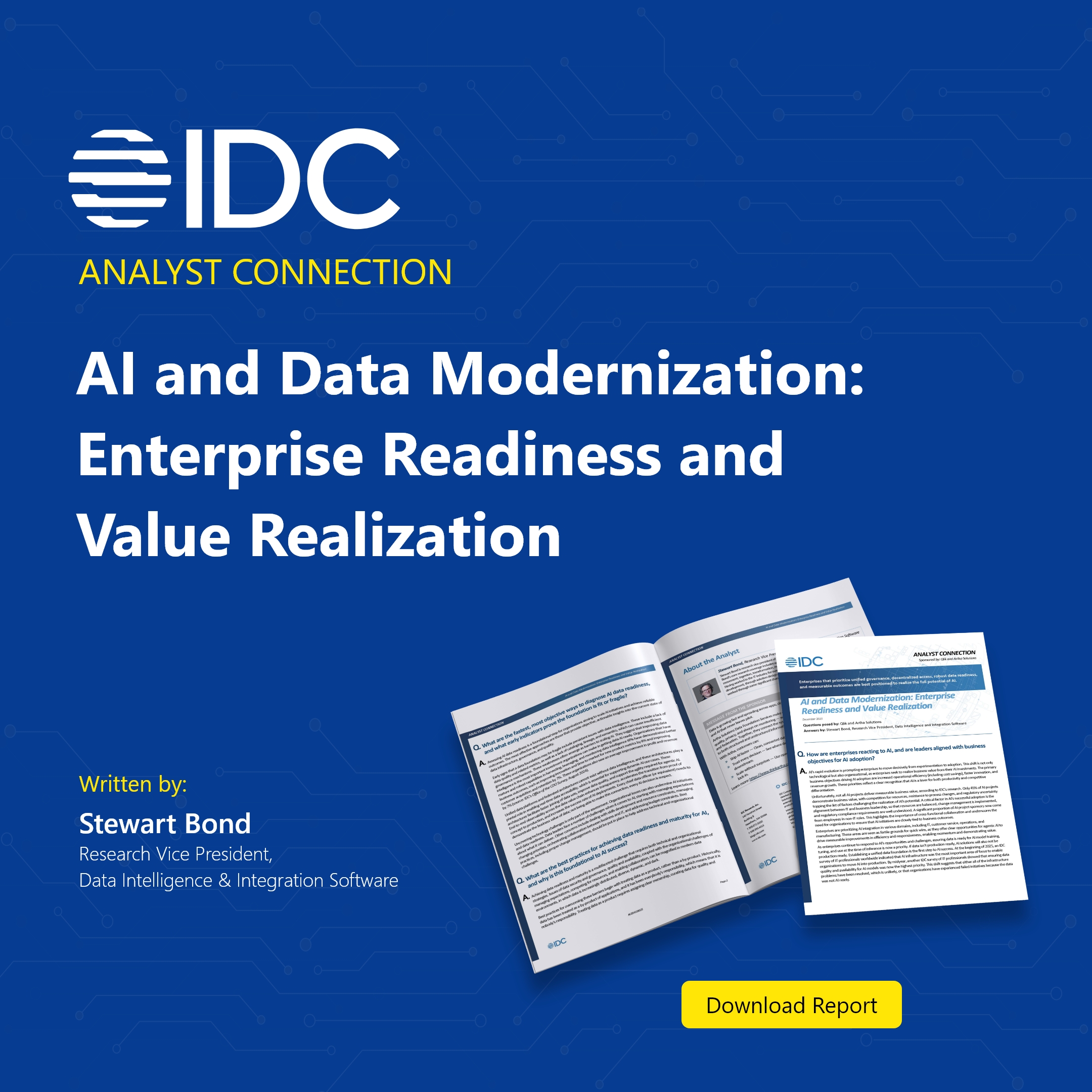
AI and Data Modernization: Enterprise Readiness and Value Realization

ANALYST CONNECTION Sponsored by: Qlik and Artha Solutions AI and Data Modernization: Enterprise Readiness and Value Realization December 2025 Questions posed by: Qlik and Artha Solutions Answers by: Stewart Bond.

Explore whitepaper
Whitepaper

Future-Ready Data Foundation: From AI Pilot to Production Value

Success with AI starts with data. Improving data quality and accessibility for AI is today’s top organizational priority; nine months ago, it was improving AI infrastructure. However, laying a solid data foundation for.

Explore whitepaper
Article

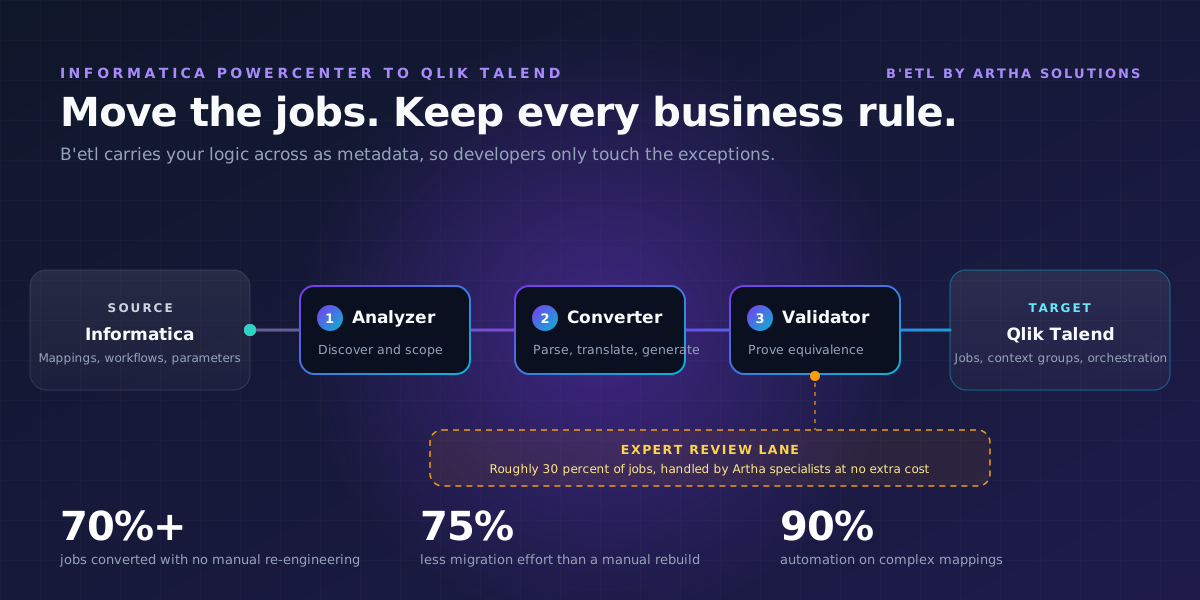
It’s Much Easier to Migrate from Informatica to Qlik Than You Think

In today’s data-driven world, staying future proof often means leaving behind legacy ETL platforms like Informatica PowerCenter, especially as they approach end-of-support. While such migrations are often perceived as...

Explore article

FREQUENTLY ASKED QUESTIONS

Questions Buyers and Architects Ask

Concise answers based on current Qlik product information and Artha’s consulting approach.

What is Qlik Answers?

Qlik Answers is a natural-language AI assistant in Qlik Cloud that can answer questions using trusted analytics and curated unstructured content. It provides contextual responses, explainability and citations for unstructured sources.

How is Qlik Answers different from enterprise search?

Enterprise search usually returns ranked documents or passages. Qlik Answers generates a contextual response from trusted analytics and curated sources, while exposing explainability and citations for unstructured content so users can inspect supporting material.

Does Qlik Answers work with unstructured content?

Yes. Qlik Answers knowledge bases can index supported document types from approved connections and uploaded content. Current Qlik documentation lists sources such as SharePoint, Google Drive, OneDrive, S3 and other file connections, subject to product limits and permissions.

Are answers linked to sources?

Qlik describes citations and source transparency for unstructured responses. Artha also recommends evaluation, content ownership and escalation controls so users can verify important answers rather than relying on generated text alone.

How should enterprises select a first use case?

Choose a focused domain with frequent questions, approved and reasonably current content, a defined user group, an accountable owner and measurable acceptance criteria. Avoid starting with an unrestricted enterprise-wide corpus.

Can Qlik Answers respect access controls?

Qlik Answers access depends on Qlik tenant permissions, space roles and, for structured applications, Section Access behavior. The indexing identity and source permissions must be designed carefully because they determine what content is indexed and what each user can query.

How does Artha evaluate answer quality?

Artha builds a representative question set, expected source set, acceptance criteria and review process. Evaluation covers relevance, groundedness, source quality, permission behavior, refusal and escalation cases, user feedback and content-change regression.

How long does a first implementation take?

A focused implementation normally begins with a defined knowledge domain, a controlled source set and measurable acceptance criteria. Timing depends on content quality, access complexity and integration requirements.

NEXT STEP

Design a Governed Enterprise Knowledge Assistant

Start with one business-owned domain, approved sources and measurable evaluation criteria.

ARCHITECTURE CONVERSATION

Talk to a Qlik Architect

Tell us about the platform, workload and business priority you are evaluating.