Skip to Qlik microsite content

THE POWER OF THREE

Two Vendors Make a Stack. Three Parties Make It Work.

The Power of Three is how Artha delivers: Qlik moving, governing and analyzing the data, a platform such as Databricks, Snowflake, AWS or Azure storing and computing it, and Artha as the one party accountable for the combination working in your estate.

Vendors are excellent at their products. Nobody's product includes your source systems, your compliance posture or your operating model. That is the third seat, and it is the one we sit in.

See How the Trio Fits Together

AI OVERVIEW

Two Vendors Make a Stack. Three Parties Make It Work.

The Power of Three is Artha Solutions' delivery model combining Qlik data integration, quality and analytics with a cloud data platform, Databricks, Snowflake, AWS or Azure, under one accountable implementation partner responsible for architecture, delivery and operations.

Artha SolutionsQlikQlik Talend CloudTalendTalend Data FabricTalend Data CatalogApache IcebergQlik Open LakehouseQlik AnswersQlik PredictQlik AutomateDatabricksSnowflakeB’etl

Why Three Parties, Deliberately

Every serious data estate already involves at least three parties: a data platform, the integration and analytics tooling on top of it, and whoever is supposed to make them behave together. The Power of Three simply makes that third seat explicit, with a name in it, instead of leaving it split across two vendors' professional-services teams and your own staff.

  • Each vendor optimizes for its own product; the gaps show up precisely at the joins, which is where programmes actually fail
  • Qlik brings movement, quality, governance and analytics; the platform brings storage, compute and scale; Artha brings the architecture and delivery that fit both into your estate
  • One accountable party means an incident has an owner before it has a root cause, instead of a triangle where each side points at the other two
  • Escalation runs into both vendors through partner channels, with the evidence already assembled, because we hold credentials on both sides of the join
  • The combination is proven: our published Talend, Snowflake and AWS governance work, and our Databricks machine-learning delivery, were all three-party engagements

It is not a procurement framework or a reseller bundle. It is a delivery stance: when the stack involves three logos, someone has to own the whole, and it should be the party whose only product is the outcome.

The Four Trios

Same model, four platforms. Each card links to the platform practice behind it.

Artha + Qlik + Databricks

Qlik streams change data into the Databricks Data Intelligence Platform, including Unity Catalog managed Iceberg tables, while governed data products keep quality checks on what lands in Delta. Qlik was named Databricks 2024 Partner of the Year for Data Integration, and Artha's Databricks practice covers lakehouse setup, medallion pipelines and ML delivery, including our published patient identity-resolution work.

Explore the Databricks practice

Artha + Qlik + Snowflake

Replication and CDC land operational data in Snowflake continuously, transformations push down to Snowflake compute instead of moving data twice, and quality rules run before consumers see a row. Our published governance and MDM work on Talend, Snowflake and AWS, and the drug-pricing and employee-integration platforms on the Snowflake page, all follow this pattern.

Explore the Snowflake practice

Artha + Qlik + AWS

Qlik Open Lakehouse runs in your own AWS account on Amazon S3 and AWS Glue, which makes AWS the natural third seat for open-format estates. Artha's AWS work spans the lakehouse foundation, Talend workloads moved from on-premises infrastructure to AWS without business interruption, and the networking, IAM and cost design underneath.

Explore the AWS practice

Artha + Qlik + Azure

For Azure-standard organizations, Qlik integration and quality feed Azure data services, with entitlements and controls mapped to the tenant you already govern. Artha's Azure delivery includes unified analytics platforms built on Azure with Talend and compliance-grade integrity controls on Synapse, so the trio lands inside your existing cloud governance rather than beside it.

Explore the Azure practice

One Architecture, Three Responsibilities

01

Sources

Core systems · SAP and ERP · SaaS applications · Events and files

02

Qlik Talend Cloud

Movement and CDC · Quality and governance · Data products · Analytics and AI

03

Platform layer

Databricks · Snowflake · AWS · Azure

04

Consumption

Analytics and reporting · AI and ML models · Applications · Regulatory delivery

Horizontal controlsArtha: architectureDelivery accountabilityEscalation to both vendorsOperations and support

What the Third Seat Changes

One accountable party

Scope, integration risk and incident ownership sit with Artha in writing. When something breaks at two in the morning, the question is how fast we restore it, never whose ticket it is. Vendors join the bridge when the fault is theirs, with the evidence already prepared.

Two product roadmaps, one design

Qlik and the platform vendors ship fast, and features overlap at the edges: transformation can live in Qlik or the platform, catalogs exist on both sides. We keep one deliberate answer to where each concern lives, revisited as roadmaps move, so the estate stays a design rather than an accumulation.

Escalation into both vendors

Artha holds Qlik Elite Channel Partner status and delivery credentials across the platform ecosystems, so vendor tickets are opened with reproductions and evidence rather than symptoms. The practical effect is that product faults get fixed on product timelines while your workload runs on a workaround we own.

No single-vendor blind spots

Advice comes from the party not paid on either licence line. When the right answer is pushdown into the platform rather than more Qlik, or Qlik quality rather than a platform add-on, we say so, because our contract is on the outcome and our credibility is spent wherever we bend that.

How a Power of Three Engagement Runs

  1. 01

    Frame the outcome

    One business outcome, named, with its decision cadence and the evidence that will prove it. Platform choices are downstream of this, which keeps the engagement from becoming a tooling debate with a budget.

  2. 02

    Architect across the three

    Decide where each concern lives: what Qlik owns, what the platform owns, what stays in source systems, and the rule for future cases. Residency, latency, cost and existing skills are weighed openly, with the trade-offs written down.

  3. 03

    Land the first workload

    One pipeline, one governed dataset, one consuming decision, in production. Real change volumes, real month-end, real access controls. Slideware architectures die here or earn the right to scale.

  4. 04

    Prove

    Reconciliation against source, quality thresholds observed over a full cycle, cost measured against forecast, and the escalation path exercised at least once for real. Confidence is built from evidence, not enthusiasm.

  5. 05

    Scale by pattern

    The second workload reuses the ingestion, quality and publication patterns of the first, which is where the three-party model starts compounding: each addition is faster because the joins are already solved.

CUSTOMER EVIDENCE

Implementation Experience Grounded in Enterprise Outcomes

Selected from Artha’s existing published case-study system. Customer anonymization is preserved.

BFSI

Enterprise Data Governance and Master Data Management (MDM)

Challenge: Customer records across 12 legacy platforms created inconsistent profiles, compliance effort and manual reconciliation.

Artha solution: Artha implemented Talend Data Fabric, stewardship and governed master data in a Snowflake and AWS data foundation.

Talend Data Fabric, Snowflake, AWS S3, Apache Spark, Talend, AWS, S3

40%Published reduction in compliance reporting time
Read the case study

Healthcare & Life Sciences

Machine Learning Deduplication for Patient Identity Resolution

Challenge: Duplicate diabetes patient records across clinical, lab, prescription and claims data prevented reliable longitudinal views and distorted care analytics.

Artha solution: Artha framed matching as a supervised classification problem on Databricks, with similarity features and steward review before any merge.

Python, Databricks, Scikit-Learn

$700K+Published saving from reduced redundant labs, admin time and claim rejections
Read the case study

Manufacturing

SAP S/4HANA ERP Cloud Migration with AWS and Talend

Challenge: A manufacturing and construction enterprise needed to integrate SAP S/4HANA with decades of ERP history and a wider operational application landscape.

Artha solution: Artha used Talend, AWS and Snowflake to create a scalable integration and historical-data foundation for the modernization program.

Talend, AWS, Snowflake, Salesforce, SAP, MuleSoft

99%Published ERP integration accuracy
Read the case study
RELATED RESOURCES

Continue the Architecture Conversation

Whitepaper

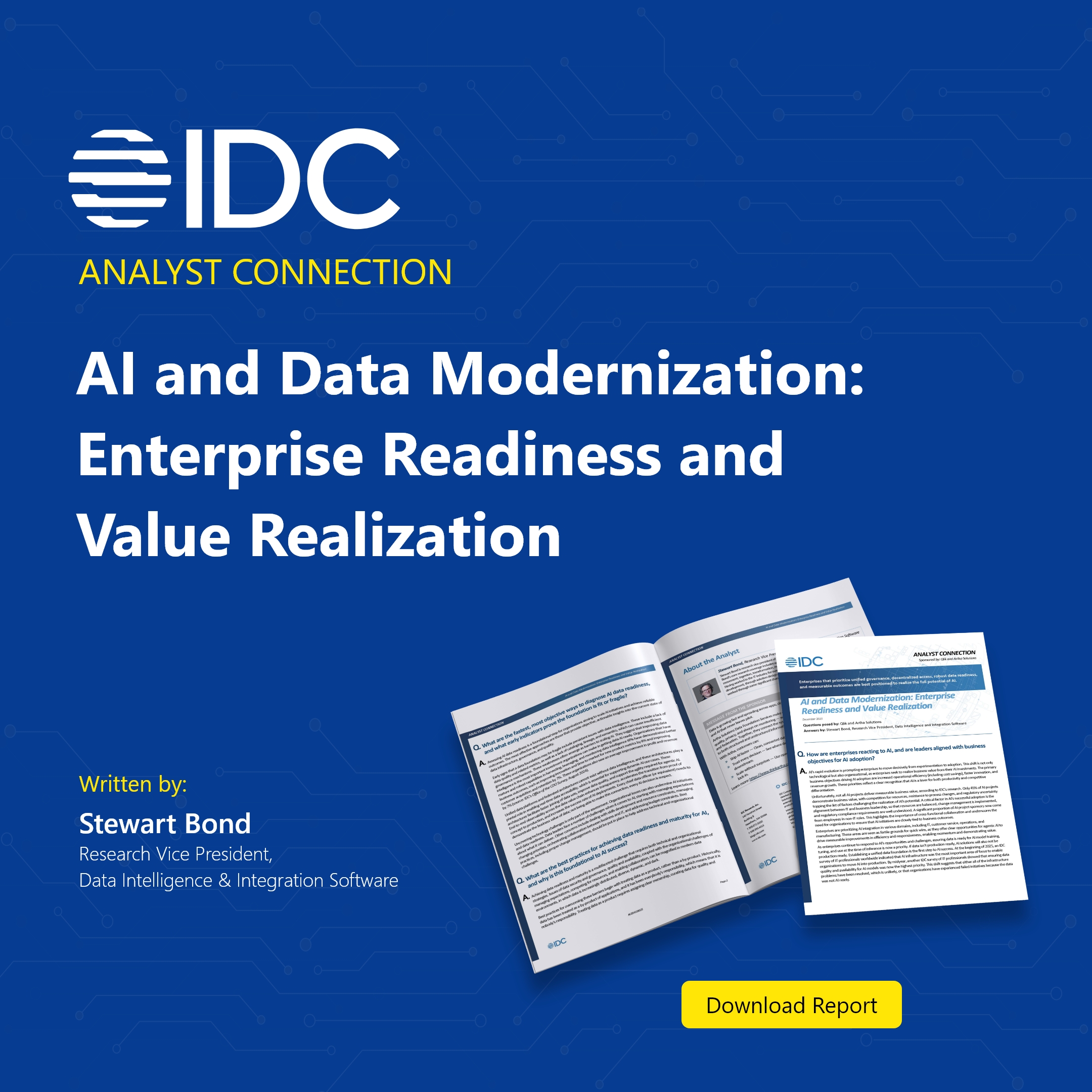
AI and Data Modernization: Enterprise Readiness and Value Realization

ANALYST CONNECTION Sponsored by: Qlik and Artha Solutions AI and Data Modernization: Enterprise Readiness and Value Realization December 2025 Questions posed by: Qlik and Artha Solutions Answers by: Stewart Bond.

Explore whitepaper
Whitepaper

Future-Ready Data Foundation: From AI Pilot to Production Value

Success with AI starts with data. Improving data quality and accessibility for AI is today’s top organizational priority; nine months ago, it was improving AI infrastructure. However, laying a solid data foundation for.

Explore whitepaper
Article

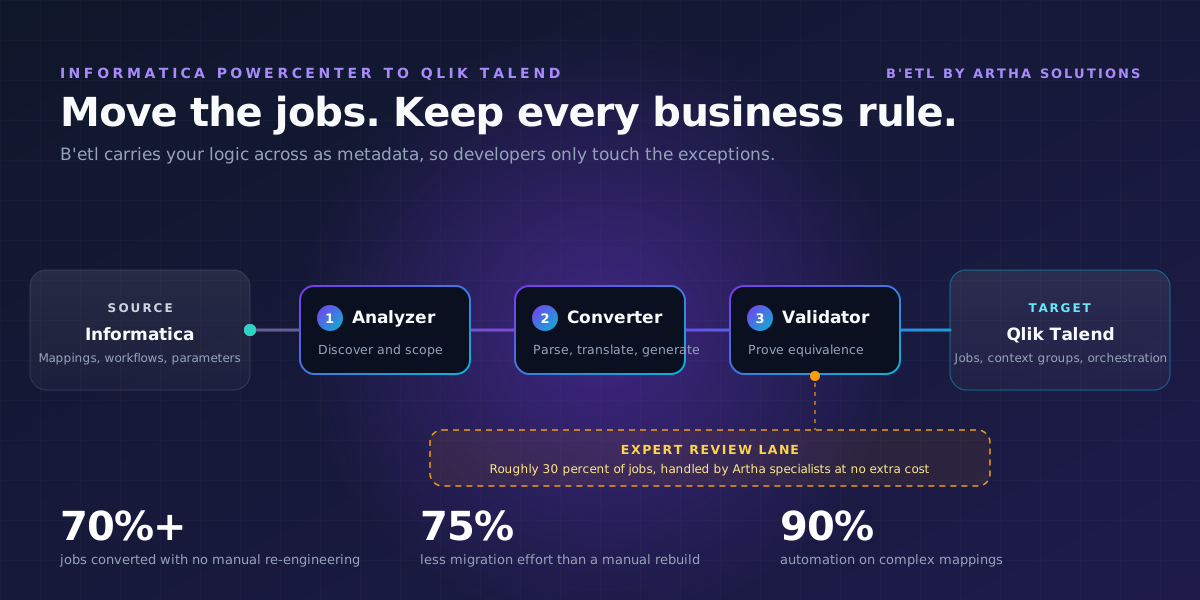
It’s Much Easier to Migrate from Informatica to Qlik Than You Think

In today’s data-driven world, staying future proof often means leaving behind legacy ETL platforms like Informatica PowerCenter, especially as they approach end-of-support. While such migrations are often perceived as...

Explore article

FREQUENTLY ASKED QUESTIONS

Questions Buyers and Architects Ask

Concise answers based on current Qlik product information and Artha’s consulting approach.

What exactly is the Power of Three?

A delivery model with three named seats: Qlik provides data movement, quality, governance and analytics; a cloud data platform such as Databricks, Snowflake, AWS or Azure provides storage, compute and scale; and Artha is the implementation partner accountable for the combination working in your environment. The point is that the third seat is explicit and contractual, not assumed.

Why not just use the vendors' own professional services?

Vendor services teams are good at their own product and stop at its edge, which is rational: their mandate ends where the logo does. Programmes fail at the joins between products and inside your estate's specifics, source systems, compliance posture and operating model. An implementation partner whose only product is the outcome owns exactly those joins. We also bring both vendors in where their depth is needed, rather than instead of it.

Which platform should we choose for the third seat?

The workload decides, not the brochure: existing cloud standards, data gravity, latency, residency, the skills you already pay for and the economics of the query patterns you actually run. Artha is not paid on either licence line, so the recommendation is free to follow the evidence, and hybrid answers, such as Snowflake for governed serving with Databricks for ML, are legitimate outcomes rather than failures to decide.

We already run Databricks or Snowflake. Does this still apply?

That is the most common starting point. The trio forms around your incumbent platform: Qlik supplies the movement, quality and governed data products the platform does not, and Artha integrates the two with your sources and controls. Nothing about the model requires a platform change, and the first engagement usually improves what the existing platform receives rather than replacing anything.

Who is accountable when something goes wrong?

Artha, in writing, for the delivered solution: incidents come to us first, we run diagnosis across the whole chain, and we drive vendor escalations with evidence when the fault is in a product. What the model removes is the triangle where each party's first move is establishing that the problem belongs to someone else. You keep one throat to choke, chosen deliberately.

How do escalations into Qlik and the platform vendors actually work?

Through the partner channels attached to our credentials: Qlik Elite Channel Partner status on one side, and platform partnerships including our Databricks and Snowflake practices on the other. Tickets go in with reproductions, environment detail and business impact already assembled, which is the difference between a fault fixed on a product timeline and one that ages in a queue.

Is the Power of Three a reseller or licensing arrangement?

No. It is a delivery stance, not a bundle: you contract licences with the vendors on whatever commercial terms suit you, and Artha's engagement is the architecture, implementation and operation of the combined estate. Where our channel status helps commercially we use it transparently, but the model's value is accountability at the joins, not margin on the paper.

Where do AWS and Azure fit if Databricks or Snowflake is already the platform?

Underneath them, and the seams still need owning: Databricks and Snowflake run on the hyperscalers, Qlik Open Lakehouse runs in your own AWS account, and networking, identity, keys and egress costs live at that layer regardless of which logo is on the warehouse. In practice the trio is sometimes four parties, and the accountability model is exactly why that does not become four directions.

NEXT STEP

Put One Name on the Whole Stack

Bring the outcome and the platform you run today. We will bring the architecture across all three seats and the accountability for the joins.

ARCHITECTURE CONVERSATION

Talk to a Qlik Architect

Tell us about the platform, workload and business priority you are evaluating.