
Last September we made the case that leaving Informatica PowerCenter for Qlik Talend is far less daunting than most data leaders assume. Since then the deadline has stopped being hypothetical. Standard support for PowerCenter 10.5 ended on March 31, 2026. Every month on extended support is a month of paying more for a platform you have already decided to leave.
The question we hear most now is not whether to migrate. It is how. How do you move thousands of mappings and workflows without an army of developers retyping logic by hand? And how do you avoid finding out six months later that a lookup condition or a rounding rule quietly changed on the way across?
B'etl solves both problems. So mappings convert with nobody retyping business logic.
This post answers that question with a closer look at B'etl, the ETL Migrator built by Artha Solutions. It follows our earlier posts on why enterprises are moving from Informatica to Talend and ETL migration in 1-2-3.
Why manual migration fails on the two things that matter
A hand migration from Informatica to Talend is a translation exercise. Translation at scale breaks down in two predictable places.
Effort
A typical PowerCenter environment carries hundreds or thousands of mappings. Each one has its own sessions, parameter files, reusable transformations and scheduling dependencies. Rebuilding them one by one in Talend Studio eats developer time that is expensive and scarce. Often those developers have never worked on the legacy system they are replacing.
Accuracy
Business logic in legacy ETL is rarely documented. It lives inside expression transformations, override SQL, lookup conditions and router groups written years ago by people who have since moved on. When a developer rebuilds that logic from a screenshot or a design document, something drifts. The errors are silent. They show up as reconciliation failures at the first run close, not as compile errors in development.
When business logic is retyped by hand, drift is not a risk. It is a certainty.
Why hand migrated jobs fail at the first run close
B'etl was built to attack both problems at the same time.
How B'etl keeps people out of the repetitive work
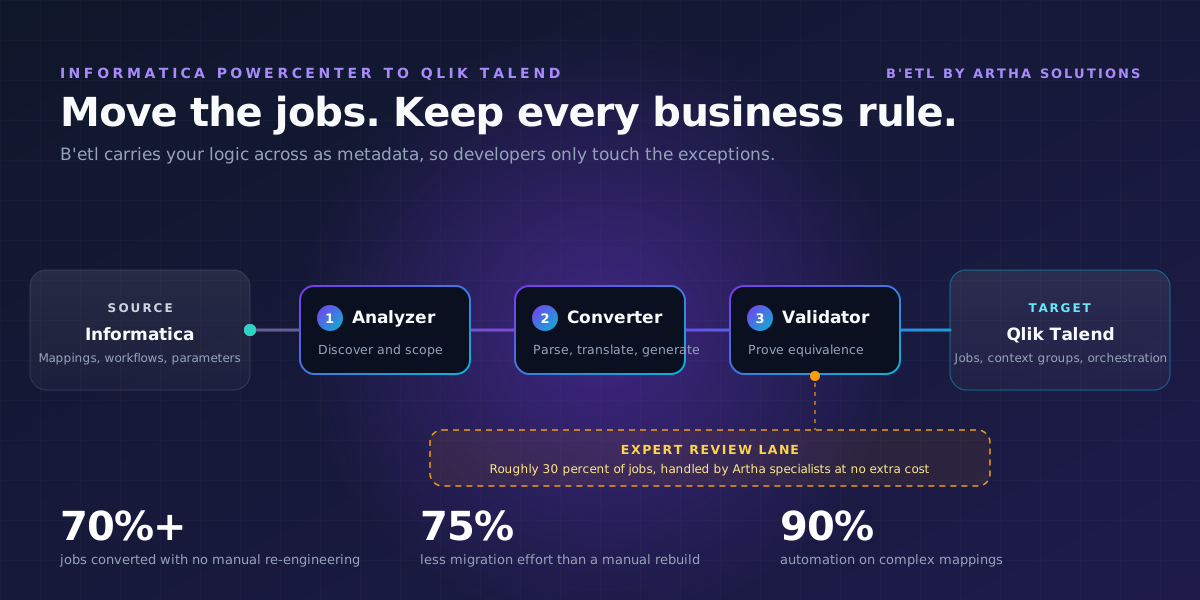
B'etl works through your Informatica jobs in three stages. The order is what keeps manual work to a minimum.
Discover and scope
Analyzer
Reads the repository export and, within seconds, inventories every mapping, workflow, transformation and connection. It classifies each object by complexity and flags redundant and orphaned jobs, so nobody spends effort migrating what should simply be retired.
An Excel ready summary that answers the scoping questions before anyone opens a development tool.
Parse, translate, generate
Converter
This is where the 70 percent figure comes from. A parser and translator framework tuned to the Informatica metadata model converts thousands of jobs in a two step, configure and click operation. The output follows the Talend design standards rather than a line by line copy of PowerCenter.
More than 70 percent of jobs convert with no manual re-engineering. On complex mappings the rate reaches 90 percent.
Prove equivalence
Validator
Converted jobs are visually validated, run against source to target reconciliation checks, and documented with impact analysis. Compliance and audit teams can see exactly what moved and how.
The custom jobs that genuinely need a person go to Artha specialists at no additional cost.
Analyzer scopes, Converter translates, Validator proves. A person is only needed for the jobs the Validator sets aside.
The net effect, as published on our B'etl migration page, is up to 75 percent less migration effort than a manual approach and roughly 70 percent of resource time saved. Across the projects behind our earlier post, migration cost came down by 40 to 60 percent.
The architecture behind the automation
The diagram below shows why the process needs so little human effort. Read it from top to bottom. Your Informatica objects enter as metadata, B'etl converts and validates them automatically, and only the custom minority passes through the expert review lane.
Source: Informatica PowerCenter
Mappings and mappletsExpressions, lookups, routers, aggregators
Workflows and sessionsDependencies, schedules, overrides
Parameter files and variablesEnvironment specific values
Connections and schemasSources, targets, reference data
B'etl reads a repository export only. Nothing in production is touched.
B'etl ETL Migrator: parser and translator framework, configure and click
1Analyzer
Discover and scope
Inventories every mapping, workflow and component
Classifies by complexity
Flags redundant and orphaned jobs
Excel scoping and budgeting summary
Seconds, not weeks
2Converter
Parse, translate, generate
Reads PowerCenter metadata
Maps each transformation to its Talend equivalent
Preserves logic, configuration, schemas and parameters
Enforces Talend design standards
70 percent plus of jobs, zero re-engineering
3Validator
Prove equivalence
Visual job validation
Source to target reconciliation
Impact analysis and audit reporting
Routes exceptions to expert review
Compliance ready evidence
Expert review lane: roughly 30 percent of jobs, the custom and the untranslatables
Artha specialists handle unusual designs at no extra cost. Training equips your own team for tuning after go live. Developers never touch the 70 percent plus that converts automatically.
Manual effort is the exception, not the method.
Target: Qlik Talend Data Integration
Talend jobsInput, mapping, aggregation and output components
OrchestrationParent and child jobs, managed schedules
Context groups and variablesDevelopment, test and production promotion
Metadata and connectionsShared schemas, repository connections
Deploy anywhere: on premises, hybrid, AWS, Azure, Google Cloud or Snowflake.
What the architecture delivers
100%Mappings and workflows carried across
70%+Of those converted with no manual re-engineering
75%Up to this much less effort than a manual rebuild
90%Automation on complex mappings
40-60%Lower migration cost than a manual program
Figure 1. B'etl reference architecture. Source objects are read as metadata, converted and validated automatically, and roughly 30 percent of jobs, the custom and the untranslatables, enter the expert review lane.
B'etl works from a read only export of the PowerCenter repository, so nothing in production is touched. Every object in that export is metadata: mappings, mapplets, workflows, sessions, parameter files and connections. B'etl treats it as metadata. The parser reads it. The translator maps each construct to its Talend equivalent. The generator writes Talend jobs, context groups and orchestration that follow the Talend design standards.
The only place a person enters the flow is the expert review lane. The Validator routes the minority of jobs that use unusual or undocumented patterns there. Those go to the Artha specialists, not back to your project team.
Where the business logic actually goes: a worked example
Take a representative PowerCenter mapping that loads a customer master table. It reads from an Oracle source through a Source Qualifier with override SQL. It enriches records through a connected Lookup against a reference table. It derives a customer tier in an Expression transformation, splits records by region with a Router, and counts orders in an Aggregator. It writes to two targets. The session is parameterized through a parameter file and runs inside a workflow with a dependent downstream session.
B'etl maps each construct to its Talend equivalent and preserves the rule, not just the shape:
| Informatica construct | Talend result after conversion | What is preserved |
|---|---|---|
| Source Qualifier with override SQL | A database input component with the query carried across and the schema regenerated | Filter and join conditions, column order, data types |
| Connected Lookup | A lookup flow into the mapping component, with the lookup condition and match behavior set | Multiple match handling, default values when nothing matches |
| Expression transformation | Output expressions in the mapping component, translated to Talend expression syntax | Derivation rules, null handling, precision and rounding |
| Router with region groups | Multiple named outputs with filter conditions | Group conditions, evaluation order, default group |
| Aggregator | An aggregation component with group by keys and aggregate functions | Grouping keys, aggregate types, sorted input behavior |
| Two targets with update strategy | Two database output components with matching insert and update actions | Key columns, load order, commit behavior |
| Parameter file and mapping variables | Talend context groups and variables | Environment values, promotion across development, test and production |
| Workflow with session dependency | A parent job that orchestrates child jobs | Execution order, success and failure branching |
The point of the table is not the component names. Every place business logic was hiding, whether a lookup default, a rounding expression or the evaluation order in a router, is carried across as metadata. It is not re-interpreted by a developer. The result is a job that reconciles against its predecessor on day one. It is also built the way Talend is meant to be built, which is what keeps it maintainable after go live.
Every place business logic was hiding is carried across as metadata, not re-interpreted by a developer.
The principle behind metadata driven conversion
Case study: consolidating fragmented data pipelines for a global quick service restaurant brand
A global quick service restaurant brand was managing data from 85,000 sources: point of sale systems, online ordering and third party agencies. There was no standard ingestion framework. Integration had grown up across multiple tools and custom development, producing inconsistent data, slow processing and no unified view of customers or stores. With 17 terabytes in play and online order leads expiring within seconds, the pipelines had to move onto a single real time platform without interrupting operations across 26 supply chain centers.
Artha moved the integration landscape onto Talend Data Fabric as the core processing and integration layer and established a unified Enterprise Information Management framework. The legacy pipelines were consolidated onto Talend with the cleansing, enrichment and identity resolution logic carried across. The new platform was integrated with Hadoop for scale and MicroStrategy for analytics.
That engagement was a platform consolidation rather than a job by job Informatica conversion. The discipline was the same, though. Move the logic, standardize the design, validate before go live. That is exactly what B'etl now automates for Informatica environments.
What this means for your migration plan
If your PowerCenter exit plan still assumes a long bench of developers rebuilding jobs by hand, the assumptions behind that plan are out of date. With B'etl the shape of the program changes.
- A short discovery phase driven by Analyzer output, not by interviews and spreadsheets.
- A conversion phase measured in days rather than months.
- A validation phase where the expertise on your team goes to the handful of jobs that need it, not the thousands that do not.
Your business logic is the accumulated knowledge in your organization about how its data should behave. Migration should move it, not rewrite it.
The test any migration approach should pass
Questions we hear most about Informatica to Talend migration
How much of an Informatica PowerCenter migration can B'etl automate?
More than 70 percent of jobs convert with no manual re-engineering, and on complex mappings the automation rate reaches 90 percent. The remaining custom jobs are handled by Artha specialists at no additional cost.
Does B'etl touch our production Informatica environment?
No. B'etl works from a read only export of the PowerCenter repository. Nothing in production is changed during analysis or conversion.
How is business logic preserved during conversion?
Every construct in the repository export is treated as metadata. The parser reads it, the translator maps each construct to its Talend equivalent, and the generator writes Talend jobs that carry the original expressions, lookup conditions, router groups and parameters across without a developer re-interpreting them.
Are the converted Talend jobs maintainable?
Yes. B'etl generates jobs that follow the Talend design standards, including context groups for environment values and parent and child orchestration, rather than a line by line copy of the PowerCenter design.
What happens to the jobs that cannot be converted automatically?
The Validator routes them to the expert review lane. Artha specialists handle those custom and unusual designs at no extra cost, and training is available so your own team can tune jobs after go live.
How can we see the conversion rate before committing?
Request a demo and we will run Analyzer against a sample of your Informatica repository. You see the inventory, the complexity classification and the expected conversion rate before you commit to anything.
The bottom line
The PowerCenter clock has already run out on standard support. The migration itself does not have to be the long, risky rebuild it used to be. Let the metadata carry your business logic across, keep your developers on the exceptions, and prove equivalence before go live.
See your own Informatica jobs through B'etl
Request a demo and we will run Analyzer against a sample of your PowerCenter repository. You get the inventory, the complexity classification and the expected conversion rate before you commit to anything.
References
Artha Solutions, B'etl ETL Migrator: Technology and Data Migration
Artha Solutions, It's Much Easier to Migrate from Informatica to Qlik Than You Think, September 2025
Artha Solutions, Why Enterprises Are Moving from Informatica to Talend, July 2025
Artha Solutions, ETL Migration in 1-2-3: From Legacy Gridlock to Automated Acceleration, June 2025
Artha Solutions case study, Enterprise Information Management Framework with Talend Data Fabric