Cross-System Patient Data Sharing: Breaking Down the Real Data Barriers

Patient data is the lifeblood of modern healthcare. Yet, despite advances in standards and digital infrastructure, the reality is that cross-system patient data sharing remains fragmented. APIs and frameworks like HL7® FHIR® or TEFCA make exchange technically possible, but the real obstacles lie in the data itself: identity mismatches, inconsistent semantics, poor data quality, incomplete consent enforcement, and challenges with scalability. 

This article takes a technical view of those data barriers, explains why they persist, and outlines how to build a data-first interoperability strategy. We’ll close with the impact such strategies have on business functions, regulatory compliance, and ultimately, the bottom line—through better care delivery. 


Patient Identity: The Core Data Challenge 

The biggest source of errors in patient data sharing is identity resolution. Records often reference the wrong patient (overlays), fragments of the same person (duplicates), or merge multiple individuals. Traditional deterministic matching based on exact identifiers fails in real-world conditions with typos, missing values, or life events like name changes. 

What Works 

  • Hybrid Identity Matching: A combination of deterministic, probabilistic, and referential methods, supported by explainable match scores. 
  • Enterprise Master Patient Index (MPI): Acts as a broker across systems, ensuring identifiers can be linked consistently. 
  • Standards-based Interfaces: Use of IHE PIX/PDQ or FHIR-based identity services for cross-domain reconciliation. 

Identity must be treated as a governed, continuously measured discipline—tracking overlay rates, duplicate percentages, and resolution latency as key performance metrics. 


Semantic Interoperability: Aligning Meaning, Not Just Structure 

Even when data is exchanged via FHIR, two systems can disagree on the meaning of fields. A lab result coded differently, units recorded inconsistently, or a diagnosis listed in a free-text field rather than a controlled vocabulary—all of these create confusion. 

What Works 

  • Terminology Services: Centralized normalization to SNOMED CT for diagnoses, LOINC for labs, RxNorm for medications, and UCUM for measurement units. 
  • Value Set Governance: Enforcing curated sets of codes, not just allowing “any code.” 
  • Implementation Guides and Profiles: Binding required elements to national core profiles and publishing machine-readable conformance statements. 

Semantic alignment ensures that what is “shared” is actually usable. 


Data Quality and Provenance: Trust Before Transport 

Low-quality data—missing, stale, or unverifiable—creates a major barrier. Even when shared, if it can’t be trusted, it can’t be used for clinical decisions. 

What Works 

  • Provenance Metadata: Capturing who changed the data, when, and with what system or device. 
  • Data Observability: Automated monitoring of schema compliance, referential integrity, recency, and completeness. 
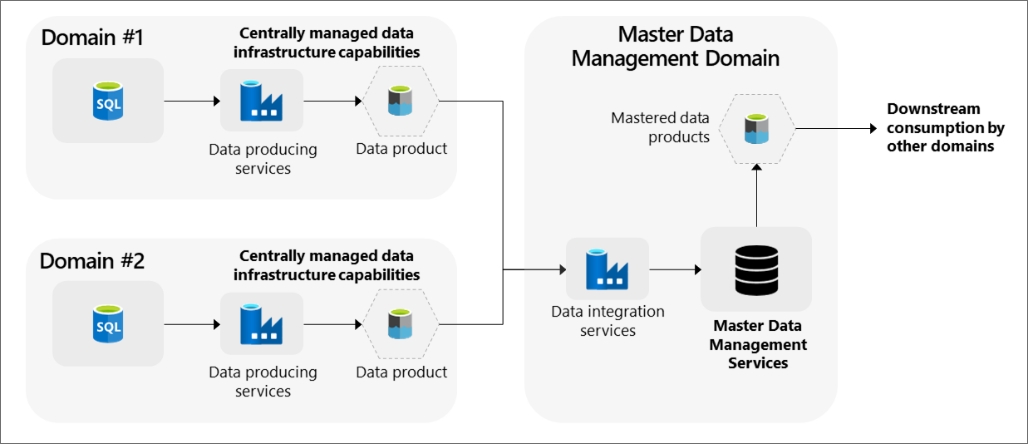
  • Golden Records: Mastering core entities such as patients, providers, and locations before analytics or exchange. 

Trustworthy data requires continuous observability and remediation pipelines. 


Consent, Privacy, and Data Segmentation: Making Policy Machine-Readable 

Healthcare data comes with legal and ethical restrictions. Sensitive attributes—mental health, HIV status, substance use disorder notes—cannot always be shared wholesale. Many systems fail because consent is modeled as a checkbox rather than enforceable policy. 

What Works 

  • Consent-as-Code: Implement patient consent in machine-readable formats and enforce it through OAuth2 scopes and access tokens. 
  • Data Segmentation (DS4P): Label sensitive fields and enforce selective sharing at the field, section, or document level. 
  • Cross-System Consent Enforcement: Use frameworks like UMA to externalize consent decisions across organizations. 

This ensures trust and compliance with regional laws like HIPAA, GDPR, and India’s DPDP Act. 


Scalability: From One Patient at a Time to Population Exchange 

Traditional FHIR APIs handle data requests one patient at a time—useful for clinical apps, but insufficient for research, registries, or migrations. 

What Works 

  • Bulk Data (Flat FHIR): Enables population-level exports in NDJSON format with asynchronous job control, retries, and deduplication. 
  • SMART on FHIR: Provides secure authorization for apps and backend systems using scopes and launch contexts. 
  • Performance Engineering: Orchestrating jobs, chunking datasets, validating checksums, and designing for high throughput. 

Population-scale exchange unlocks analytics, registries, and payer-provider coordination. 


Reference Interoperability Architecture 

Ingress & Normalization 

  • FHIR gateway validating incoming requests against national profiles. 
  • Automatic terminology normalization via a central terminology service. 

Identity & Consent 

  • Hybrid MPI with IHE PIX/PDQ interfaces. 
  • Consent enforcement via OAuth2, UMA delegation, and DS4P security labels. 

Data Quality & Provenance 

  • Provenance capture at every write. 
  • Continuous monitoring of schema conformance and freshness SLAs. 

Population Exchange 

  • Bulk FHIR services with job orchestration and secure data staging. 

Audit & Trust 

  • Immutable consent receipts, audit logs, and access telemetry. 


Implementation Playbook 

  1. Baseline Assessment: Map current systems, FHIR maturity, code sets, and identity errors. 
  2. Identity Hardening: Stand up an MPI, calibrate match strategies, and monitor overlay rates. 
  3. Semantic Governance: Centralize terminology, enforce value sets, and reject non-conformant codes. 
  4. Consent Enforcement: Model consent policies and enforce masking and selective sharing. 
  5. Quality Monitoring: Validate completeness, freshness, and schema adherence continuously. 
  6. Scale Enablement: Implement Bulk FHIR for population exchange, ensuring resilience and retries. 
  7. Compliance Alignment: Map implementation to national frameworks (TEFCA, ABDM, GDPR, DPDP). 


Pitfalls to Avoid 

  • Believing FHIR alone solves interoperability—semantic and consent governance are still required. 
  • Treating identity as an afterthought—MPI must be foundational. 
  • Ignoring operational realities of population-scale data flows—job orchestration and validation are essential. 
  • Modeling consent as policy documents but not enforcing it technically—non-compliance and trust issues follow. 

Measuring Success 

  • Identity: Overlay/duplicate rates, match precision and recall. 
  • Semantics: Coverage of standardized value sets, error rates in mappings. 
  • Quality: SLA attainment for data freshness, schema violation counts. 
  • Consent: Percentage of redactions applied correctly, consent revocation enforcement times. 
  • Scale: Bulk Data throughput, failure/retry ratios, end-to-end latency for cohort exports. 

Closing Comments: Impact on Business and Care Outcomes 

Breaking down cross-system patient data barriers isn’t just a technical exercise—it’s a strategic imperative. 

  • Clinical Functions: Clinicians get a unified, trustworthy view of the patient across hospitals, labs, and payers, reducing misdiagnosis and duplicate testing. 
  • Operational Functions: Payers and providers streamline claims, referrals, and prior authorizations, cutting administrative costs. 
  • Regulatory & Compliance Functions: Automated consent enforcement and audit trails reduce compliance risks and penalties. 
  • Analytics & AI Functions: Clean, semantically aligned, and population-scalable data fuels predictive models, research, and quality reporting. 

The business impact is measurable. Reduced duplication lowers cost per patient. Stronger compliance avoids fines and reputational damage. Reliable data accelerates innovation and AI adoption. Most importantly, seamless patient data sharing improves care coordination, outcomes, and patient trust—directly strengthening both top-line growth and bottom-line efficiency. 

In short: investing in data-first interoperability creates a competitive advantage where it matters most—better care at lower cost, delivered with speed and trust. 
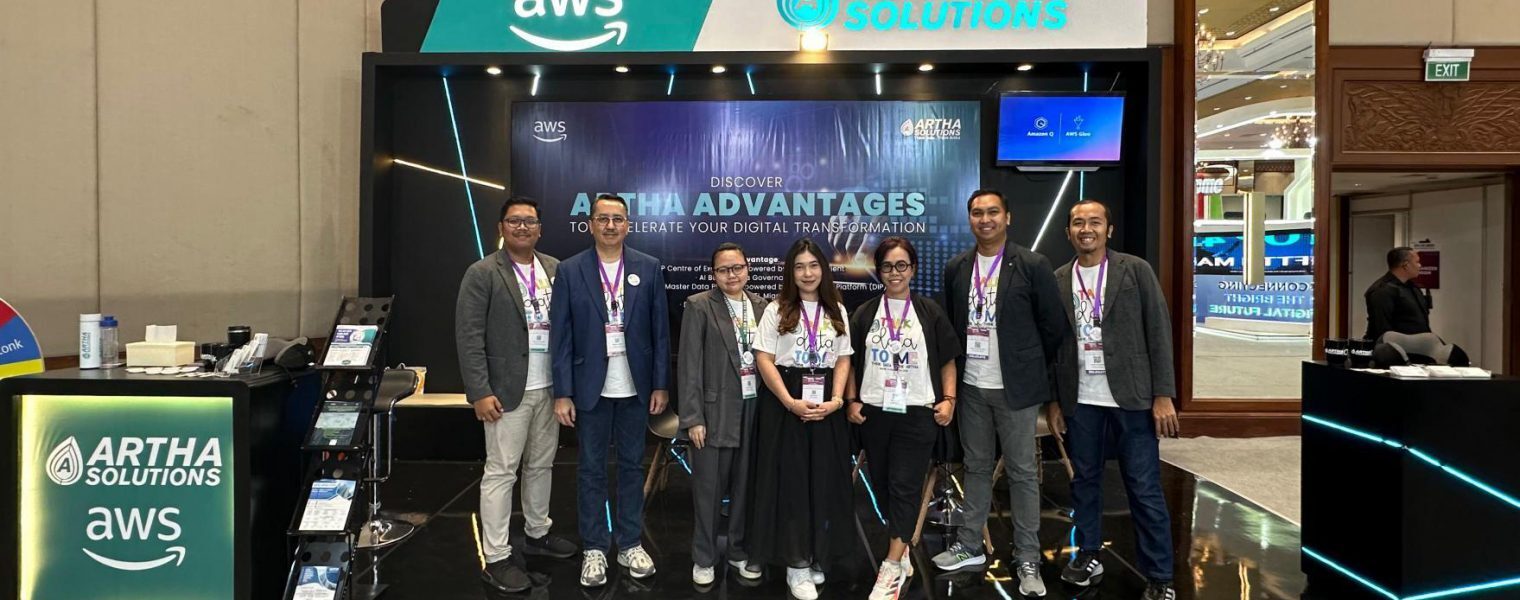
 

Artha Solutions Shines at DTI-CX 2024

Artha Solutions Indonesia was privileged to participate as a Silver Sponsor in the dynamic Digital Transformation Indonesia DTI-CX 2024, Jakarta. It was an incredible opportunity to connect with industry leaders, share our expertise in customer experience innovation, and explore new avenues for collaboration.

Our team was thrilled to showcase how Artha Solutions can be a catalyst for digital transformation, empowering businesses to deliver exceptional customer experiences, enhance efficiency, and drive innovation. We were delighted by the overwhelming interest and engaging conversations with visitors at our booth.

We had the pleasure of meeting representatives from diverse industries, including Huawei, Icon+, PT. Sinergi Informatika Semen Indonesia (Cement Industry), PT. Kaltim Prima Coal, and Kepala Pusat Data Badan Pengawas Obat dan Makanan (Governance), Pertamina (Oil Industry), BPJSTK (Governance Insurance), Bank Sumut, Taspen (FSI), PT. Rajawali Nusantara Indonesia (Governance), Jakarta Smart City (Governance), PT Sicepat Ekspres Indonesia (Logistic) among many others. These interactions provided invaluable insights into the challenges and opportunities facing businesses in Indonesia.

A key focus of our discussions was highlighting Artha Solutions’ advantages in accelerating digital transformation journeys. We emphasized our expertise in data management and analytics, which are crucial for organizations seeking to gain a competitive edge.

Dodi Y Soewandi, Country Head, Artha Solutions Indonesia, delved deeper into how Artha Solutions can support Indonesian businesses in optimizing their data management strategies. He emphasized the importance of effective data management in improving operational efficiency and achieving growth objectives. Additionally, he addressed the common hurdles businesses encounter when adopting advanced data analytics solutions and outlined how Artha Solutions can help overcome these challenges.

To illustrate the impact of our solutions, we shared a successful case study where a client leveraged our data analytics capabilities to gain a competitive advantage within their industry. This real-world example resonated with attendees and demonstrated the tangible benefits of partnering with Artha Solutions.

Our booth at the conference attracted many visitors who participated in thought-provoking discussions. Their engagement and support inspire us to continue developing innovative solutions that drive digital transformation and create exceptional customer experiences.

Artha Solutions looks forward to building stronger partnerships and contributing to the growth and success of the Indonesian business landscape.

Strategic Data Governance in the Age of AI: A Bengaluru Masterclass

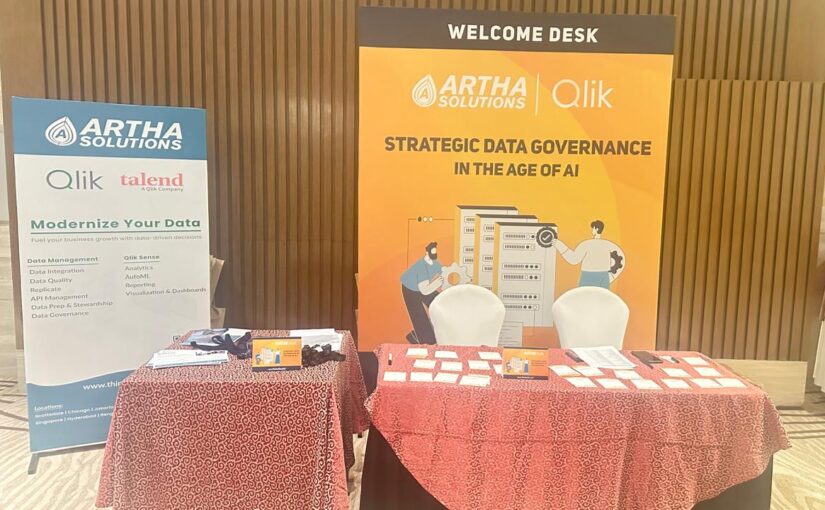
Last Thursday, July 25th, Bengaluru played host to a thought-provoking event, “Strategic Data Governance in the Age of AI,” jointly organized by Artha Solutions and Qlik. The evening brought together industry experts and data enthusiasts for a deep dive into the critical role of data governance in today’s AI-driven world.

The event was expertly hosted by Ramesh Tata, Lead – ISR at Artha Solutions, who warmly welcomed attendees and introduced the esteemed panel of speakers. Anush Kumar, Regional Business Development Manager, provided a comprehensive overview of Artha Solutions and its suite of solutions. Nilesh Kulkarni, Director Pre Sales at Qlik, shed light on Qlik’s cutting-edge data integration, analytics, and AI solutions, emphasizing the power of Qlik Talend in delivering business-ready data. Kulkarni also underscored the paramount importance of data quality and governance in building trust, establishing controls, and mitigating risks.

The spotlight then shifted to Artha Solutions’ Prashanth Akula, Delivery Head – India, who delivered a compelling presentation on building a privacy-first culture in alignment with India’s Digital Personal Data Protection (DPDP) Act. Prashanth emphasized the need for robust data governance frameworks to future-proof businesses. He expertly dissected the significance of data protection in today’s digital landscape, highlighting the crucial pillars of privacy, cybersecurity, regulatory compliance, reputation, and data sovereignty. With real-world examples, Prashanth underscored the severe consequences of non-compliance and elucidated the core rights granted under the DPDP Act. The audience was particularly engaged by Prashanth’s case study on a successful data strategy implementation.
Deepthi Dharmasagar, Data Governance Practice Lead at Artha Solutions, took the stage to unveil the Artha Advantage Accelerators, a powerful suite of tools designed to expedite data governance excellence and DPDP compliance. Deepthi delved into the components of these accelerators, including the Artha Data Insights Platform, MDM Light, and Dynamic Ingestion Framework.

The event culminated with a captivating live demonstration of the Data Insights Platform by Karthik Kakubal, Principal Solutions Architect at Artha Solutions. Karthik’s engaging presentation showcased the platform’s impressive features, leaving the audience intrigued and eager to explore its potential applications.

A lively Q&A session followed, offering attendees the opportunity to engage with the speakers and gain deeper insights into the discussed topics. The event concluded with a networking cocktail dinner, providing ample time for attendees to connect, share ideas, and build relationships.

The “Strategic Data Governance in the Age of AI” event was undoubtedly a resounding success, offering valuable insights and practical guidance to attendees. To sum up, the takeaways are:

  • How data protection is crucial for privacy, cybersecurity, regulatory compliance, reputation, and data sovereignty.
  • The proposed DPDP Act that is India’s privacy law protecting personal data. It grants individuals control, access, and correction rights over their data, while imposing data handling, security, and transparency obligations on companies.
  • Artha Advantage Accelerators that provide a comprehensive toolkit for achieving data governance excellence and DPDP compliance. Key components include the Artha Data Insights Platform, MDM Light, and Dynamic Ingestion Framework, enabling effective data management, quality, and utilization.
  • How Artha’s Master Data Management (MDM) centralizes and improves data quality, ensuring regulatory compliance, operational efficiency, and better decision-making through a unified view of data.
  • Live demo of the DIP capabilities and how DIP empowers data-driven decisions through robust governance, trusted insights, and a comprehensive suite of features including a business glossary, data asset repository, and advanced analytics capabilities.

The Right Digital Transformation Strategy Will Change The Game

Digital transformation refers to the amalgamation of digital technology into all the aspects of an organization. Such change brings in fundamental shifts in the manner that a business functions. Organizations are employing this transformation strategy to revamp their businesses into being more efficient, seamless, and profitable.

Digital transformation is more than just migrating data to the cloud. It enables a technological framework that can transform all services and data of a business into functional insights to improve all the areas of a company.

Today we will look into what makes digital transformation necessary and how businesses can use the benefits of this game-changing strategy.

Why is Digital Transformation Important?

Digital transformation can modify the way an organization works about its systems, creating an avenue of new innovations that make redundant tasks obsolete and make space for better productivity. While using a digital transformation strategy, your business systems, workflow, processes, and culture are thoroughly scanned to find areas of improvement. Such transformation includes making changes across all levels of a business and leveraging data to make more informed decisions.

The Advantages of Digital Transformation

For many organizations, the catalyst for digital transformation usually involves expenses since shifting their data to a public, private, or hybrid Cloud can substantially lower their operational cost per year. It also frees up their existing hardware and software budgets and also lets team members focus on other important projects. Mentioned below are the benefits of adopting a digital transformation strategy:

1. Magnified data collection

Most organizations keep collecting heaps of data about their customers, but the real advantage lies in optimizing such data to be analyzed so you can drive your operations forward. Digital transformation facilitates a system to gather the appropriate data while integrating it completely to be used as business intelligence by the management.

It formulates a path for various functional units in an organization to translate raw data into valuable insights throughout different touchpoints. By this function, it creates a cumulative snapshot of your customers’ journey, production, operations, finance, and business avenues.

2. Better resource management

Digital transformation converts the business data and resources into a range of tools for the organization. Rather than distributing the software or database of a company, it pulls all of them together to a centralized location. As per reports, on average, 900 applications were employed in enterprise businesses in the year 2020. This could be exceptionally challenging to inculcate a consistent business experience.

Digital transformation today has the scope to integrate applications, software, and databases into a central repository to enhance business intelligence.

This is not a compartmentalized or functional section because it comprises every facet of an organization and can commence process innovation across all units.

3. Data-driven Consumer Insights

Data can help find better customer insights for a business; when you understand your customers and their requirements better, organizations can make a business strategy that caters to the exact demands. Using structured and unstructured data like social media insights, an organization can attain business growth.

Data can help business strategies to render more relevant, personalized, and flexible services.

4. An overall better customer experience

Customer expectations have skyrocketed in recent years concerning their brand experience. Since they are now used to getting an endless sea of options, competitive prices, and quick delivery, it is harder to keep them loyal to a brand. The customer experience (CX) is the new turf for organizations to fight for market dominance. Gartner says that over two-thirds of organizations admit competing majorly using customer experience. In 2020, they expect the projection to reach 81%.

Industry experts have found that CX has emerged as the primary driver of sustainable business growth. In fact, they believe that a single-point incline in CX score can make the annual growth worth millions of dollars.

5. Promotes digital culture and collaboration

By helping your team members with the appropriate tools, personalized to their work settings, digital transformation promotes a digital culture.

While such tools make it easy for teams and employees to collaborate, especially while working from home, they also assist in shifting the entire company leagues above the mediocre. Digital culture is going to be highly relevant and critical in the future for better collaboration. It pushes organizations to help their employees upskill via digital learning and make good use of the digital transformation.

6. Enhanced profits

Businesses that take up digital transformation strategies are shown to have improved performance and profitability. Here are some statistics to put things into perspective:

  • 80% of businesses that have successfully executed digital transformation report increased profits.
  • 85% of companies report they have increased their market shares.
  • On average, business leaders are projecting a 23% hike in revenue growth over their competitors.

7. Enhanced agility

Digital transformation turns businesses to be more flexible as per their circumstances. Learning from the universe of software development, organizations can improve their agility using digital transformation to enhance their speed-to-market whole employing Continuous Improvement (CI) tactics. This facilitates quicker innovation and adaptability while showing the way to organizational improvement.

8. Growth in productivity

Possessing the appropriate tech tools that collaborate well can help to streamline business workflow and enhance overall employee productivity. By automating most of the redundant and mundane tasks and integrating data within the company, employees will work more efficiently.

Conclusion:

With the right digital transformation strategy, companies can find new opportunities to innovate at reduced costs. Digital technologies like data analytics, cloud, mobile, and social media are changing the business dynamics across industries and companies that embrace these innovative technologies, rather than resisting them, have a better chance at finding success in a digital-first business environment.

About Artha Solutions:

Artha Solutions is a premier business and technology consulting firm providing insights and expertise in both business strategy and technical implementations. Artha brings forward thinking and innovation to a new level with years of technical and industry expertise and complete transparency. Artha has a proven track record working with SMB (small to medium businesses) to Fortune 500 enterprises turning their business and technology challenges into business value.