
Every member, every month, against both governments
Your highest-revenue members are your highest-complexity data: CMS sends one file, the state sends another, and your core system holds a third version of the truth. Every unworked discrepancy is either revenue you earned but will not collect, or a finding waiting for an auditor — and the queue ages while the team loads next month files.
What is D-SNP enrollment reconciliation?
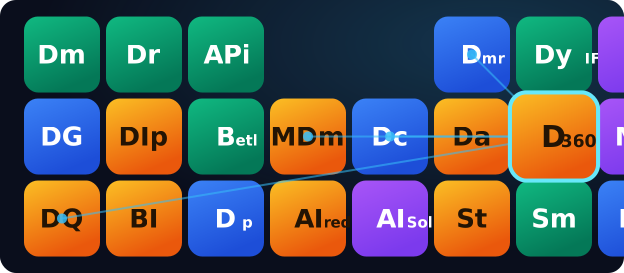
D-SNP enrollment reconciliation is the monthly three-way comparison of a plan's own membership records against the federal CMS files (the Monthly Membership Report and Transaction Reply Report) and the state Medicaid file — with every discrepancy worked through a queue with a root-cause code and corrected back to the responsible government.
Dual-eligible members are covered by Medicare and Medicaid simultaneously, so two governments send two files on two schedules in two formats, and both must agree with the core administration system. Errors cut both ways: care delivered without revenue in one direction, compliance findings in the other.
The highest-revenue members, the least forgiving data
Dual-eligible members generate revenue from both governments and carry the most complex eligibility data in the book. CMS keeps tightening integration requirements through 2027 — exclusively aligned enrollment, and the rules separating highly integrated (HIDE) from fully integrated (FIDE) plans.
Missed status flags are silent revenue loss. When an ESRD, hospice, or institutional flag never reaches the file, the risk-adjusted payment is quietly too low — historically $80,000 to $100,000 per identified member per year in client-identified recoveries. And every cutover defect is a member who cannot fill a prescription on day one.
What the reconciliation backlog is costing you
Each line below is already in your numbers — the question is only whether anyone has added them up for your 2027 expansion filing.
The enrollment symptoms that mean reconciliation is not working
What a clean monthly reconciliation looks like
-
1
Ingest 834 enrollment files, the state Medicaid file, and the CMS MMR and TRR on their own schedules
-
2
Validate each file before it touches the core system — structure, codes, and date logic
-
3
Load core administration with correct plan codes and effective dates, including retroactive changes
-
4
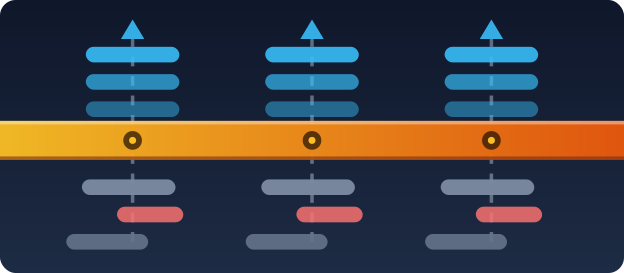
Reconcile three ways — plan records vs. CMS vs. the state — member by member, every month
-
5
Work a discrepancy queue with root-cause codes and aging, so patterns get fixed at the source
-
6
Send corrections back to CMS and the state, and prove the loop closed
The 30-day audit ages your open discrepancies, classifies their root causes, and quantifies the revenue sitting in unrecorded status flags.
What good looks like — and where it's already running
Results from Artha's anchor engagement at one of the largest Blue Cross Blue Shield plans. Presented as capability proof from a single client — not industry averages.
D-SNP reconciliation, answered
A three-way comparison that confirms every dual-eligible member matches across the plan's core system, the federal CMS files (MMR and TRR), and the state Medicaid file — with each discrepancy worked through a queue with a root-cause code and corrected back to the source government.
The Monthly Membership Report (MMR) tells a plan who CMS believes it is paying for and at what rate. The Transaction Reply Report (TRR) answers the plan's own enrollment submissions, confirming or rejecting each transaction. Reconciling both against plan records is the core of the D-SNP monthly workload.
Dual-eligible members are covered by both Medicare and Medicaid, so two governments send two files on different schedules in different formats. A member present in the plan's system but missing from a government file means care delivered without revenue; the reverse produces compliance findings.
Status flags such as ESRD (end-stage renal disease), hospice, and institutional status drive risk-adjusted payment. When a flag never reaches the file, the government underpays silently — historically $80,000 to $100,000 per identified member per year in client-identified recoveries.
CMS continues tightening integration requirements, including exclusively aligned enrollment and the rules distinguishing highly integrated (HIDE) and fully integrated (FIDE) plans. Plans expanding their D-SNP footprint must demonstrate that Medicaid feed integration and reconciliation actually work.
Yes. Ongoing three-way reconciliation, discrepancy queue management with root-cause coding, and correction transactions back to CMS and the state are delivered as a managed DataOps retainer alongside your existing enrollment team.
Reconcile every member, every month
Start with a 30-day audit of your open discrepancies and the revenue hiding in them.