
It is September 2026. The CMS Interoperability and Prior Authorization Final Rule, CMS-0057-F, takes full effect on January 1, 2027. That leaves four months.
The industry's own numbers say this will be tight. In a February 2026 survey by WEDI, the standards body CMS itself relies on for electronic data exchange advice, 35 percent of payers estimated they were only a quarter of the way through their Patient Access API work. Just 16 percent expected to be mostly complete by the deadline. The platforms are largely bought. The data behind them is what remains.
What follows is a month by month checklist for payer data and IT leaders, grounded in what the leading research says. It is a companion to our longer 90 day action plan for CMS-0057-F, rewritten for the time that is actually left.
Where the industry actually stands
Progress is real but uneven. WEDI found that only 10 percent of payers had not started implementation, down from 33 percent in October 2025. Budgets are moving in the other direction. Most payers put implementation cost between 1 and 5 million dollars, and a quarter now expect to spend more than 5 million.
The top challenges payers named are telling: connectivity with delegated third parties, digitizing prior authorization policies, and funding.
None of these is an API platform problem. They are data and operations problems.
On the three challenges payers ranked highest in the WEDI survey
The pressure is not only regulatory. Deloitte reminds plans that standard prior authorization requests must already be decided within seven calendar days, and that turnaround times, denial rates, and appeal outcomes are now reported publicly every year.
The American Medical Association's 2025 physician survey shows why regulators acted. Ninety five percent of physicians say prior authorization delays care, and a typical physician handles about 40 requests a week. After January 1, how well your plan answers those requests becomes visible to members, providers, and CMS alike.
What must be live on January 1, 2027?
Four FHIR APIs: Patient Access with prior authorization data added, Provider Access, Payer-to-Payer, and Prior Authorization. They apply to Medicare Advantage organizations, Medicaid and CHIP programs and their managed care plans, and qualified health plans on the federally facilitated exchanges.
Each API must serve complete, current, correctly matched data and pass the implementation guides the rule points to, including US Core, CARIN Blue Button, and the Da Vinci guides for prior authorization. That is the whole architecture in one sentence, and it is why the work in front of you is data work.
What you hold today
Claims in the core administration system
Enrollment arriving as X12 834 files
Clinical records and supporting documentation
Prior authorization policies in PDFs and spreadsheets
The payer data ops layer, where the four months are spent
X12 and core system data mapped into FHIR resources
Member and provider identity resolved to one record
Executable validation rules run before data leaves
Lineage, freshness and match rates under watch
Four FHIR APIs, live January 1, 2027
Patient Access, with prior authorization data added
Provider Access
Payer-to-Payer
Prior Authorization
Who is on the other end
Members and the apps they choose
Treating providers
The member's next health plan
CMS, and the annual public report
The top and bottom layers are fixed by the rule. The platforms that serve the third layer are largely bought. Everything still open sits in the second layer, and that is what the next four months are for.
The four month checklist
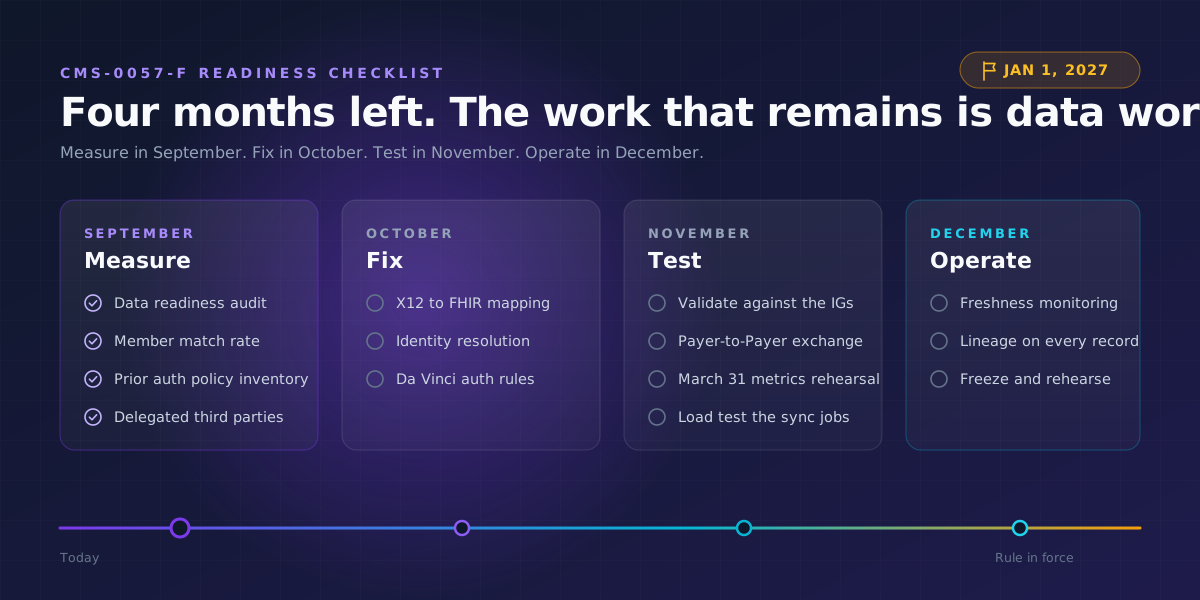
One theme per month, in an order where each month depends on the one before it. Measure, fix, test, operate.
September
Measure
Audit the data, not the platform
October
Fix
Remediate mappings and identities at source
November
Test
End to end, with production shaped data
December
Operate
Monitoring, lineage, and a dress rehearsal
January 1
In force
CMS-0057-F applies in full
SepMeasure your data, not your platform
Run a CMS-0057-F data readiness audit. Pull real samples of claims, clinical, and prior authorization records. Map them to FHIR and validate against the implementation guides. Count failures and trace each to its source system.
Measure member matching. The same person often carries different identifiers in claims, clinical, and enrollment systems. Every mismatch is an API response that fails or misleads.
Inventory your prior authorization policies. WEDI ranks digitizing them among the top payer challenges. Rules sitting in PDFs and spreadsheets cannot answer an automated documentation query.
Map your third parties. Delegated vendors for behavioral health, dental, or pharmacy must connect too, and WEDI found they are a leading source of delay.
OctFix the data foundation
Remediate the mappings. Translate core system data, X12 transactions, and legacy code values into the FHIR resources each API must serve. Fix the mapping once at the source rather than repairing records downstream forever.
Resolve identities. Build or tune the matching that links every claim, authorization, and clinical record to one member, and every record to the right provider.
Digitize authorization rules into the Da Vinci pattern: what needs approval, what documentation is required, and how a decision is returned. McKinsey estimates that 50 to 75 percent of manual prior authorization tasks can be automated, but only on top of clean, structured data.
NovTest end to end, with real data
Validate every API against the implementation guides with production shaped data, not synthetic happy path records.
Test Payer-to-Payer exchange with at least one trading partner. Five years of member history must move when a member switches plans.
Rehearse the metrics pipeline. The annual public prior authorization report is due each March 31. Confirm you can produce turnaround times, denial rates, and appeal outcomes from live data.
Load test and fix the sync jobs. An API that serves yesterday's truth fails members and audits equally.
DecMake it an operation
Stand up monitoring: data freshness, match rates, validation failures, and API errors on one dashboard someone actually owns.
Put lineage in place so any served record can be traced back to its source when a regulator or member asks.
Freeze changes, run a full dress rehearsal, and document the runbook for the first weeks of January.
Each month produces what the next one needs. A November test on unmapped data tells you nothing you did not already know in September.
Why bringing in specialist help is the smart move now
Oliver Wyman calls 2027 a reset year for Medicare Advantage economics: a proposed rate update of 0.09 percent against medical cost trends several points higher. There is no budget for a compliance program that overruns, and little time to hire scarce payer data engineers.
The CAQH Index makes the same point from the other direction: electronic transactions saved the industry 258 billion dollars in 2024, and the remaining 21 billion dollar opportunity sits in exactly the manual, data heavy work this rule targets.
This is where ThinkArtha's payer data ops practice fits. We do not sell another platform. We are the data operations layer that makes the platforms you already bought compliant: X12 to FHIR mapping, member and provider identity resolution, executable validation rules, and monthly reconciliation, delivered on your existing systems.
Our team runs these pipelines at scale today, from provider directory compliance covering more than 271,000 providers, to encounter data quality programs holding state submission rejections under 3 percent, to D-SNP enrollment reconciliation loaded with zero cutover defects. A focused 30 day audit scores all four of your regulatory pipelines and gives you a board ready picture of where the gaps are and what they cost.
Frequently asked questions
How long is left to comply with CMS-0057-F?
Four months. The rule takes full effect on January 1, 2027, and the four FHIR APIs it requires must be live on that date.
Which APIs must be live by January 1, 2027?
Four: Patient Access with prior authorization data added, Provider Access, Payer-to-Payer, and Prior Authorization. Each must serve complete, current, correctly matched data and pass the implementation guides the rule points to, including US Core, CARIN Blue Button, and the Da Vinci guides for prior authorization.
Which payers does CMS-0057-F apply to?
Medicare Advantage organizations, Medicaid and CHIP programs and their managed care plans, and qualified health plans on the federally facilitated exchanges.
How ready is the payer industry?
In WEDI's February 2026 survey, 35 percent of payers estimated they were only a quarter of the way through their Patient Access API work and just 16 percent expected to be mostly complete by the deadline. Only 10 percent had not started at all, down from 33 percent in October 2025.
Is four months enough time to get ready?
Yes, if the time is spent on the data rather than on more platform. Measure in September, fix in October, test in November, and operationalize in December.
What should a payer do first?
Run a data readiness audit on real records. Map samples of claims, clinical, and prior authorization data to FHIR, validate them against the implementation guides, count the failures, and trace each one back to its source system.
The bottom line
Four months is enough time, but only if it is spent on the data. Measure in September. Fix in October. Test in November. Operationalize in December.
If you want an experienced partner to compress that timeline, start with a data readiness assessment. January 1, 2027 will arrive either way. The plans that treat CMS-0057-F as a data mandate, not an API mandate, will be the ones ready for it.
Score your four regulatory pipelines before the year ends
A focused 30 day audit maps real records to FHIR, runs the regulators' own validation rules against them, and hands you a board ready picture of every gap and what it costs. Then we fix the mappings at the source and leave reconciliation, attestation, and lineage running as an operation.
References
CMS, Interoperability and Prior Authorization Final Rule CMS-0057-F fact sheet
Deloitte, AI Could Help Health Plans Simplify Prior Auth, Comply With Regs, January 2026
McKinsey and Company, AI ushers in next-gen prior authorization in healthcare
American Medical Association, 2025 Prior Authorization Physician Survey
Oliver Wyman, Medicare Advantage plan economics reset in 2027, March 2026