
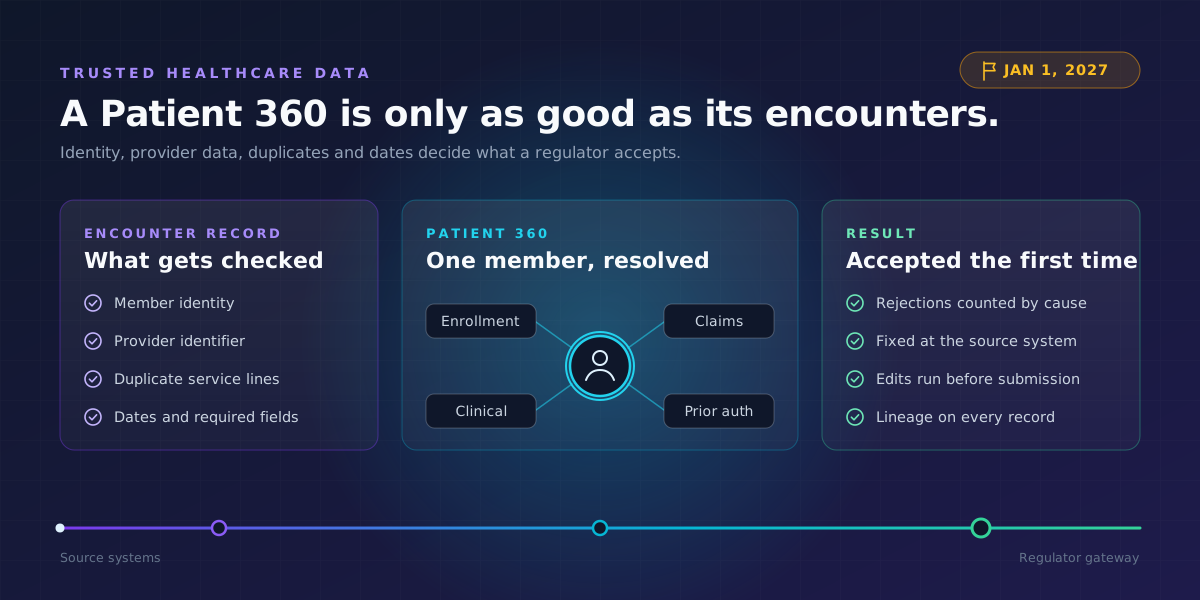
A Patient 360 is only as good as the encounters underneath it. Each encounter record says who the member was, which provider saw them, what was done and when. If a regulator sends that record back, the 360 view built on it is wrong in the same place.
That makes encounter quality the most practical test of trusted healthcare data. From January 1, 2027, the test also stops being private. Under CMS-0057-F, impacted payers must make claims and encounter data available to in-network providers and to other payers through FHIR APIs.
Encounter data now carries payment and compliance
Three federal rules tie encounter records to money and to regulatory standing.
- Medicare Advantage. For 2022, CMS moved the risk score used for plan payment to rely entirely on encounter data and fee for service claims.
- Medicaid managed care. Under 42 CFR 438.818, federal matching funds for plan contracts are available only if the state gives CMS encounter data it has validated as complete and accurate.
- CMS-0057-F. The Provider Access and Payer-to-Payer APIs must carry claims and encounter data with a date of service within five years of the request. CMS set the compliance dates as generally beginning January 1, 2027.
More is on the way. In April 2026, CMS proposed CMS-0062-P, which would add drug prior authorization details to the same APIs. If it is finalized as proposed, the main requirements start on October 1, 2027.
What federal reviews say about encounter rejection
Your rejection rate is specific to your plan, but federal reviews show where records fail.
The HHS Office of Inspector General reviewed 102 million Medicare Advantage encounter records from the first quarter of 2014. It found that 28 percent had at least one potential error, which fell to 5 percent after CMS corrections. The errors were inactive or invalid billing provider identifiers, duplicated service lines, missing required data, inconsistent dates, and beneficiary details that did not match CMS records.
Medicaid shows a similar picture. In a 2021 review of the largest managed care plan in each of 39 states, the Inspector General found that most states did not provide complete or accurate payment data on encounter claims.
Denials are already public for exchange plans. KFF found that HealthCare.gov insurers denied 20 percent of in-network claims in 2023. In the limited data on reasons, 21 percent of those denials were administrative.
Where Patient 360 comes in
A Patient 360 (a member 360, in payer terms) resolves one person across enrollment, claims, clinical and prior authorization records. Encounters fail when that resolution is weak.
Matching is harder than it looks. A 2018 Pew Charitable Trusts report cites estimates that matching within a single facility can be as low as 80 percent, and as low as 50 percent between organizations, even when both use the same record system vendor. The same report notes that organizations reach 90 percent or higher when they keep data quality high and manually check uncertain matches.
So trusted healthcare data and a low rejection rate come from the same work: confident member identity, a clean provider master, and one version of each service event.
Encounter quality optimization in five steps
Encounter quality optimization is a routine you run every cycle, not a one time cleanup.
- Measure your own rejection rate. Medicare Advantage plans already receive the MAO-002 report from CMS, which gives the acceptance status of every submitted encounter record. Count rejections by edit code, source system and provider.
- Group rejections by root cause. Member identity, provider identifiers, duplicates, dates and codes each need a different owner.
- Fix the source, not the file. A corrected resubmission clears one record. A corrected matching rule or provider record clears the ones that follow.
- Run the regulator's edits before you submit. Catch the failure inside your own pipeline, while there is still time to repair it.
- Reconcile end to end. Every adjudicated claim should trace to a submitted encounter and an accepted response, with lineage you can show an auditor.
We cover this pipeline in more detail on our encounter data quality page.
See it on a real record
On Wednesday, December 2, 2026, at 1:00 pm ET, Qlik and Artha Solutions are running a 30 minute live session: Compliant Is Not Ready: the 30 Day Data Plan for CMS-0057-F.
Three payer records go through the data layer on screen: an inbound Payer-to-Payer member matched and scored, a provider directory entry verified and published, and an encounter caught before the state gateway sees it. You leave with a 30 day plan from December 2 to January 1, with exit criteria for each phase.
Compliant Is Not Ready: the 30 Day Data Plan for CMS-0057-F
Thirty minutes with Qlik and Artha Solutions. Every registrant receives the recording.
References
CMS, Interoperability and Prior Authorization Final Rule CMS-0057-F fact sheet, January 2024
CMS, 2022 Medicare Advantage and Part D Rate Announcement fact sheet, January 2021
Code of Federal Regulations, 42 CFR 438.818, Enrollee encounter data
KFF, Claims Denials and Appeals in ACA Marketplace Plans in 2023, January 2025, updated March 2026
CMS, Announcement of Enhancements to MAO-002 Report, HPMS memo, February 2022