CIO, CTO and VP Data
The four APIs go live on your watch and the data behind them is what gets tested

Your FHIR endpoints will pass on January 1. The question is what happens on January 2, when real members, real providers and real trading partners start moving data through them. Join Qlik and Artha for a live working session: three records taken through the payer data layer on screen, and the plan for the 30 days between this session and the deadline.
Thank you. Your joining link and calendar invite are on their way to your inbox. If you added a question, our speakers will build it into the live session.
While you wait: the checklist we use on readiness audits, no form needed.
The exchange is working. What arrives is often not usable. A 2026 survey of 371 payer organisations found that most exchanged data still fails at the point of operational use, and the deciding factor is member identity.
Score My Four PipelinesSource: Black Book Research, Payer-to-Payer API Reality Gap report, April 2026, 371 payer respondents.
Where the industry stands 30 days out, what a conformance validator does and does not prove, and the four data pipelines where compliance passes or fails: FHIR API data, provider directory, D-SNP reconciliation and encounter submissions.
An inbound Payer-to-Payer member matched and scored, a provider directory entry verified and published inside the two business day clock, and an encounter caught before the state gateway sees it. All on Qlik Talend Cloud, with before and after numbers.
A calendar from today to January 1: measure all four pipelines, fix the one that will cost you most, test with one real trading partner, then freeze. With exit criteria your CIO can hold the programme to.
What CMS-0062-P adds from late 2027, why the data layer has to run as an operation rather than a project, and live questions answered by the speakers.

Moderator · Partner Account Manager at Qlik
A performance-driven global sales leader with a track record of exceeding revenue targets through direct, channel, and alliance-based sales. Barbara moderates the session and the live questions.
Learn More
Senior Solutions Engineer at Qlik
Robert is a Senior Solutions Engineer at Qlik, working with data and analytics teams on how Qlik's data integration and analytics platform fits their systems and use cases. In this session Robert brings the Qlik view of the payer data layer and how Qlik Talend Cloud runs the pipelines shown in the live walkthrough.

Delivery & Presales at Artha Solutions
Data leader with 10+ years of experience enabling enterprise-wide data governance, metadata management, cloud modernization, AI-powered data platforms, MDM frameworks, and large-scale ETL migrations. In this session Rama Krishna takes three payer records through the data layer live, from ingestion and identity resolution to validation and publication, and shows what changes between a compliant endpoint and a ready one.
Learn MoreMost health plans will have CMS-0057-F endpoints that pass conformance testing by January 1. What decides whether those APIs work is the data underneath them: members matched with confidence, provider directories inside their verification clocks, and submissions the receiving side can act on. This session is about that layer, the mapping, matching and reconciliation between the platforms a plan has bought and the systems of record it runs, and what can still be fixed before the deadline.
Why a compliant endpoint is not the same as a ready one, and the three tests that tell them apart.
How member identity resolution decides whether exchanged Payer-to-Payer data is usable, shown on a real record.
A 30 day plan from December 2 to January 1, with exit criteria for each phase.
What CMS-0062-P adds after January, and why the data layer has to be run as an operation.
The four APIs go live on your watch and the data behind them is what gets tested
The live walkthrough is the work your team does, on a real record
Prior authorization metrics are public and directory accuracy is now an enforcement issue
The provider directory record shows the 90 day and two business day clocks in action
Member identity and reconciliation drive both Payer-to-Payer and dual eligible enrollment
Designed for health plans with 100,000 to 2 million covered lives: Medicare Advantage, Medicaid managed care, D-SNP and regional Blue Cross Blue Shield plans.
No. The live segment uses three synthetic records to show how the data layer works. There is no product tour and no company history slide.
Yes. Every registrant receives the recording and the readiness checklist within 24 hours.
Yes. The session is about the data the APIs serve, which sits outside most vendor contracts.
No. Part 2 is technical, but each record ends with what it would cost the plan if it reached a regulator.
Yes. Use the optional field on the form. Questions sent in advance are answered live.
No. The session is free to attend.
More on the payer data layer, if you want to arrive with your own questions ready.
 White Paper
Payer Data Ops: The CIO and CDO Blueprint for CMS-0057-F Readiness
The compliance calendar, the reference data architecture between core systems and the four APIs, and a 100 day plan with a 12 question readiness scorecard.
Read the White Paper
 Solution
Payer Regulatory DataOps
How Artha runs the four regulatory pipelines: FHIR API data, provider directory, D-SNP reconciliation and encounter submissions.
Explore Payer Data Ops
 Blog
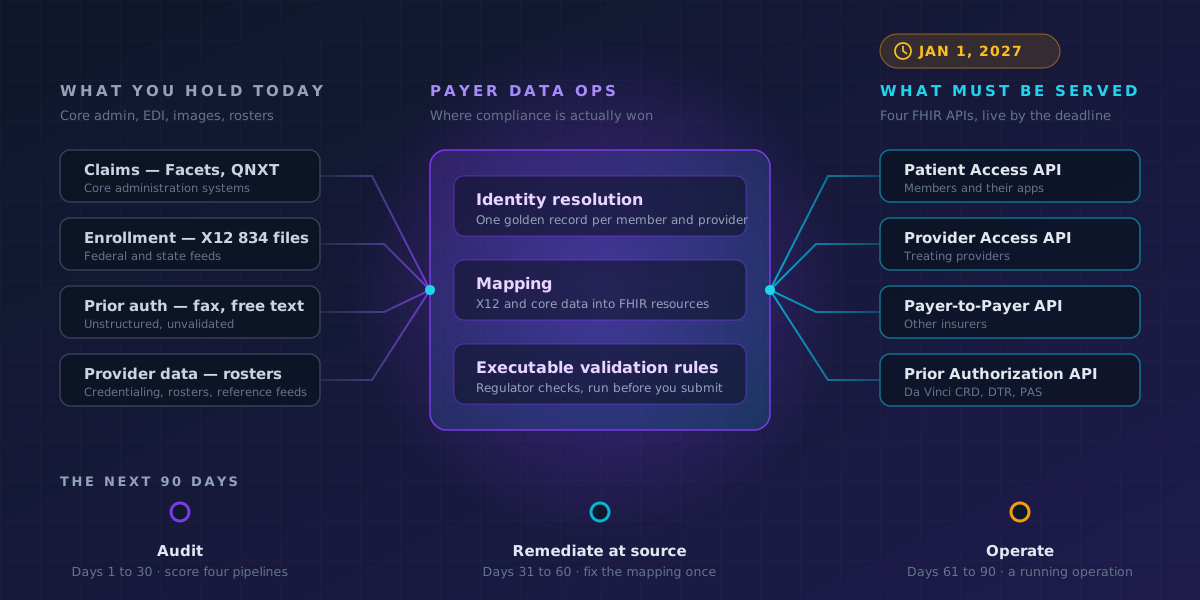
CMS-0057-F Is a Data Mandate: A 90 Day Action Plan for Payer Data Leaders
What the rule requires, why the remaining work is data work, and a 90 day plan to close the gap.
Read the Article
 Blog
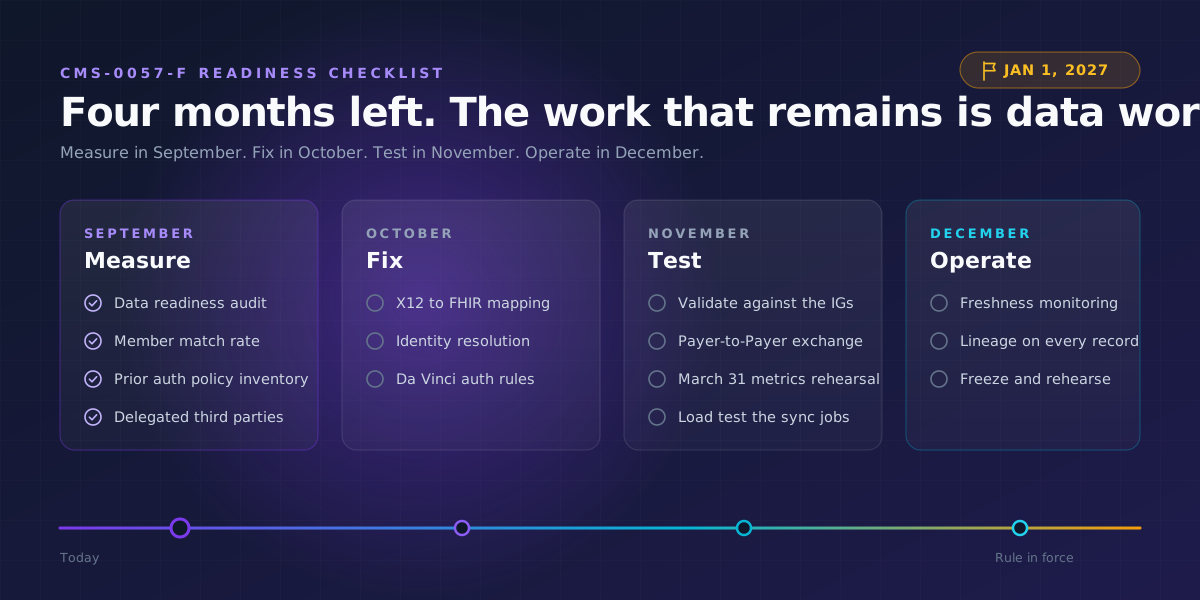
4 Months to CMS-0057-F: A Payer Data Readiness Checklist
A month by month checklist for the run to January 1: measure, fix, test, then operate.
Read the Checklist
Think Data... Think Artha.
Want your own numbers rather than ours? The 30 day Payer Data Readiness Audit scores all four pipelines against the regulators' rules. Started by December 1, it finishes before the deadline.