
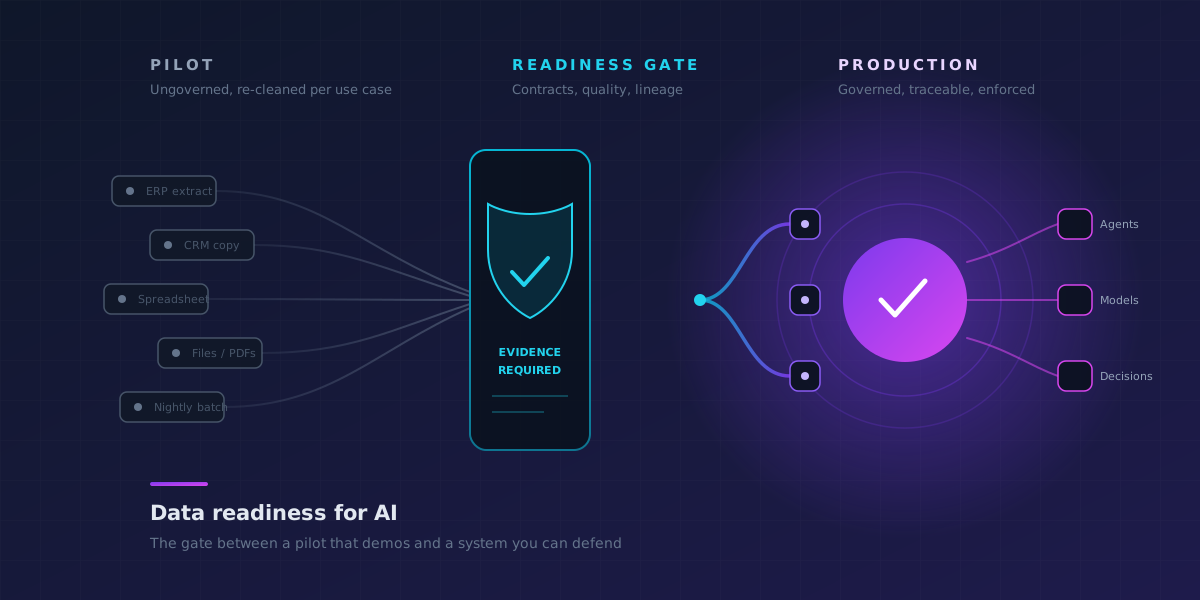
Most data leaders can recite this pattern from memory. A model performs well in the sandbox. The demo lands with the executive committee. Budget gets approved. Then twelve months pass and the initiative is still a pilot, still fed by a hand-curated extract that one engineer refreshes on Tuesday mornings.
Two questions tend to settle whether that changes this quarter. Can you put your AI into production today? And are you confident in the data underneath it? When either answer comes slowly, the model is rarely the reason.
The evidence points at data, not algorithms
IDC, working with Lenovo on the CIO Playbook 2025, put a ratio on the attrition. For every 33 AI proofs of concept a company launched, four graduated to production. That is an 88% loss rate at the last mile, after the money is spent and the sponsor has been briefed.
MIT's Project NANDA arrived at a similar place from a different direction. Its report, The GenAI Divide: State of AI in Business 2025, reviewed more than 300 publicly disclosed AI initiatives, ran 52 structured interviews and collected 153 survey responses from senior leaders. Around 95% of organizations were seeing no measurable P&L return, and only about 5% of integrated pilots were producing real value.
Gartner's finding is the most useful of the three, because it names a cause instead of a symptom. Through 2026, the firm expects organizations to abandon 60% of AI projects that are not supported by AI-ready data. In the same research, based on 1,203 data management leaders surveyed in July 2024, 63% either lacked appropriate data management practices for AI or did not know whether they had them.
Buyers describe the same wall. The Qlik 2025 Agentic AI Study, fielded by Enterprise Technology Research across more than 200 enterprise technology decision-makers, found that 97% had allocated agentic AI budget while only 18% had fully deployed anything. Nearly half expect three to five years to scale. Data quality and integration with existing systems topped the barrier list, ranking above model performance. In a separate Qlik survey of 500 US senior decision-makers run by Censuswide, 86% said executing with AI is core to competitive strategy, and roughly 74% named infrastructure cost, disconnected silos or slow data ingestion as their biggest obstacle to scaling it.
Why AI-ready data is a stricter standard than analytics-ready
This is where a lot of programs get caught. A reporting estate can live with a nightly refresh and a quality summary someone reviews on Monday, because a human sits between the number and the decision. That human absorbs a surprising amount of mess. They notice the regional total looks wrong, they remember the ERP cutover last quarter, and they quietly adjust.
Take the human out of the loop and those tolerances disappear. A model scoring a transaction has no memory of the cutover. An agent booking a replenishment order will not pause because the supplier record looks unusual. So the standard moves from "accurate enough to interpret" to "accurate, timely and traceable enough to act on unattended."
In practice that means four things your BI stack was never asked to guarantee:
- Freshness measured against the decision, not the schedule. The relevant number is the age of the data at the moment of inference, compared with how stale the decision can tolerate.
- Quality enforced in the pipeline. A failing batch has to be stopped before it reaches a feature store or a vector index, not flagged after it has trained a model.
- Meaning that survives the handoff. One approved definition of customer, product and revenue, resolving identically in a dashboard, a notebook and an agent.
- Lineage that answers an auditor. For any output, which sources produced it, under which transformation, and who was permitted to see them.
We covered the diagnosis side of this in more depth in Why AI Projects Fail Without AI-Ready Data. What follows here is the execution side: the specific failure modes to look for, and the order in which to fix them.
Three failure modes worth auditing this week
1. Batch pipelines feeding real-time decisions
A nightly ETL window is invisible during a pilot that gets evaluated on historical accuracy. It becomes expensive in production, where the model is pricing a transaction or judging a supply position that moved four hours ago. Nobody notices until a decision is defended in a review.
What to do: inventory every AI use case and record two numbers, the actual age of its data at inference and the staleness the decision can absorb. Where the gap is negative, the answer is log-based change data capture rather than a faster batch. Tools such as Qlik Replicate and Qlik Talend Cloud read changes from SAP, Oracle and mainframe sources without adding load to the production system.
2. Quality assessed after the fact
Most enterprises still validate data in a dashboard that gets read on Monday morning. By then the model has already trained, or has already answered a customer. Measurement without enforcement is reporting, not control.
What to do: move the quality gate into the pipeline so failing batches are quarantined before they land. Qlik's Trust Score for AI, generally available in Qlik Talend Cloud in 2025, scores data across diversity, timeliness, accuracy, discoverability and usage. The first two are the dimensions traditional data quality tooling tends to skip, and the ones AI workloads punish hardest.
3. Raw tables handed to AI teams
When every use case starts from raw schema, every team re-cleans, re-joins and re-interprets the same entities in slightly different ways. You do not end up with one definition of a customer. You end up with eleven, each defensible on its own terms.
What to do: package data as data products, meaning domain-owned, contract-backed, versioned assets with a named owner. Qlik Data Products publish these through a self-service marketplace with lineage, quality metrics and access policy attached. Qlik cites Harvard Business Review research suggesting a data-as-product approach can cut implementation time for new use cases by up to 90% and total cost of ownership by up to 30%.
Two architecture decisions that set your ceiling
Open table formats decide your unit economics
If AI data sits in a proprietary silo, every additional engine you point at it (training, retrieval, BI, feature engineering) means another copy and another compute bill. That cost compounds quietly, and it caps how many use cases the platform can carry before finance starts asking questions.
Apache Iceberg is the common answer. Qlik Open Lakehouse keeps one continuously optimized copy of the data queryable from Snowflake, Databricks, Spark, Trino, Athena and SageMaker. Qlik reports 2.5x to 5x query performance against unoptimized tables and up to 50% lower cost.
Unstructured content needs the same controls as your SQL estate
Policies, contracts, manuals and support transcripts are production inputs now. They feed retrieval systems that answer customers and staff, which means they need the same permissioning and provenance you already apply to structured data. A retrieval system pointed at an open file share inherits every stale document and every misconfigured folder in it.
Qlik Answers enforces domain-level access and returns source citations with each response. Citations are what let a reviewer confirm an answer came from the current policy rather than the 2019 version, which is the difference between an answer that is defensible and one that is merely fluent.
Score your data readiness for AI on four axes
Before approving further model spend, mark your current posture honestly. Any row still sitting in the middle column is a production blocker rather than a backlog item.
| Capability | Pilot posture (high risk) | Production posture |
|---|---|---|
| Delivery | Nightly batch, ad-hoc extracts | Continuous log-based change data capture |
| Assets | Raw tables, re-cleaned per use case | Governed data products with owners and contracts |
| Quality | Post-load dashboards | In-pipeline gates with automated quarantine |
| Storage | Proprietary silos, duplicated compute | Open Iceberg lakehouse, multiple engines |
Score your AI data readiness in about 15 minutes
The four axes above are a useful gut check. For a defensible number, work through the 60-question assessment behind them: eight domains covering strategy, ownership, metadata and lineage, quality, architecture, privacy, AI-specific controls and value measurement, mapped to DCAM, ISO/IEC 42001, the NIST AI RMF and the EU AI Act.
It applies the evidence rule an auditor would apply, so a claim only scores well if someone can produce the artifact behind it. You get a readiness stage, a domain-by-domain scorecard, a gate check and your results by email. No documents are uploaded at any point.
Where the roadmap usually breaks: migration
Architecture is rarely the hard part. Migration is. Legacy ETL estates with thousands of undocumented jobs are where a data roadmap for AI quietly stalls, because the work is unglamorous, hard to estimate and impossible to skip.
Artha Solutions works this specific gap as a Qlik Elite Channel Partner holding Talend Cloud and Data Governance expert certifications. Two accelerators do most of the lifting:
- B'etl, an ETL migrator that inventories legacy jobs and their dependencies, then automates roughly 90% of pipeline translation and cuts migration timelines by about 70%.
- Dynamic Ingestion Framework, metadata-driven onboarding so a new source arrives as a configuration entry rather than bespoke code, including schema-shift handling.
The delivered outcomes matter more than the tooling:
- Healthcare and life sciences. A 100+ TB Talend estate moved onto AWS and Snowflake, with a 50% reduction in processing time and 40% fewer data errors.
- Utilities. Real-time pipeline validation, halving manual data processing.
- Manufacturing. Latency cut from more than 24 hours to under two minutes, with 99% accuracy migrating 25 years of ERP history.
None of those are AI metrics. They are the preconditions for AI metrics, which is exactly why they tend to get deferred and then block everything.
A 30-day data roadmap for AI you can start on Monday
Pick one stalled pilot rather than the whole portfolio. Then measure three things.
- The age of its data at inference. Compare that against the staleness the decision can tolerate. A negative gap tells you the delivery pattern is wrong, not the model.
- The share of its inputs covered by an enforced quality contract. Enforced means a failing batch stops moving. Anything below full coverage is an open path from bad data to a live decision.
- Engineer-days spent preparing data per use case. When preparation is measured in weeks, you are paying the data-product tax repeatedly instead of once.
That order is deliberate. Enforcement without a named owner produces alerts nobody acts on. New architecture without contracts moves the same ambiguity onto a faster platform.
The two questions, again
Can you take your AI to production today? Are you confident in your data foundations? A quarter from now, the useful version of those questions is narrower. Which use case cleared a readiness gate, who owns the data behind it, and can you show the lineage from its output back to source without scheduling a working session.
You cannot prompt your way out of a data foundation problem. But you can measure the problem this week, and measurement is what turns a stalled pilot into a funded plan.
Start with the AI Data Readiness Assessment, or talk to our team about a Data Foundation Architecture Review, a structured audit of your data estate against production AI requirements.
References
- IDC with Lenovo, CIO Playbook 2025. Reported ratio of four production deployments per 33 AI proofs of concept, an 88% attrition rate. Via CIO, "88% of AI pilots fail to reach production".
- MIT Media Lab, Project NANDA, The GenAI Divide: State of AI in Business 2025. Multi-method study conducted January to June 2025: review of 300+ publicly disclosed AI initiatives, 52 structured interviews, 153 survey responses from senior leaders.
- Gartner, "Lack of AI-Ready Data Puts AI Projects at Risk", February 26, 2025. Prediction that 60% of AI projects unsupported by AI-ready data will be abandoned through 2026; 63% of organizations lack or are unsure of appropriate data management practices for AI. Based on a survey of 1,203 data management leaders, July 2024.
- Qlik, "Qlik 2025 Agentic AI Study: Budgets Surge, but Data Readiness Delays Scale", October 2025. Fielded by Enterprise Technology Research in August 2025 among 200+ enterprise technology decision-makers. Source of the 97% budget allocation and 18% full deployment figures.
- Qlik, "AI Is Core to Strategy for 86%, But Most Are Stuck in Data Complexity", May 2025. Conducted by Censuswide among 500 US senior business and technology decision-makers at director level and above.
- Qlik product references: Trust Score for AI in Qlik Talend Cloud, Qlik Data Products (including the Harvard Business Review figures Qlik cites for implementation time and total cost of ownership), and Qlik Open Lakehouse (source of the 2.5x to 5x performance and up to 50% cost claims). Vendor-reported figures.
- Artha Solutions: Qlik partnership, accelerators including B'etl and the Dynamic Ingestion Framework, and client case studies for the delivery outcomes cited above.