
Enterprise AI has hit an awkward phase. The conversation has moved on from demos and one-off productivity wins. Now it's about production systems that touch how organizations price products, serve customers, manage risk, and allocate capital.
And that shift is exposing something a lot of teams got away with ignoring during the pilot stage: even with a good model and plenty of cloud infrastructure, most enterprises still don't trust the data feeding it. There's a name for that gap. It's AI-ready data, or rather, the lack of it.
We've sat in enough of these conversations to notice a pattern. The next stage of AI adoption isn't going to be won by whoever has access to the flashiest model. Model access is becoming a commodity fast. What's harder to copy is an organization's ability to feed AI data that's accurate, current, contextual, governed, and actually fit for the specific job it's being asked to do.
The AI Trust Problem: Why Pilots Don’t Reach Production
AI projects rarely die in one dramatic moment. They fade instead. A prototype looks great in a demo, then meets live enterprise data: shifting business definitions, incomplete records, feeds that arrive late, ownership nobody can quite pin down.
Accuracy gets patchy. Exceptions pile up. People start double-checking the AI's output by hand, which sort of defeats the point. Risk teams quietly narrow what the system is allowed to touch. Eighteen months later, it's still called a "pilot," even though the technology worked fine from day one.
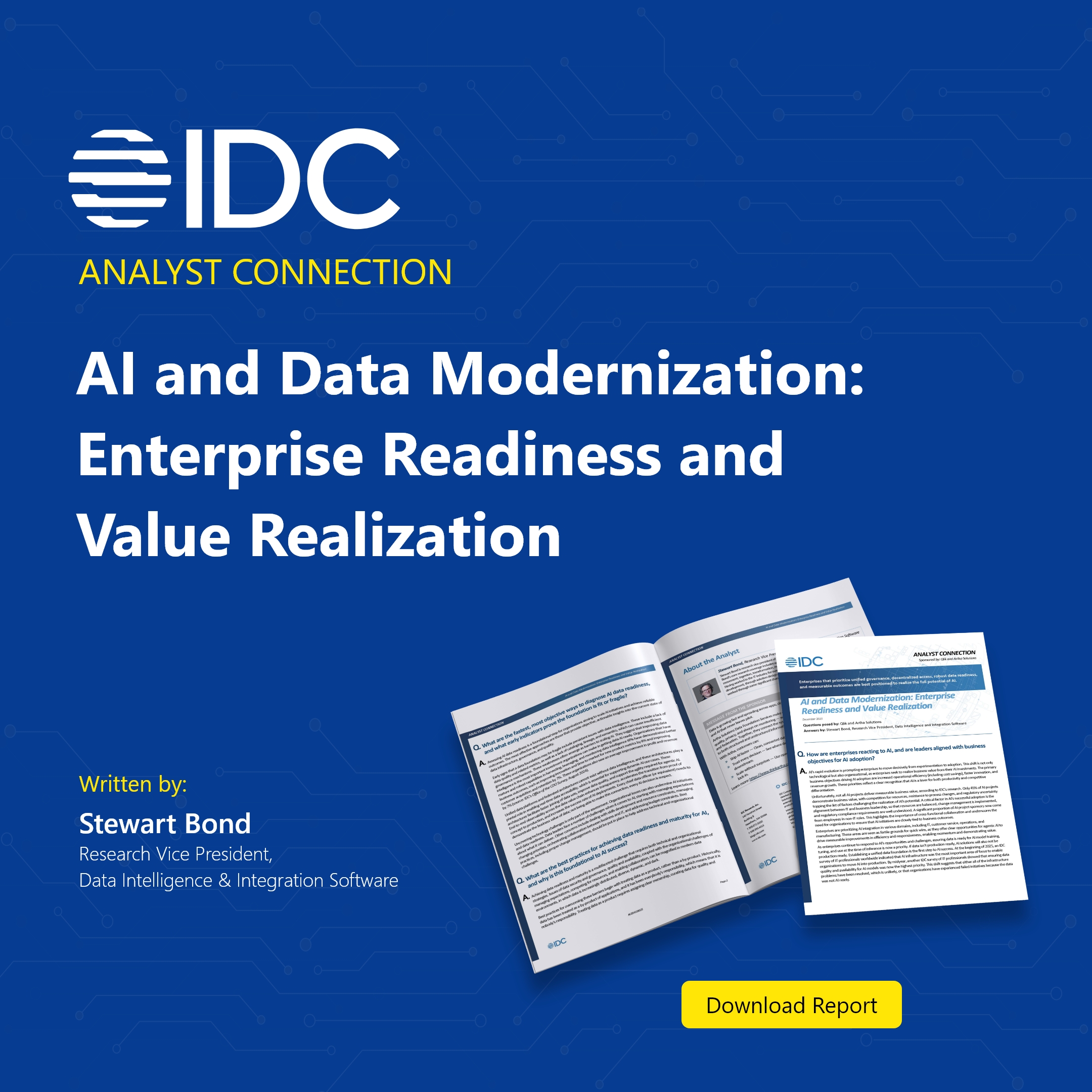
IDC's December 2025 Spotlight Paper ties that shortfall directly to data foundations. The related IDC Analyst Connection report makes an even blunter point: if the data isn't production-ready, the AI built on top of it can't be either. Most enterprises aren't stuck on an AI capability problem. They're stuck on a trust problem.
We saw this play out almost exactly on schedule with a healthcare client that wanted to move into AI-driven forecasting but had no clear starting point, no governance model, and no validated prototype to build on.
Rather than let the experimentation sprawl, we stood up a quick-start AI/ML lab scoped to six to eight weeks: one forecasting use case, a working prototype, and a governance playbook the client could reuse for the next one.
It shipped 40% faster than their prior attempts at AI deployment, and stakeholder confidence in the results jumped by 20%, mostly because the data behind the model had actually been checked, not just assumed to be fine.
AI Changes the Economic Consequences of Poor Data
Data quality problems aren't new. Companies have spent decades reconciling customer records, standardizing product catalogs, and stitching operational systems together. In traditional analytics, bad data usually showed up as a reporting disagreement. Two teams had different numbers, an analyst dug in, and someone made a decision once the discrepancy got sorted out.
AI skips that review cycle entirely.
A predictive model prioritizes customers automatically. A pricing engine recommends a discount. A service agent gives a regulated answer without a human reading it first. An autonomous workflow kicks off a transaction. In every one of those cases, bad data doesn't just produce a wrong report anymore. It produces a wrong action, and nobody catches it until later.
"When AI moves from producing answers to making decisions and taking actions, weak data becomes an execution problem rather than merely a reporting problem."
Mike Capone, CEO, Qlik
That's the distinction CIOs and CDOs need to sit with. The cost of bad data scales with however much autonomy you've handed the AI. A missing field in a dashboard is annoying for an analyst. That same missing field inside an automated underwriting or fraud workflow can cost real money, or worse, trigger a compliance problem nobody saw coming.
Model accuracy alone was never going to be enough to prove something is production-ready. Trust has to be built into the whole chain, from raw data to the decision it eventually produces.
AI-Ready Data Is More Than Clean Data
Most AI-readiness programs start with cleansing the data. Fair enough, that's necessary. It's just not sufficient on its own. A dataset can pass every technical quality check and still be wrong for AI: complete but stale, accurate in one system but defined differently in another, legally accessible to one employee but off-limits for a specific model to touch.
Genuinely AI-ready data gets judged on more dimensions than that. It needs to be accurate enough for the job at hand, complete enough, representative of the population it's describing, current at the moment a decision gets made, understandable to the business people who rely on it, and governed according to whatever privacy and access rules apply.
It also needs enough lineage attached that someone can explain, months later, exactly how a piece of data got from a source system into a model's output.
Qlik frames AI-ready data as information that's systematically prepared, evaluated, and governed to support outcomes people can actually rely on, built around dimensions like accuracy, timeliness, and diversity. We'd say something similar: production-ready data isn't just clean, it's accessible, explainable, secure, and governed at scale.
That's the exact model behind our own AI Data Readiness services, and it's what we built for a commercial bank whose customer records were scattered across twelve legacy systems after a string of acquisitions.
That engagement consolidated everything into one MDM-driven customer directory, cut compliance reporting time by 40%, and got automated data validation scoring up to 95%.
What stuck with us afterward was what the client said once it was live: "Artha Solutions transformed our customer data landscape, bringing order to our compliance pipelines and delivering a trusted data repository that underpins our modern banking applications." That's what "trusted data" looks like once you stop treating it as a slogan.
Trust, in other words, is relative to what you're using the data for. A customer dataset might be perfectly fine for campaign segmentation and completely wrong for a credit decision. It's a relationship between data, context, and intended use, not a permanent stamp you put on a table once and forget about.
The Hidden Failure Is Often a Loss of Business Meaning
A lot of AI programs focus hard on moving data into one platform and barely think about whether everyone still means the same thing by it. You can consolidate every record you own and still have three different definitions of "active customer" floating around, or a claim status field that means something different in billing than it does in operations.
Those gaps get dangerous fast once generative or agentic AI starts pulling information across domains and stitching it into one confident-sounding answer. The system looks like it's working. It's actually just combining incompatible interpretations and presenting them cleanly.
IDC calls out the absence of cataloging, metadata, and lineage, paired with weak quality metrics, as an early warning sign of a fragile foundation and a direct barrier to scaling AI. For a CIO, that's mostly an architecture problem. For a CDO, it's an organizational one.
Business definitions can't be handed off entirely to a central data team, since the meaning genuinely lives inside the business domains, but no single domain can define things in isolation either without wrecking consistency for everyone else. The fix tends to be distributed ownership held together by shared governance and trust signals people can actually see.
Data Products: The Bridge Between Governance and Speed
Treating data as a product is a practical way out of that bind. A data product isn't just a nicely curated dataset. It has a named owner, known consumers, an agreed business meaning, quality thresholds, access rules, lineage, and service levels attached to it. It gets managed like a reusable piece of infrastructure, not a one-off deliverable from whatever project happened to touch it last.
Without reusable data products, every new AI use case starts from zero: rediscovering sources, renegotiating access, reconciling definitions, rebuilding pipelines, repeating quality checks that were already done for the last project. IDC has a name for that too: a "data tax," the hidden time and risk that rigid, one-off approaches to data keep charging you.
With governed data products already in place, teams reuse the same trusted inputs across predictive models, generative AI, analytics, and automated workflows instead of paying that tax every single time.
Agentic AI Makes Real-Time Trust Unavoidable
The bar gets higher again once organizations start moving toward agentic AI. A conventional model works through a reasonably stable dataset on a schedule someone controls. An AI agent doesn't get that luxury.
It might need to pull live customer information, interpret a policy, check inventory, call three other systems, and initiate an action, all within a few seconds. Its performance depends as much on how fresh and reliable that data is in the moment as it does on the model underneath it.
IDC predicts that by 2027, 80% of agentic AI use cases will need real-time, contextual, and near-everywhere data delivery, which is going to push a shift away from centralized repositories toward federated models where data stays closer to home while governance still applies consistently across the board.
"AI infrastructure" doesn't mean models, compute, and orchestration anymore. It has to include real-time integration, change data capture, streaming, metadata, quality controls, and observability too. Agents can't fix an untrusted data environment on their own. If anything, they just move its weaknesses faster.
Make Data Trust Measurable
Most enterprises already have data governance policies written down somewhere. Fewer can actually show whether those policies do anything at the exact moment AI reaches in and uses the data. Closing that gap between "governed on paper" and "governed in practice" is shaping up to be one of the bigger stories of the rest of 2026.
CIOs and CDOs need harder evidence than a policy document: quality-rule pass rates, freshness against agreed service levels, how complete the lineage actually is, policy violations, schema drift, anomalies nobody's resolved yet, how much data-product usage is happening, and what share of critical AI inputs actually have an accountable owner attached to them.
No single score is going to replace judgment here. But the underlying idea holds up: trust should be something you can see and monitor, tied to the specific use case, not something you discover has broken only after the model, the users, or the regulator already noticed.
A Practical Agenda for the Rest of 2026
The right move for the rest of 2026 isn't pausing AI investment until every data problem gets fixed. That program would be too broad, too slow, and it would lose executive sponsorship long before it finished.
A better approach ties data readiness directly to a small number of high-value AI outcomes, starting with a focused 90-day assessment: cross-functional oversight, an honest look at gaps in quality, governance, and infrastructure, an inventory of what AI initiatives and data assets actually exist, and governance principles built around actual risk rather than blanket rules.
For CIOs and CDOs, that turns into four decisions worth making deliberately rather than by default:
- Pick a small portfolio of production-relevant use cases instead of continuing to fund a scattered pile of disconnected experiments. Each one needs a business owner, a number attached to the outcome, and a clear line describing what it's allowed to decide.
- Identify the data products those outcomes actually depend on, and put an accountable owner on each one who defines business meaning, quality thresholds, freshness expectations, access rules, and lineage.
- Build continuous observability from source to AI output, covering not just model drift but data drift, schema changes, pipeline failures, stale feeds, and business definitions that quietly shift underneath everyone.
- Measure value and trust together, not separately. An AI system that's efficient but can't be explained, governed, or relied on isn't actually ready to scale. A perfectly governed platform that never produces a measurable result won't keep its funding either.
We walked through this exact sequence, live, in our on-demand webcast with IDC Research VP Stewart Bond, including how to scope the 90-day assessment so it turns into a working data-to-AI pipeline instead of another slide deck.
The Next AI Divide Will Be a Data-Trust Divide
The competitive gap opening up in enterprise AI probably won't separate companies that have AI from companies that don't. Most will end up with access to fairly similar models and platforms. The gap that actually matters is between enterprises that can connect AI to trusted, real-time, business-contextualized data, and the ones that can't.
IDC reports that organizations investing in enterprise intelligence services see, on average, 24% faster innovation, 23% higher operational efficiency, 23% greater business agility, 21% revenue growth, and 19% cost savings. None of that proves data foundations alone cause every improvement. It does show a strong link between mature data-intelligence capabilities and results you can actually measure.
AI projects fail without trusted data because intelligence can't be separated from the evidence it's acting on. In 2026, the organizations that escape pilot purgatory won't be the ones running the most AI experiments. They'll be the ones that can show, continuously and at the point of use, why their data deserves to be trusted.
The takeaway for CIOs and CDOs isn't that data readiness has to happen before AI, as some separate multi-year transformation project. It's that data readiness and AI delivery need to become the same program, running on the same clock.
If you're not sure yet where your own data actually stands, our AI data readiness assessment scores your data, governance, and AI controls against frameworks like DCAM, NIST AI RMF, and ISO 42001. It won't tell you everything, but it beats guessing.