
Is your data foundation
ready for AI?
The 90-Day AI Data Foundation self-assessment — 60 capability checks across eight domains, scored the way an auditor would score them. Mapped to DCAM, ISO/IEC 42001, the NIST AI RMF and the EU AI Act.
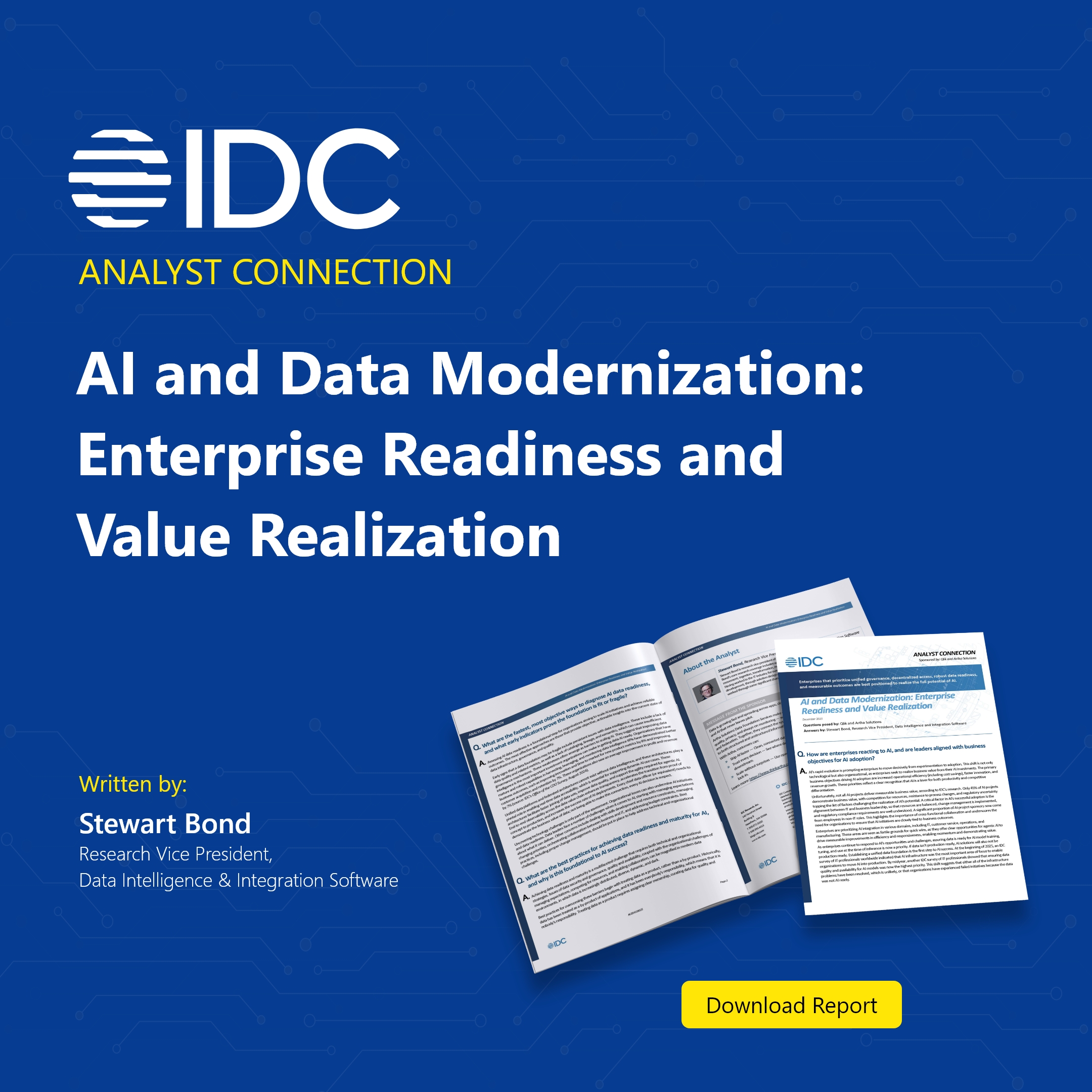
Start the assessmentSource: IDC Future Enterprise Resiliency and Spending Survey, July 2025 · IDC Analyst Connection, December 2025 · IDC Spotlight: Future-Ready Data Foundation · IDC Enterprise Intelligence Services Survey, June 2025.
Tell us where to send your scorecard
Your full results — readiness stage, domain scores, gate check and spider chart — are emailed to you the moment you finish. We use a business email to build your scorecard; personal email domains are not accepted.
Sixty questions. One honest score.
You will score 60 capability statements across 8 domains — strategy, ownership, metadata, quality, architecture, privacy, AI-specific readiness and value measurement. One question at a time, about 15 minutes end to end. Your progress autosaves in this browser, so you can leave and pick up where you stopped.
| 0 | Absent | Nothing in place. No one would claim otherwise. |
| 1 | Conceptual | Discussed, planned or in a slide deck. No operating artifact. |
| 2 | Developmental | Partially in place. Works for some domains, some of the time, with manual effort. |
| 3 | Defined | Documented, owned and operating across the critical domains. Repeatable. |
| 4 | Managed | Enforced enterprise-wide, measured against a target, evidence produced on demand. |
The evidence rule — this is the whole thing. A score of 3 or 4 requires an artifact someone could produce within five minutes. Whenever you pick a 3 or 4, we will ask you to confirm — with a checkbox, never an upload — that the artifact exists. No artifact, no 3: the answer is recorded as a 2. Apply it and you have an assessment; skip it and you have a survey that tells you what you want to hear.
Rule 1 — The domain floor
Any domain scoring below 40% of its own maximum is a blocking gap, however good the total looks.
Rule 2 — The nine hard gates
Nine items are marked GATE. If any one scores 0 or 1, you do not have a foundation that supports production AI — whatever your total is.
The question that settles this domain
The evidence rule. A score of 3 means this is operating and documented — which means an artifact exists. Could someone on your team produce it within five minutes?
Press 0–4 to score · Enter to continue · ← to go back
Your readiness profile
Each axis shows the percentage of that domain's maximum score. The dashed line is an illustrative industry baseline — a typical enterprise at the start of a 90-day readiness programme, shown for orientation only.
The nine hard gates
Domain scores & floors
The amber tick on each bar marks the domain floor (40% of maximum). Any domain below its floor is a blocking gap, however good the total looks.
Scores adjusted by the evidence rule
You scored these items 3 or 4 but couldn't confirm a producible artifact, so each was recorded as a 2. They are usually the fastest points to win back — the capability half-exists; the evidence doesn't.
What the next 90 days should do
Before you report the number upward, report the total, the floors and the gates together: “We scored X of 240. Domains Y and Z are below floor. Gate G5 is open, so we cannot reconstruct how an AI output was produced.”
Review your answers
Every item, with the score recorded after the evidence rule.
Now run it for real — with evidence, not checkboxes
This self-assessment took your word for the evidence. Artha's AI Data Readiness Assessment doesn't have to: our data architects and SMEs run the same framework-aligned assessment on Artha's Intelligent Data Assessment Platform, where an AI-driven evidence analysis tool examines the actual artifacts behind every score — so the result is completely auditable and defensible to a regulator, an auditor or your board.