

In the highly competitive healthcare sector, talent acquisition has become a critical operational challenge. With multiple disparate data sources, inconsistent candidate formats, and persistent data quality issues, human resources departments struggle to fill critical vacancies efficiently.
Implementing a Unified Talent Analytics Platform enables healthcare providers to streamline their hiring pipelines, enforce data governance standards, and leverage actionable KPI-driven insights.
The Recruiting Challenge in Healthcare
Healthcare recruitment is uniquely complex, requiring rigorous verification of licensing, qualifications, and background checks across varying state registries.
When data is scattered across legacy applicant tracking systems (ATS), emails, and spreadsheets, recruiting teams face manual reconciliation delays, leading to high vacancy fill times and increased overhead.
The Power of Unified Talent Analytics
By integrating various data sources into a centralized analytics repository, organizations gain a complete, multi-dimensional view of their talent acquisition process. Key benefits include:
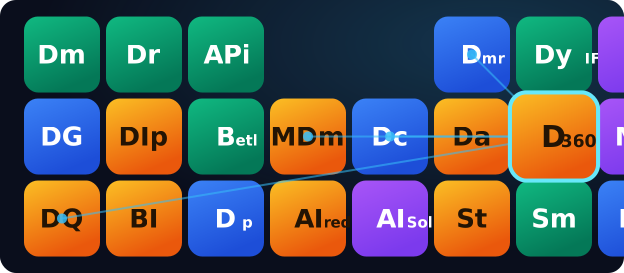
- Ingestion Automation: Consolidating candidate profiles from external job portals, internal ATS databases, and agency feeds.
- Data Quality Audits: Standardizing address fields, phone numbers, and qualification credentials to prevent duplicates.
- Credential Verification: Automatically cross-referencing candidate records with license databases.
Key Recruitment KPIs to Monitor
A unified analytics model enables HR leadership to track critical performance metrics in real time:
- Time-to-Hire: Days elapsed from posting to offer acceptance.
- Cost-per-Hire: Direct and indirect expenses associated with candidate acquisition.
- Offer Acceptance Rate: Percentage of candidates accepting job offers.
- Source Effectiveness: Identifying channels yielding the highest quality hires.
Conclusion
A cloud-based talent analytics platform built on modern data foundations empowers healthcare providers to optimize resources, reduce recruitment overhead, and secure top-tier professionals. By transforming raw candidate data into actionable operational insights, enterprises ensure they are prepared for future organizational scaling.