
Prepare Manufacturing Data for AI, Automation, and GenAI
Artha helps manufacturers move from AI pilots to production value by building trusted, governed, integrated, and model-ready data foundations.
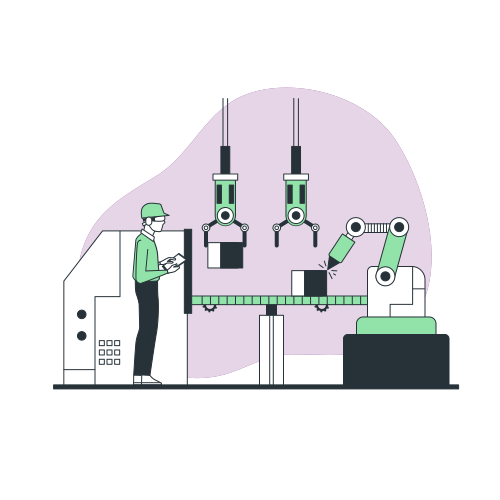
Modern Solution Brief
Artificial intelligence in manufacturing holds immense promise—from predicting equipment failure to automating inventory purchasing. However, models require clean, contextual, and timely data inputs. If raw sensor streams or ERP logs are fragmented, outdated, or poorly documented, AI models will generate false alarms or fail in production. Artha builds the necessary data products, pipelines, and governance to scale AI.
Technical & Platform Capabilities
Engineered processes built to align physical inputs with executive data structures.
AI Data Readiness Assessment
Audit existing data assets to identify quality, latency, and cataloging gaps.
Data Quality Scoring & Profiling
Continuously monitor data streams to ensure inputs match model specifications.
Feature Store Engineering
Build centralized libraries of model-ready variables, allowing engineering teams to reuse features safely.
Metadata & Traceability Mappings
Track model inputs and output results to ensure auditability and explainability.
Common Domain Use Cases
Operational applications that deliver business value using clean datasets.
Predictive Maintenance Telemetry
Structure and tag machine sensor streams to feed predictive maintenance models.
Quality & Defect Prediction
Unify assembly parameters and inspection data to predict defect trends before they manifest.
Demand & Inventory Optimization
Analyze supply lead times, sales spikes, and vendor performance to forecast inventory needs.
GenAI Process Search
Build secure retrieval layers (RAG) over technical manuals, maintenance records, and processes.
Responsible Model and Data Governance
Ensuring full traceability, access boundaries, and audit logging across operational data loops.
Lineage and Inputs Traceability
Document what data trained and influenced model recommendations for audit checks.
Role-Based Access Controls
Enforce security protocols so models only query authorized datasets, preventing PHI/PII leakage.
Data Drift and Quality Monitoring
Flag pipeline alterations or device failure drifts before they corrupt model outputs.
Frequently Asked Questions
Get answers to questions regarding this solution area.
Pilots are often built using clean, static files. In production, real-time data streams are noisy, have inconsistent schemas, or suffer from pipeline latency, causing models to fail.
We structure knowledge bases and establish private API frameworks with role-based access rules. This prevents proprietary maintenance or customer data from leaking to public models.
Ready to Begin?
Connect with our data integration and enterprise platform specialists to scope your project.